Tuesday, May 22, 2012

The Course of True Love

Reading a legendary love story is a bit like flipping a coin. Heads, they survive; tails, they die miserably. For all that people like hearing about a young couple in love, they sure do have a lot of stories that end in tears and heartbreak. And for that certain subsection of these tales - the star-crossed lovers - everything they do to fix their situation just ends up drawing the noose even tighter around their necks.

Deirdre and Naisi, Breogan
Take Deirdre and Naisi, the great tragic lovers of Irish mythology. The cards were stacked against them from the start; poor Deirdre wasn't even a day old before druids prophesied the bloodshed that would result from her incredible beauty. Locked up away from the world, promised to a king with a yen for a trophy wife, Deirdre decides that she deserves a say in her own fate and promptly falls in love with the equally-gorgeous Naisi. Like any knight in shining armor worth his salt, he throws caution to the winds and elopes with her. So far, so good, right?

Well, there's that king. He's not happy about this interloper. And he's also not above using treachery, magic, and plain old pettiness to avenge his wounded pride. By the time the story's done, Naisi and his brothers have been murdered, and Deirdre - who tried belatedly to warn them of the dangers of hanging out with her - has died of a broken heart, but only after having been married for a year to King Backstabber. And the worst part is that they go into danger knowing that they could die. Deirdre's ominous dreams, the warnings of Naisi's brothers, even the prophecy that started the whole shebang are all openly discussed and perfectly interpreted. They know exactly what faces them, and they still can't change their fates.

Lancelot and Guinevere, Herbert James Draper
For that very reason, Lancelot and Guinevere fight tooth and nail against their forbidden passion. They too can see with perfect clarity the chaos that it could bring: the destruction of the Round Table, the death of Arthur's dream, the confusion and anarchy of civil war. Lancelot, sworn to be Guinevere's knight from the moment they meet, goes out questing again and again to remove himself from temptation. (Of course, lesser temptations present themselves all the time, but the strength of his love for Guinevere - unacknowledged, unconsummated, and for all he knows unreciprocated - lets him steer clear.) Guinevere wrestles her demons in silence, molding herself into a perfect queen and Arthur's mainstay. But when they finally give in and become lovers, all their good work goes for naught. Just as their secret passion tormented them earlier, now their betrayal of Arthur cuts them both. Tons of versions (Tennyson most notably) turn Guinevere into a jealous shrew, quarreling with Lancelot over the strength of his love at any opportunity. And it's their affair that provides the crack through which Camelot is broken open - again, the very outcome the lovers foresaw and dreaded, come about directly through their own actions.

In comparison, the Weaving Princess and the Cowherd seem positively peaceful. They don't cause any wars; there's no blood shed on their behalf; they don't even die. But it's still tricky to get more star-crossed than them. They're total workaholics - her cloth and his cows are the best in the world - until she gets wistful about the fact that her crazy work schedule means she'll never have time to fall in love. Her father, the Sky King, brings the two of them together, and it's love at first sight, which means they both take an indefinite vacation from weaving and tending the herd. From being exemplars, they become a cautionary tale, and the Sky King goes to the opposite extreme: he puts a river between them and forbids them ever to cross it. Only when his daughter begs him to let her see her beloved again does he allow them to meet for one day out of every year, and then only if there are enough magpies to make a bridge for her to cross the river. No magpies, no reunion. And it's really hard to blame either lover for this bittersweet end to their story. Yes, if the Weaving Princess had just been satisfied with a life chained to her loom, or if the lovers had only acted in moderation, none of this would have been necessary. But you can't fault them for wanting to fall in love, or for being carried away by a grand passion. Unlike Deirdre and Naisi, who walk with open eyes toward their fate, the Weaving Princess and the Cowherd get blindsided by every twist in their path. Their actions still create their lousy situation, but much less deliberately.

Romeo and Juliet, Frank Dicksee
We probably don't even need to discuss Romeo and Juliet. But you can't mention impulsive star-crossed lovers and not talk about them. They get married the day after they meet, and separated the following morning. They concoct wild schemes of escape and reunion. And their own unwillingness to move "wisely and slow," as Friar Laurence urges, leads to their horribly early deaths. Juliet prefers a faked death to coming clean to her (admittedly terrifying) parents; Romeo can't even wait a day after hearing of it before making rash plans to kill himself. Given how early and often these two threaten suicide, it's a miracle they make it through Act Four still alive.

But here's the catch. Even though pretty much everyone can agree that each pair of lovers creates their own problems, no story ever takes them to task for the impulsiveness and recklessness that leads them to separation and/or death. Deirdre and Naisi are fulfilling a prophesied fate; Lancelot and Guinevere are used as pawns by Mordred; the Weaving Princess and the Cowherd are perhaps most sympathetic because they're most human, stumbling through life with no foreshadowing and reacting to things as they happen. And Romeo and Juliet get romanticized to a ludicrous extent. They were incredibly lucky that the greatest poet of the English language made their story famous. Without Shakespeare's exquisite words, they'd be a couple of innocently moronic teenagers who made their bed and now have to lie in it. As it is, they're the English byword for true love, with countless silly songs using their names as shorthand. (No, Taylor Swift wasn't the first one to misread the play. She's just the most obvious.)

So even when the lovers themselves contribute materially to their own destruction, they're not really blamed. Storytellers may be trying to hammer home a moral about rash impulse, but even they fall under the spell of an all-consuming love. It's an easy thing to do. Two people who sacrifice everything, including themselves, for each other, is an incredibly attractive story. In fact, the lovers who make that sacrifice get immortalized far more readily than those who don't. Prince Charming and his princess of choice have a zillion iterations; Romeo and Juliet are unique, and instantly recognizable. It's as if the making of that sacrifice elevates a particular love above all the other couples who, for all we know, would have given their lives for each other just as readily. But it wasn't asked of them, and so they're not the celebrated ones.

Romeo and Juliet, Joseph Wright
It's much easier to swoon than to question. Rationality has no place in a tale of grand passion and high stakes. But there's probably a reason that those lovers die young and wildly. They don't just make their fates; they make their world. The rules they live by are not the rules that the rest of us cleave to. Theirs is an all-or-nothing world (with the exception of the Weaving Princess and the Cowherd, who get dragged out of that world and forced into a compromise that tortures them eternally). We swoon because we admire their absolute conviction, their refusal to have only some when they want all. But while theirs may be a world that two people can live in, it's not one that fits well with the rest of us. In their refusal to surrender to outside demands, these lovers lay down an ultimatum to themselves. And if they are to hold true to each other and their wild and reckless love - which is what their world is built around - they must follow through.

Saturday, May 12, 2012

Love Potion Number Nine

Ah, young love. You burn, you pine, you perish. A smile sends you soaring; a glare tumbles mountains around your head. You just have to feel for those two crazy kids, thrown together by their unruly hearts. Sometimes. After all, if the object of your affection doesn't return your
The Love Potion, Evelyn De Morgan
feelings, you can always brainwash them with a handy love spell! Those never backfire!

For all their ubiquity in myths, it is a rare story where the love spell actually works out all right. There's Cupid and Psyche, sort of; he scratches himself with the arrow of love, falls head over heels, and... abducts her, woos her while invisible, and has to abandon her to a torturous set of quests before they can be reunited. And that's the happy one.

It's much easier to find a love spell gone wrong. Sometimes it's played for laughs, as Shakespeare does in A Midsummer Night's Dream. Frequently it's the province of a villainous woman, a "false bride" seeking to blot out a man's memories of his beloved and claim him for herself. (There's a splendid Grimm story, Sweetheart Roland, in which the heroine's loss of her beloved is just one of the many trials she faces.) More often, however, a love spell leads to total disaster. And I'm not talking about Our Hero and Our Heroine not ending up together. I'm talking about the breaking of the world.

Aphrodite Leading Helen to Paris, Jack Pane
The most famous of these is, of course, Helen of Troy. The jury will probably always be out on whether or not Helen went with Paris willingly, but in the Iliad she has no doubt of the answer: she demands to know if she is to be sent hither and yon, crazed with desire, whenever Aphrodite has a new mortal favorite. Obviously this was a flawed love spell, since Helen's own wishes can still make themselves felt, but it's still highly potent. Helen does in the end sleep with Paris, and the direct outcome of Aphrodite's love spell is the destruction, not just of a city, but of an entire generation.

Helen is a particularly sad case because not only has she been brainwashed, she knows it. The gods can force mortals to do their bidding; Helen knows all too well that no matter how much she might want to go home to Sparta, she will never be able to fight off Aphrodite's mind control. The best she can do is complain about it, and even that arouses the wrath of a goddess who's notoriously vindictive when thwarted. There are plenty of love-spelled bridegrooms unaware that they're about to marry the wrong girl; Helen is fully conscious all the time of just how much she doesn't want what Aphrodite's love spell is forcing on her. Hell with brainwashing - this is torture.

Tristan and Isolde, Yoshitaka Amano
Later stories shift the blame away from the lovers. Tristan and Isolde drink a love potion unknowingly (again, the jury is still out on whether it really was an honest mistake, or whether Isolde's mother or maidservant thought that Isolde would be better paired with Tristan than with King Mark). It's just as unfair for them as it is for Helen; while their love is deeply felt, it's also created without their consent, and locks them into a fate as destructive as Troy's. For a long time they choose to deny their love, unlike Helen and Paris, for the sake of preserving the political alliance that Isolde's marriage creates. But all that that does is drive them to distraction and inflame Mark's suspicions. When they run away together, their guilty consciences send Isolde back to Mark and Tristan across the sea to Brittany, and ultimately into a marriage of convenience with a girl he never touches, who rightly becomes as suspicious as Mark. Conscience proves their undoing, since out of decency Tristan waits to seek Isolde's healing help until it's too late to save his life, and she dies of a broken heart when she arrives to find him dead. Their story is a tragedy where Helen and Paris's is not, primarily because they fight as hard as they can against a love that they know will doom them. But that knowledge gives them precisely zero help. The best you can do, apparently, is to live a tortured life of denial and hope that posterity thinks well of you.

Siegfried Meets Gutrune, Arthur Rackham
And that's only if your family is inclined to let it rest. Siegfried's wife Kriemhild enticed him away from Brunhilde with a love spell, but the ensuing love dodecahedron creates a situation where murder and mayhem are the only outcomes. Siegfried's friendship with Gunther, Kriemhild's brother, leads him to betray his initial (and real) love for Brunhilde by posing as Gunther in order to win her for his new brother-in-law; Brunhilde's outraged pride and rejected love make her arrange for Gunther to kill Siegfried, and then to throw herself on his funeral pyre; and Kriemhild, furious at her brother's treachery, has him slaughtered at the feast celebrating her second marriage and burns the great hall down around them all.

Brunnhilde on the Pyre, Arthur Rackham
The characters of the Nibelungenlied (or the Volsunga saga, whichever version you prefer) are neither heroic nor villainous. They do horrible things, but for reasons well within the code of their society. Kriemhild's terrible vengeance is something that her honor requires her to do; in the Volsunga saga, the gods decide that she did exactly the right thing and bring about a third (and apparently happy) marriage, this time to a Swedish king. Siegfried deserves more pity than condemnation; for most of the story, he operates under the brainwashing influence of the love spell, and can't even remember being in love with Brunhilde. As far as he knows, he's doing some iffy things in the service of his best friend and the woman he loves. Brunhilde, although vindictive as hell, also recognizes that she's gone too far (although arguably she's operating under the exact same rules as Kriemhild will later); her suicide reclaims for her a moment of true tragic dignity. Only Gunther comes off as a real lowlife, literally stabbing his best friend and brother-in-law in the back. The whole mess could have been avoided if the love spell had never entered the picture. Once it does, everyone involved is doomed. The rules of honor require them all to make the moves that will lead to their deaths.

Death of Tristan, Robert Engels
Which makes sense. Clearly we're uncomfortable with the idea that we can be brainwashed and never regain our true minds. But the horrific endings to so many love spell stories place the brunt of the fallout on the shoulders of the victims. Siegfried gets murdered; Tristan and Isolde both die; Helen sees herself become the byword for a faithless whore. Aphrodite never suffers for enchanting Helen. The queen of Ireland, who sends the love potion with Isolde, is punished not at all; nor is Kriemhild's mother, who puts the spell on Siegfried. In some "false bride" fairy tales, the villainous woman who tried to steal the bridegroom gets torn limb from limb by horses, or rolled down a hill in a barrel full of knives, or even just exiled or humiliated in front of the whole court. But in some (like Sweetheart Roland), there's again no punishment for the instigator of the mess.

The Death of Siegfried, Hermann Hendrich
It's incredibly unsatisfying to see relative innocents pay with their lives for the crime of another. But it reveals a realistic attitude towards life that legends and fairy tales (often unjustly) aren't seen as having. People escape justice all the time. Innocents suffer all the time. The punishment for making a mistake is often out of proportion to the mistake itself. These aren't giddy Disneyfied tales of happily-ever-after; these are tragedies of epic scope, designed to reveal dark truths about humanity and about life. Instead of spoon-feeding you a happy ending, the love spell stories and their awful endings force you to think about human nature: about love, about hate, about injustice.

It's heavy stuff. But it's what we have legends for. We tell those stories to remember what happens when we impose our will on someone else. And in telling them, hopefully we remember that that path rarely leads to dignity, or happiness, or anything we'd want for ourselves.

Tuesday, May 8, 2012

We Are Not Amused

"All right, people. Our next lot is one Muse of fire, a bit late for Shakespeare but just in time for you lucky folks! Do I hear one thousand?

"What do you mean, what's she like? She's a Muse! Of fire! Isn't that all you need to know?"

Well, that's the thing. Muses are weird that way. They might be Greek mythology's greatest crossover success story. Countless modern artists invoke them, whether in blame or in thanks. We love the idea of patron goddesses of the arts, watching over those brave and reckless souls who dare to pursue art.

We just don't know a single thing about who the Muses actually are.


Apollo, Mnemosyne, and the Nine Muses, Anton Raphael Mengs

Sure, we know what they represent. Poetry, theater, dance, even history and astronomy. All cool, worthwhile things. But beyond each Muse's designated area of specialization, we know squat. They're the nine daughters of Zeus and Mnemosyne, they hang out with Apollo (who got around with quite a few of them), they serve on occasion as jury and record-keepers for the Olympians. Calliope has a bunch of sons. That's about it.

Okay, so maybe they're the personifications of their individual arts, not just the patron goddesses. All well and good, except even in the arts that have definable personalities, they come off as extremely one-note and confusing. Is Thalia, Muse of comedy, an absurd gigglefest? Does Clio get frustrated with Terpsichore dancing away while she's trying to give a lecture on history? How does personifying epic poetry get Calliope all that action? Shouldn't that logically be the domain of Erato, Muse of love poetry? If a solution raises more questions than it answers, it's probably not the right solution.

Hesiod and the Muse, Gustave Moreau
There's another problem with the Muses and their lack of personality, related directly to the artists who call on them for help. Those artists consider the Muses their personal property. "Sing, Muse, of the rage of Achilles." "My muse isn't cooperating." "I'm blocked; I can't get to my muse." Shakespeare in Love uses the introduction of its title character to let him discourse on his need to "find" his muse. Did you check under the bed yet, Will?

From benevolent patrons who can withhold their needed assistance, the Muses become things that are owned. Part of it comes from the close identification of art with artist: it's "your" artwork, after all, and it's easy to see where the muse that inspired it could become "your" muse. But it's easy to do precisely because the Muses lack personality. Can you imagine anyone owning Zeus, or Poseidon, or Aphrodite? Artemis turns a guy into a deer and has him slaughtered by his own hounds for nothing more than the implication that he might want to possess her. The Muses don't even put up a fight. Instead they take on the personality of the artist who claims them.

The Nine Muses, wegs
There are no Muse-centric stories. In the stories where they feature, it's always as side characters, and always in a group. They judge the music contest between Apollo and Marsyas (three guesses as to who wins); they gather Orpheus' strewn limbs; they get super-vindictive when a prize idiot named Thamyris tries to do a rerun of the Apollo-Marsyas contest, except with himself as Marsyas and the Muses as Apollo. When he fails to outsing them, they blind him and strip him of his skill with the lyre. But here's the kicker: yes, it's excessive punishment, but it's completely par for the course among the Greek gods. It only strikes us as over-the-top because the Muses, unlike the Olympians, have no personality to justify their harshness. Apollo, let's not forget, flayed Marsyas and made a drum out of his skin. The Muses were merciful in comparison. So we still don't know anything about them as characters.

It may well have something to do with the fact that the "traditional" nine Muses took a while to show up. For quite some time there were only three - Melete, Aoide, and Mneme (kind of like the equally character-less Three Graces, who receive Aphrodite on Cyprus and do basically zip for the rest of the mythology). It's tricky to make up lasting stories when no one can even agree on the number and names of your prospective characters. But even after the Romans cemented their names, number and specialties, no one had any Muse stories to tell. They stayed as they always had: benevolent but shadowy figures, popping in and out of the narrative.

The Muses, Ingri and Edgar d'Aulaire
It's a tricky business, looking for inspiration to an unknown quantity. You never know what she'll bring you, if she brings you anything at all. Artistic narcissism raises the uncomfortable question: is your muse actually you, an idealized you who only has good ideas? And why ask for help from someone randomly designated by some clown in a toga?

The Muses, Ingri and Edgar d'Aulaire
If the Muses have personality, it comes from the artists who supplicate them, who see in them the personification of inspiration, that rush of excitement and energy in which nothing bad can be created. But they're not individuals. In a pantheon full of living, breathing characters, the Muses are as three-dimensional as a line. And it's very weird to have nonentities presiding over humanity's greatest form of individual expression.

Tuesday, May 1, 2012

She's Got a Great Personality

Beautiful princesses are one of the classic staples of great fairy tales, right up there with fire-breathing dragons and evil magicians. The landscape of legend would be unrecognizable without Sleeping Beauty, Snow White, and Helen of Troy, to name just a few. But after a while you start to roll your eyes and wonder if any female in all of myth who's not a stepsister is anything less than a stunning beauty. Worse - a stunning beauty whose entire value rests on her looks, not on anything she says or does or thinks or is.

Luckily, there's another kind of heroine. She's much more obscure than her good-looking cousins, but she's there. She goes by names like Tatterhood, Lady Ragnell, or Penelope. In her stories, it's made explicit that she has nowhere near the beauty that's expected of a heroine. Tatterhood's twin sister is everything a princess should be; Tatterhood takes hilarious joy in subverting all those expectations, smacking goblins over the head, riding around on a goat, and negotiating her marriage by her own damn self. Penelope is Odysseus' consolation prize for ending his courtship of Helen of Troy and concocting the Oath of the Horse, sworn by all of Helen's remaining suitors. "Sorry you won't get the hottie of the century. But hey, she's got a cousin who's obviously not getting fawned over by scads of suitors. How about you marry her instead and take her off our hands?"

The Loathly Lady, Juan Wijngaard
Lady Ragnell, of course, is hideous beyond description. (Not that that's ever stopped writers from describing how physically painful it is to look at her, or artists from showing us in stomach-churning detail.)

So what gives? Why are these oddballs heroines? Why match an unattractive or even downright hideous woman with some poor dope who has little to no choice in the matter? What are these women's redeeming qualities?

Well, they tend to be far more self-sufficient than your average swooning princess. Penelope is a perfect match for wily Odysseus: when suitors finally flock to her (although drawn more by the lure of marrying a crown than by her beauty),
Penelope and the Suitors, John William Waterhouse
she holds them off for ten years without ever offering the deadly insult that would turn them and their military force against herself, her son, and her throne. She even outwits her husband, forcing him to reveal himself with a well-timed lie about their bed. Lady Ragnell, cursed into ugliness, doesn't lock herself in some tower and wait for a brave knight to save her; she masterminds her own rescue, tricking her way into marriage with the one knight whose sense and goodwill can break her curse. (Not to mention that she saves King Arthur's life while she's at it.) Tatterhood is just a badass. I can't do justice to her in a sentence or two. Read for yourself. (But see also, above, re: goblins and goat.)

There's a very obvious, and very uncomfortable, lesson here. Beautiful girls don't need brains; plain girls, who can't coast on their looks, are the only ones who need to be able to think. But in multiple cases, that lesson is subverted by the twist ending to these stories of unlovely
"My Lord?", Juan Wijngaard
heroines. Both Tatterhood and Lady Ragnell transform into beauties at the moment of the happy ending, to the shocked delight of their respective husbands. Lady Ragnell's comes as a relief on many counts: for her, since her spell is broken; for Gawain, since he's now married to a beautiful as well as intelligent woman; and for the audience, since we really didn't want to see Gawain the awesome shackled to a hag. Tatterhood's transformation is especially noteworthy. She's not under any curse. She herself wields the magic that changes her into a beauty. She looks the way she does because she chooses to. Whatever face she wears, it's one that she creates for herself. The message is subtler than "plain girls need brains," but it's actually much more interesting to deal with a heroine who shapes her own notion of beauty and worthiness.

Odysseus and Penelope Reunited, N.C. Wyeth
And Penelope's marked lack of a transformation is nothing short of heartwarming. Odysseus gets a magical face-lift thanks to Athena, who restores to him all the beauty of his youth when he arrives at last in Ithaca. But Penelope, who's now twenty years older than when Odysseus went to Troy, gets no such divine gift. She's as careworn as she was five minutes before he came back. She doesn't get to erase those years from her body. And Odysseus, who has slept with nymphs and flirted with a princess, returns to her arms with joy. For him, physical beauty is irrelevant; it's Penelope herself that he loves, her cleverness, her personality, her determination. Their reunion is both physical (as in, old as she is, he still desires her) and intellectual (they use the afterglow to catch each other up on their lives and plan for the future). Theirs is the most satisfyingly depicted marriage in all of Greek mythology, precisely because it's based on a connection deeper than that of a young prince and a beautiful princess. Penelope doesn't need to pretend to a beauty she never had in order to entrance her husband.

So why aren't there more of these heroines? Mostly because they're too complex. Fairy tales run on archetypes. Everyone already knows what you mean when you say "the beautiful princess." If you're telling the story of Tatterhood, you have to take time out to explain about her weirdness. If you create a marriage like that of Odysseus and Penelope, the characters have to be real enough to support its complications; you have to tell an epic, not a five-minute
Tatterhood, Lisa Hunt
bedtime story. But the comparative lack of non-beauties does emphasize the trend-buckers. Among all the Andromedas, Ledas, and Semeles, Penelope stands out. The Round Table seats one hundred and fifty knights; Lady Ragnell is among the few knight's wives who gets named. (Another one, Linette, is equally famous for her lack of conformity to the expectations of a damsel in distress.) Tatterhood, alas, is obscure in comparison to other fairy tales, but she's not easily forgotten.

And maybe the scarcity of non-beauties lets the chosen few shine a bit brighter. After all, the independent non-beauty too can become an archetype: the shrewish unpleasant scold who lives to plague the poor hero's life, a la Kate in "The Taming of the Shrew" or the greedy fisherman's wife who makes him use up all of the wish fish's goodwill. But this kind of heroine never got so popular that she became ubiquitous and boring. Her low level of exposure let her stay stubborn, strong and awesome. She's always there, if we know where to look.

Saturday, April 28, 2012

Problematic Myths and the People Who Love Them

I grew up on d'Aulaire's Greek myths. My father brought it back from the library one day when I was about five or six, and my initial attempts to sound out the phenomenally impossible word "Aphrodite" sent my mom into well-muffled hysterics. (The best I could do, before she took mercy on me and corrected me, was "uh-PRO-fa-deet." And now you know.) The pictures were gorgeous, the stories were entrancing, and I wanted to be Artemis or Atalanta when I grew up. More recently, my boyfriend introduced me to the d'Aulaire book of Norse myths, which is just as awesome and explained a lot of things that confused me about the Norse gods. Safe to say, I'm a fan.

But reading those myths when I was seven, and again when I was seventeen, were two very different things. The d'Aulaires took great pains to avoid the word "mistress," even and especially when it was applicable. Zeus had a ridiculous number of "wives." Odin's seduction of Gunnlod, the mother of his son Bragi, god of bards, is hinted at but
Odin and Gunnlod, Ingri and Edgar d'Aulaire
never outright stated. (The story itself, in which Odin drinks up all three of her kettles of precious mead, then leaves her to weep beside her lost treasure, is suggestive enough.) The d'Aulaires told you that Aphrodite was in love with Ares, but I never learned the tale of Hephaestus catching them in flagrante - in a net, for maximum humor - until I was a teenager. Thor is outraged at the cutting of his wife Sif's hair not because she has awesome hair, but because a woman with shorn hair is branded a whore. It took a long time for me to realize that Daphne and Syrinx flee from Apollo and Pan because they're threatened with rape, rather than an awkward proposal of marriage.

Loki, Ingri and Edgar d'Aulaire
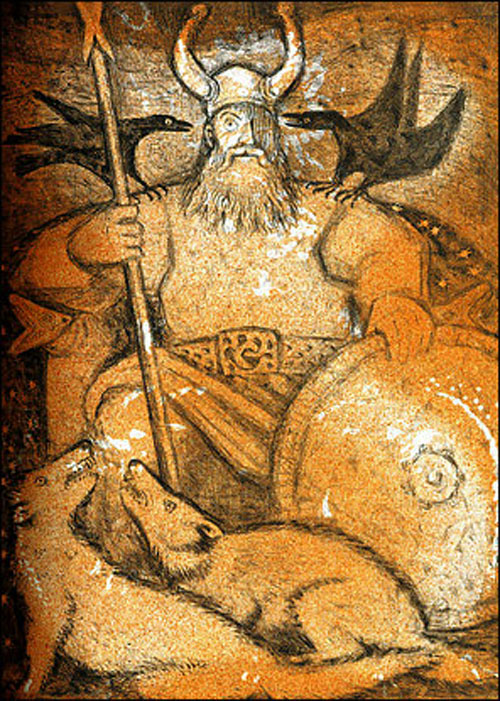
Odin, Ingri and Edgar d'Aulaire
And not even the d'Aulaires could
whitewash out the incredible sexual tension between Odin and Loki. They're attracted to each other at first sight. They mingle their blood. They swear fidelity. Odin even offers Loki a lovely, patient goddess as his beard. (Poor Sigunn also winds up as the beard for Loki's other marriage to the ogress Angerboda, mother of Hel, Fenris, and the Midgard Serpent. My guess is, safe and loving didn't do much for Loki's libido.)

I was shocked when I first read a kids' version of Edith Hamilton and asked my parents what "out of wedlock" meant. "But I thought Zeus was married to all his wives," I said. My long-suffering mother gently made clear that this was a polite fiction. And one of the great building blocks of my imaginative life began to shift. Zeus was no longer a responsible if reckless husband. He was a cad, a seducer, a thoughtless pig who cared more about the kids he sired than the women who bore them, and about his own fun most of all. The king of the gods, came the awful thought, was a jerk. And in that case, why was he the king? Why should I root for such a careless user?

The Abduction of Persephone,
Ingri and Edgar d'Aulaire
The floodgates had been opened, and the rush of criticism was impossible to stop. Hera gained a lot more of my sympathy. I stopped trying to excuse Aphrodite on account of her beauty. Hades and Persephone became one of my favorite couples for the simple reason that he was faithful to her. Suddenly the gods had faults, huge gaping faults of personality and behavior. Their humanity - the squabbles, the contests, the grousing - had been charming before. Now it became deeply problematic. The gods were worse than most people I knew. They acted with impunity, taking whatever they wanted and only offering an explanation if they felt like it. (Often those explanations were woefully inadequate. I've never been able to get behind the transformation of Niobe into a stone, just to shut up her crying. Especially since the stone itself keeps crying.)

Freya, Ingri and Edgar d'Aulaire
Other mythologies were equally subject to the criticism of my now-jaded expectations. So what if Freya's married? Her husband's missing, she's the goddess of love, and she has a hall full of strapping warriors. What do you think she's going to do with them? I revisited the tale of Sir Gawain and Lady Ragnell, understanding finally why he couldn't choose whether to have her beautiful by day or by night. I was dismally unsurprised to learn that Osiris, Isis, Set, and Nephthys were all siblings. I'd hoped for better from the Egyptians than from the Greeks, but it was par for the course; gods liked incest. Myths became more important to me for the stories than for the codes of conduct they supported, or even for the reverence of the supernatural that they'd previously made me feel. Why should I revere Zeus the rake, or Loki the asshole, or Osiris the idiot? They didn't practice what they preached; they gleefully ignored their own rules. I enjoyed the stories; it didn't mean I had to like the characters as people.

The Wooing of Gerd, Ingri and Edgar d'Aulaire
Which, I suspect, is exactly why the d'Aulaires did what they did. It's impossible to like or respect some of the choices that the gods make. Hera dooms Semele to a horrific death for sheer spite. Set takes vengeance to an appallingly vindictive level. The wooing of Gerd is an uncomfortable story of dubious consent, with a fertility moral that transforms rape into love. You could list every altruistic act of Loki's on one hand and still have fingers left over. These are awful people: morally corrupt, shamelessly self-serving, and whiny when someone else's underhanded gambit beats theirs. But they are also the core of the world's great stories, most of which wouldn't have happened without the appalling deeds committed by the gods.

So in telling those stories, you have to bowdlerize. You have to leave out the worst of the gods in order to communicate the real wonder and excitement of their stories. Especially when writing for kids, who may be encountering them for the first time, the magic should come first. There's plenty of time later for kids to learn the shades of gray. If you're going to entrance them with the glory of myth, you'd better make it as entrancing as it can be.

The Olympians, Ingri and Edgar d'Aulaire
Because it does lose something. I used to fling myself headlong into those stories, trusting in the awe-inspiring power and beauty of invincible immortals to do the right thing and save the world. I still love those stories, and I've forgiven the gods for not being as perfect as I wanted them to be. But I read them with my tongue in my cheek now. I ask questions; I groan at bad decisions; I mock the gods. I'm not sorry that I learned to think and doubt, but sometimes I miss the way it used to be. And I'm hugely grateful to the d'Aulaires for making me fall so hard for those stories that I can still love them even after I learned the truth.

Thursday, April 26, 2012

Life After Troy

The Burning of Troy, Francisco Collantes
Part of the sheer fascination we've always had with the Trojan War is its unbelievable death toll. The Iliad spends a whole chapter naming all the kings, sons of kings, and kings' lieutenants who sailed to Troy, only to describe in equally loving detail the manners of their deaths a chapter or so later. Morbid? Of course. But magnetic.

And it explains why imagination clings so desperately to those lucky few who make it out alive. Odysseus, Aeneas, Cassandra (for a while), Andromache, the house of Atreus - all are names to conjure with. They're the survivors. Be it luck, courage, or determination, they were still standing at the end. They're the ones we want to know more about.

But there's a very distinct line drawn even among the survivors. It's apparently not enough to survive a ten-year siege of nonstop brutality. The survivors who live past the war are the ones who get as far from the war as they possibly can.

Captive Andromache, Frederic Leighton
This dooms most of the women from the start. Women's fortunes in ancient Greece were tied directly to their men and their city. When both those mainstays disappear, the women have no status anymore. Andromache suffers the humiliation of slavery and gets lusted after by the son of the man who killed her
Ajax and Cassandra,
Solomon J. Solomon

husband. Cassandra - princess, priestess, and prophet - is raped by two Greek commanders and murdered as collateral damage in Clytemnestra's vengeance. (An alternate version lets her run away to start a new line, but while I'd love to believe it - Cassandra's one of my Iliad favorites - I can envision a bloodthirsty Clytemnestra mowing down everyone in her path much more easily than I can see an escape for Cassandra.) Hecuba, powerless to save her husband or her children, gets claimed as a slave by Odysseus, which means that unless she was on the ship he himself left Troy in, it's very likely that she drowned en route to Ithaca. Only Helen manages to be female and in a safe place by the end of the war, and even her peace comes through depressing self-slander. Women in a society shaped by fighting men have very few tools for forging their own paths beyond destruction.

Even among the men, it's tough to break away from the defining episode of their lives. Agamemnon is most obviously tripped by
Clytemnestra and Agamemnon, Pierre-Narcisse Guerin
it, and through his death his entire family becomes accessory to the destruction of the Trojan War. Ajax of Locris earns the enmity of Athena when he rapes Cassandra inside her temple; his prideful refusal to atone, or to acknowledge the power of the gods, is so outrageous that Athena and Poseidon put aside their own feud to tag-team on drowning Ajax. Menelaus jumps at the chance to relive the war when Telemachus comes to visit. In the guise of telling the young man about his unknown father, he journeys back to the thrill of war, something he's evidently missed in the past ten years of domestic calm. Keep in mind here that Menelaus is by far the most successful, of the men who get back to Greece, in living beyond the war. Even he can't get over it.

Ulysses and the Sirens, Roman mosaic, 3rd century CE
What about Odysseus, you say? Well, sure, Odysseus is really good at making his own life. The Odyssey is arguably more famous than the Iliad. And he does indeed return home, to where his loving wife and valiant son await him. But don't forget that it takes him ten years to get home, on top of the ten years he spent fighting at Troy. Don't forget that one stupid remark to Poseidon's Cyclops son dogs him throughout those ten years. And don't forget - however much you might want to - that tradition, if not Homer, sends him on still further journeys after his return to Ithaca. Odysseus' success in shaking off the Trojan War wakes in him a wanderlust that he cannot ignore. He all but creates the archetype of the restless wanderer, searching for something new and different. His life is big enough to contain the war and his own travels, but one snares him as completely as the other snares the women.

Aeneas and Dido, Pierre-Narcisse Guerin
And then there's Aeneas. Flat-out awesome in the Iliad, with no ending given him by tradition, he gets co-opted into a spectacular piece of poetic propaganda written to justify the Roman Empire. He's the only one who gets a truly happy ending: his journey done, his quest fulfilled, his line and city firmly founded. Like Odysseus, he has rough seas to sail; unlike Odysseus, he knows what he's looking for and when he's found it. In one sense, of course Aeneas triumphs in the creation of a life free of the Trojan War; the rise of Augustus Caesar demands the legitimation that only Aeneas can provide. But even within the story, as a character, Aeneas tries harder than anyone to break free. He may be haunted by his failure to save his wife from Troy, but it doesn't stop him from falling in love with Dido or marrying Lavinia. Offered the chance to call it quits and rule Carthage, he refuses. He clings to his search for a new city, far from his home, precisely because it is the only way to escape Troy. He creates his own life on his own terms, refusing to be defined by the war, and he alone manages to get a satisfying happily ever after. (It's telling, too, that in the happy-ending alternate version of Cassandra's fate, she also finds a home and a life far beyond Troy or the Greek city-states. Getting out of Dodge is the only way to escape.)

The Trojan War is a paradigm-breaker. It's massive, spanning generations and continents; its consequences define "far-reaching." It makes sense that a world trying to patch itself back together in the image of the past is a world doomed to failure. Aeneas and Odysseus are the only ones who realize the impossibility of going home after the breaking of the world, and only Aeneas realizes it in time.

Tuesday, April 24, 2012

Too Much of Water

Oh, dear. It looks like you've got a tragic heroine on your hands. Well, there's only one thing to do with her: get her to the nearest body of water and dump her in.

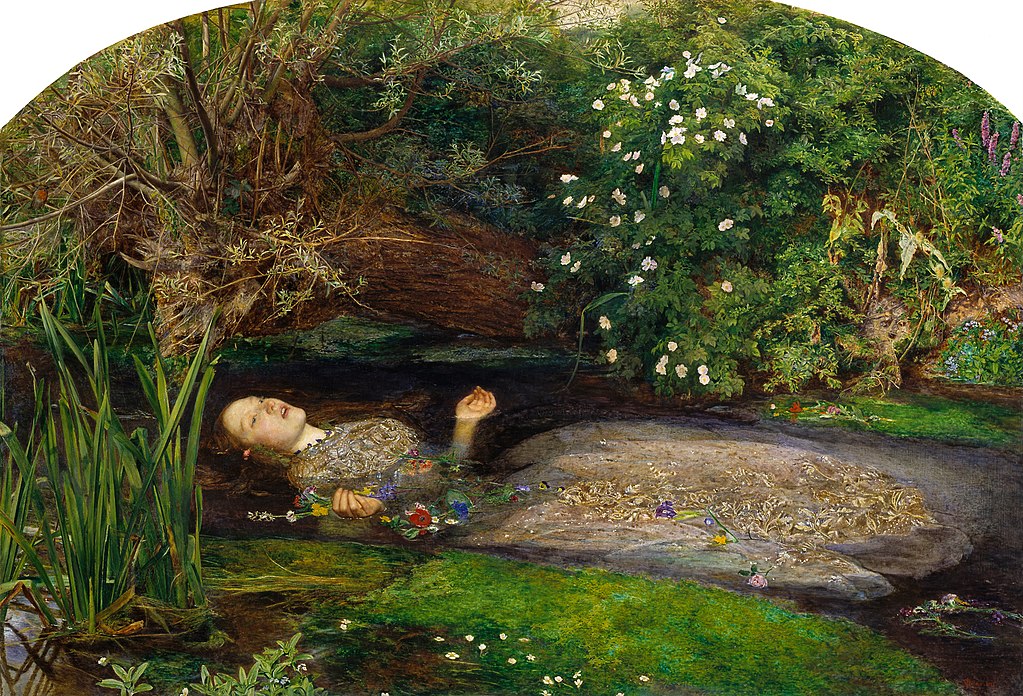
Ophelia, John Everett Millais

It's really astounding how many tragic heroines die by water. You'd think there was a handbook or something. Elaine, Ophelia, Hero, Helle - their deaths are all intimately associated with water. Helle's is particularly egregious, as the only purpose she serves in her entire story is to fall off the Ram with the Golden Fleece while he's flying over an ocean. Her brother, also riding the Ram, survives to found a royal line, but his sister just drops into the sea like someone cued her. She exists to drown. I smell a thematic necessity.

The Lady of Shalott, John William Waterhouse
It's fairly obvious at first glance why water, of all four traditional elements, is so closely identified with women. Shakespeare spells it out when Laertes mourns his sister. "Too much of water hast thou, poor Ophelia," he chokes out upon hearing of her death, "and therefore I forbid my tears." Women cry; tears are water; water is a woman's element. That makes it especially appropriate for heroines foiled in love, like Ophelia and Elaine; death by water is as good as a signed confession of love. "I drowned in the tears I shed for my lover." The Lady of Shalott dispenses even with Elaine's farewell letter; she only needs to drift down to Camelot on the river for everyone to understand that she has died for love. The symbolism of a woman in water is universal.

Hero, William Henry Rinehart
And then there's the nature of these women's characters. Water-deaths are generally performed by women who lack control of their lives. Ophelia is hounded from pillar to post by father, brother, lover and king, until her suicide becomes her only act of agency in the entire play. Hero is first aggressively wooed by Leander, then sits in her tower and lights a lamp and waits for him to swim to shore. The several Elaines in Arthurian legend make it murky which, precisely, is the one who dies for love of Lancelot, but in some versions she's not even the spunky rapist who gives birth to Galahad; in these, she tends his wound, gets summarily rejected, pines for him, and expires right after demurely stage-managing her own death to give it the proper emotional punch. And the Lady of Shalott (who I differentiate from all the zillion Elaines because, after all, Tennyson never names her, and "Shalott" is not "Astolat") is the saddest of them all, locked in her tower by the whispered threat of a curse, and doomed to death in the very moment she truly experiences life. These are women more acted upon than acting, for whom the cool calm of a watery death seems fitting.

The Death of Dido, Peter Paul Rubens
Compare them to, say, Dido, another suicide for love. But she dies by fire, and therein lies all the difference. Dido is fire; she's passionate, headstrong, determined, and impulsive. She's not the kind of woman who could float from Carthage to Rome with a passive-aggressive scroll of farewell in her languid dead hands. There is nothing passive about her. When she goes out, she makes damn sure that everyone in the vicinity knows about it. She even goes the extra mile and stabs herself on her own funeral pyre, proving her courage and her recklessness - and starting the bitter feud of Rome and Carthage at the same time. All that makes her far more intimidating than an Elaine or an Ophelia. Dido, the suicide by fire, is a dangerous femme fatale. In comparison, the other tragic heroines are far easier to swallow. They don't wreak havoc; they don't die in a grand operatic manner; they have the decency to shuffle off quietly and modestly, without causing too much fuss and drama for their menfolk. Water is acceptable; fire is, well, fire. And sensible women, even tragic heroines, don't play with fire.

Ophelia, Fernando Vazquez
But, as always, there's more to the story. Water isn't just smooth and serene. Its depths are invisible and ominous; the calm surface covers the roiling underneath. In the same way that fire provides a key to Dido's character, water tells us everything we need to know about what's really going on in the heads of the drowned heroines. These aren't emo girls who feel the need to proclaim their heartbreak at the top of their lungs. They keep everything inside, undercover, out of sight - but it doesn't mean it's not there. Sometimes it breaks free, as in Ophelia's madness; sometimes it provides a poignant emphasis to the heroine's tragic fate, like the Lady of Shalott "singing in her song" as she dies. And sometimes it drives a quiet, secretive girl like Hero to the drastic act of flinging herself out of her tower.

The water suicides make it too easy for us to take them, as we take their element, at surface value. Drama queens like Dido get all the attention, while the Ophelias and Elaines sit quietly by, holding their emotions in. But those emotions are still there. They ruffle the surface. And they offer some answers to the mysteries of these heroines.