Showing posts with label husbands. Show all posts

Saturday, December 22, 2012

A Love Letter to Bigamists

Right off the bat, you need to know that the Snow White story has never done much for me. This may have something to do with being traumatized before age 6 by the re-release of the Disney version (the transformation scene, oh my god), but it's also deeply rooted in my disdain for heroines who don't do anything, and distrust of stories that hold them up as role models. By now you should know that I'll take Kate Crackernuts over the fairest of them all any day of the week.

Which makes it odd that a Snow White variant is among my favorite fairy tales of all time.

Silver-tree, John Batten
"Gold-tree and Silver-tree" is different from the classic version, though, in all the ways that matter. The Scots felt no need to whitewash the mother's murderous designs on her biological daughter; Silver-tree, the evil queen, even couches her single successful plot in a false solicitude for Gold-tree's well-being. Gold-tree has a modicum of sense; when she sees Silver-tree's ship coming for her, she knows perfectly well that her mother wants to kill her, and that she needs to hide. But the biggest difference, and the reason why I love this version, lies in the actions of the prince.

In the Grimms' Snow White, the prince is at best a moron and at worst a necrophiliac. Either way, he is primarily a plot device. And in "Gold-tree and Silver-tree," that's exactly how he starts out. Right after Silver-tree finds out that Gold-tree is more beautiful than she is, up rides the prince, seeking Gold-tree's hand in marriage. Problem solved: Gold-tree marries the prince, her father slips Silver-tree a goat's heart, and for bonus points, Gold-tree and the prince actually fall in love. Everything's perfect until Silver-tree realizes that Gold-tree's alive, sticks a poisoned dart in her finger, and sails back home, presumably cackling all the way.

Death of Gold-tree, Michelle Hunt
Point one in the prince's favor: He doesn't try to kiss, sleep with, or otherwise perform acts of dubious consensuality on the seemingly-dead body of his wife. (He does keep her unblemished corpse in a locked room, but he can't really be blamed for that, since it's plot-relevant and he's grieving for his lost love. At least, I cut him some slack on that. And I bet poor Talia would, too.)

And then things get really interesting. The prince remarries.

So. It's a fairy tale. We already know that Gold-tree's not really dead. But no one in the story does. This may be the one and only time where I'm glad to see characters not operating in full awareness of fairy tale logic. I'll pull out my hair and scream at clueless third brothers and innocent girls victimized by their stepsisters, wondering why the hell they don't wise up. But here, I'm completely on board, because what's happening is that real-life logic is superseding fairy tale logic. Of course the prince would remarry. He's a prince, and he didn't have any kids with Gold-tree. It's his job, regardless of the fact that he still mourns the woman he loved.

Gold-tree, Morris Meredith Williams
And then, he wins my undying love, because his second wife is a complete and total badass. When he forgets to take the key to Gold-tree's locked room, she Bluebeards in there and finds the body of her predecessor. Does she go all "other woman" on poor defenseless Gold-tree? Does she cook her in a stew? Does she confront her husband about the near-literal skeleton in his closet?

Nope. She just takes out the poisoned dart. And when the prince gets home, she tells him right away, "Hey, I woke up your first wife, and you obviously still love her, so I'll just peace out and let you two lovebirds get back together." Is there anyone else in fairy tales who freely walks away from a love conflict with sincere goodwill? Is there anyone in the real world who can do that? The second wife basically thumbs her nose at fairy tale convention, while at the same time making us desperate to keep her around. I love her for it.

Two Princesses, One Prince, V-Eclipse
Point two in the prince's favor: He made a very intelligent second marriage.

Point three in the prince's favor: As soon as the second wife offers to step out, he refuses to let her. She says she'll go away. His exact words in reply? "Oh! indeed you shall not go away, but I shall have both of you."

This guy is so cool. Maybe not smart enough to just take the dart out of his first wife's finger, but totally smart enough to marry a woman with brains, to value her for her intelligence, and to let his first and second loves know that he cherishes them both equally.

It's hardly conventional, either in fairy tales or in the world we live in. But I have to think that this is one awesome three-way marriage. No one is superior: Gold-tree owes her life to the second wife, who owes her continued place to the prince, who owes his happiness to both of them. It's impossible to feel like anyone's an interloper here, because they all play integral parts in the relationship. Plus we get to keep the smart girl on the heroes' team. This is a total win for everyone involved.

The clincher of it all, vindicating the prince's unconventional decision, is that the second wife is solely responsible for the death of Silver-tree (remember her?). Once again, Silver-tree hears that Gold-tree's alive and comes back for more murder. Gold-tree's initial instinct - to flee, again - is firmly countermanded by the second wife, who gets them both down on the beach to say hello. Silver-tree offers Gold-tree a cup laced with poison, pulling the caring-mother card yet again in front of witnesses. Cool as a cucumber, the second wife retorts that she doesn't know where you come from, honey, but in this country the person offering a drink takes a sip first, I mean really, where are your manners. And when Silver-tree pretends to drink, the second wife just smacks the bottom of the cup so that the poison goes straight into the would-be murderess's mouth. Call me crazy, but I think that's even more karmic than Snow White's stepmother dancing to death in red-hot iron shoes. It's quick, it's elegant, and it's not nearly as grotesque.

The Two Princesses of Bamarre, eala-nedea
This is a fairy tale where real-world rules also apply. Sure, there's a talking trout and some confusion over the actual fact of death. There's also unvarnished mother-daughter darkness, the irreplaceable value of second love, and perhaps the most unconventional marriage fairy tales have to offer, portrayed in unambiguously glowing terms. I've never read a fairy tale quite like this one. With the exception of the Beauty and the Beast variants, I've never seen more interesting romantic dynamics. It's a lot more complicated and compelling than "someday my prince will come."

And it's subversive as hell. It pokes fun at the passive heroine. It giggles at the genre's conventions. A secondary character steals center stage halfway through, and the reader never looks back. It never punishes its heroes for their atypical choices, and in fact rewards the unexpected over the standard. Fairy tales exist to reinforce the status quo. But by the end of this one, you're cheering for the triumph of true love expressed through bigamy. That is gutsy like nobody's business. And more than anything else, I love this story for that very fact: that it stakes out its territory, takes a stand, and refuses to back down.

If only we could get Snow White to read it...

Tuesday, July 3, 2012

The Lone Artist

Let's talk about Hephaestus.

Hephaestus, Scott Eaton

Because honestly, who else is going to? The poor guy is the underdog to beat all underdogs, even in a mythos that includes Menelaus. He's the son of Zeus and his actual wife, so he gets no fun cavorting origin story. He's got a much hotter, flashier brother - and a gorgeous wife who flagrantly cheats on him with said brother. He's stuck in a volcano making pretty and amazing things for the ungrateful bastards he calls family, who grab what he gives them and don't even stay to say thank you. After Oedipus, he may have been dealt the worst hand in all of Greek mythology.

Mars and Venus Surprised by Vulcan,
Alexandre Charles Guillemot
It gets worse. All the memorable Hephaestus myths involve him getting humiliated in some way. How did he become lame? Well, Zeus pitched him off Olympus for siding with Hera in a marital spat. How did he score the most beautiful of all goddesses? Well, because his dad thought opposites might attract (and also figured that he owed him one after the whole laming business). How did he finally figure out that Aphrodite was two-timing him? Well, he had to catch her with Ares in a net before he could get anyone to pay attention. Even when he's a peripheral character, he's put-upon; when Achilles needs new armor in which to kill Hector, guess who has to pull an all-nighter to have it ready by morning?

You have to feel for the guy.

What makes things even sadder is that everyone on Olympus recognizes his competence.  No one dreams of going to anyone but Hephaestus for everything from jewelry repairs to new thunderbolts. Among scads of glory-hungry and talented deities, he is universally recognized as the most gifted. And no one ever asks anything more of him than what they want from him. He's the ugly friend who makes you look better by comparison.

And he does his job tragically well. Athena gets all the glory for giving handicrafts to humans, with no mention of who might have taught her. Apollo runs away with the artistic laurels, because it's not like any other god might be good at making pretty things. The guy can make a freaking volcano erupt when he works the night shift, but his own father steals the shock-and-awe points whenever he feels like pitching a hissy fit and a few thunderbolts. Hephaestus gets no credit for things that, in a more attractive god, would be cause for adoration and fangirling.

To which he says, with consummate grace: So what?

Hephaestus isn't a fame-seeker. He's not waiting with bated breath for the popular verdict on his latest creation. He knows it's good. He knows he made it. And he knows the next one will be even better. Hephaestus is an artist. He's actually a much more dedicated artist than Apollo, who spends more time skirt-chasing and scoring good PR than actually making music. Hephaestus lives in his studio. He literally breathes his creations. He is focused 24/7 on the thing he does well and that he loves to do. And most importantly, he's made it pay. All artists need patrons; what good is art if no one sees it? Hephaestus's skills earn him a dedicated clientele. Big freaking deal if they don't actually talk to him; capital-P Patrons of Art are almost always assholes in one way or another. The main thing is, they come back. They recognize the value of what he creates, and they want more. Hephaestus is living the artist's dream.

Sure, he's the solitary artist, the one who works in seclusion churning out beauties. But he's also a god. When he wants something done, he gets it done, whether it's a gorgeous new shield or an invisible wife-catching net. It's no coincidence that he traps Ares and Aphrodite in the literal coils of his own skill, which they thoughtlessly undervalued in undervaluing him. Hephaestus lives by his art. And he likes it that way.

Because if he didn't? Come on. This is a go-getter. This is a guy who knows where he's headed. If he didn't like the destination, he'd just set course for a new one. He wouldn't do it with a fuss and a fanfare, and someone would probably tease him for it. But he'd still be doing what he wanted. You just can't stop him.

Saturday, April 28, 2012

Problematic Myths and the People Who Love Them

I grew up on d'Aulaire's Greek myths. My father brought it back from the library one day when I was about five or six, and my initial attempts to sound out the phenomenally impossible word "Aphrodite" sent my mom into well-muffled hysterics. (The best I could do, before she took mercy on me and corrected me, was "uh-PRO-fa-deet." And now you know.) The pictures were gorgeous, the stories were entrancing, and I wanted to be Artemis or Atalanta when I grew up. More recently, my boyfriend introduced me to the d'Aulaire book of Norse myths, which is just as awesome and explained a lot of things that confused me about the Norse gods. Safe to say, I'm a fan.

But reading those myths when I was seven, and again when I was seventeen, were two very different things. The d'Aulaires took great pains to avoid the word "mistress," even and especially when it was applicable. Zeus had a ridiculous number of "wives." Odin's seduction of Gunnlod, the mother of his son Bragi, god of bards, is hinted at but
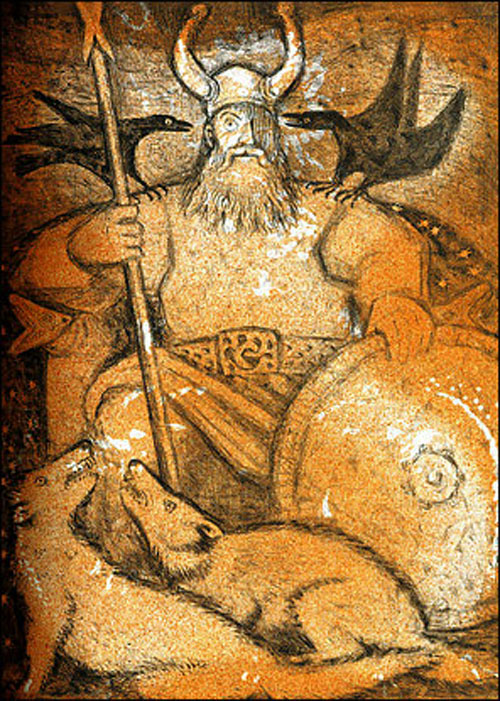
Odin and Gunnlod, Ingri and Edgar d'Aulaire
never outright stated. (The story itself, in which Odin drinks up all three of her kettles of precious mead, then leaves her to weep beside her lost treasure, is suggestive enough.) The d'Aulaires told you that Aphrodite was in love with Ares, but I never learned the tale of Hephaestus catching them in flagrante - in a net, for maximum humor - until I was a teenager. Thor is outraged at the cutting of his wife Sif's hair not because she has awesome hair, but because a woman with shorn hair is branded a whore. It took a long time for me to realize that Daphne and Syrinx flee from Apollo and Pan because they're threatened with rape, rather than an awkward proposal of marriage.

Loki, Ingri and Edgar d'Aulaire
Odin, Ingri and Edgar d'Aulaire
And not even the d'Aulaires could
whitewash out the incredible sexual tension between Odin and Loki. They're attracted to each other at first sight. They mingle their blood. They swear fidelity. Odin even offers Loki a lovely, patient goddess as his beard. (Poor Sigunn also winds up as the beard for Loki's other marriage to the ogress Angerboda, mother of Hel, Fenris, and the Midgard Serpent. My guess is, safe and loving didn't do much for Loki's libido.)

I was shocked when I first read a kids' version of Edith Hamilton and asked my parents what "out of wedlock" meant. "But I thought Zeus was married to all his wives," I said. My long-suffering mother gently made clear that this was a polite fiction. And one of the great building blocks of my imaginative life began to shift. Zeus was no longer a responsible if reckless husband. He was a cad, a seducer, a thoughtless pig who cared more about the kids he sired than the women who bore them, and about his own fun most of all. The king of the gods, came the awful thought, was a jerk. And in that case, why was he the king? Why should I root for such a careless user?

The Abduction of Persephone,
Ingri and Edgar d'Aulaire
The floodgates had been opened, and the rush of criticism was impossible to stop. Hera gained a lot more of my sympathy. I stopped trying to excuse Aphrodite on account of her beauty. Hades and Persephone became one of my favorite couples for the simple reason that he was faithful to her. Suddenly the gods had faults, huge gaping faults of personality and behavior. Their humanity - the squabbles, the contests, the grousing - had been charming before. Now it became deeply problematic. The gods were worse than most people I knew. They acted with impunity, taking whatever they wanted and only offering an explanation if they felt like it. (Often those explanations were woefully inadequate. I've never been able to get behind the transformation of Niobe into a stone, just to shut up her crying. Especially since the stone itself keeps crying.)

Freya, Ingri and Edgar d'Aulaire
Other mythologies were equally subject to the criticism of my now-jaded expectations. So what if Freya's married? Her husband's missing, she's the goddess of love, and she has a hall full of strapping warriors. What do you think she's going to do with them? I revisited the tale of Sir Gawain and Lady Ragnell, understanding finally why he couldn't choose whether to have her beautiful by day or by night. I was dismally unsurprised to learn that Osiris, Isis, Set, and Nephthys were all siblings. I'd hoped for better from the Egyptians than from the Greeks, but it was par for the course; gods liked incest. Myths became more important to me for the stories than for the codes of conduct they supported, or even for the reverence of the supernatural that they'd previously made me feel. Why should I revere Zeus the rake, or Loki the asshole, or Osiris the idiot? They didn't practice what they preached; they gleefully ignored their own rules. I enjoyed the stories; it didn't mean I had to like the characters as people.

The Wooing of Gerd, Ingri and Edgar d'Aulaire
Which, I suspect, is exactly why the d'Aulaires did what they did. It's impossible to like or respect some of the choices that the gods make. Hera dooms Semele to a horrific death for sheer spite. Set takes vengeance to an appallingly vindictive level. The wooing of Gerd is an uncomfortable story of dubious consent, with a fertility moral that transforms rape into love. You could list every altruistic act of Loki's on one hand and still have fingers left over. These are awful people: morally corrupt, shamelessly self-serving, and whiny when someone else's underhanded gambit beats theirs. But they are also the core of the world's great stories, most of which wouldn't have happened without the appalling deeds committed by the gods.

So in telling those stories, you have to bowdlerize. You have to leave out the worst of the gods in order to communicate the real wonder and excitement of their stories. Especially when writing for kids, who may be encountering them for the first time, the magic should come first. There's plenty of time later for kids to learn the shades of gray. If you're going to entrance them with the glory of myth, you'd better make it as entrancing as it can be.

The Olympians, Ingri and Edgar d'Aulaire
Because it does lose something. I used to fling myself headlong into those stories, trusting in the awe-inspiring power and beauty of invincible immortals to do the right thing and save the world. I still love those stories, and I've forgiven the gods for not being as perfect as I wanted them to be. But I read them with my tongue in my cheek now. I ask questions; I groan at bad decisions; I mock the gods. I'm not sorry that I learned to think and doubt, but sometimes I miss the way it used to be. And I'm hugely grateful to the d'Aulaires for making me fall so hard for those stories that I can still love them even after I learned the truth.

Thursday, February 23, 2012

Part of Your World: Limited Engagement Only

Adrift at Sea, Nilah Magruder
So much fuss gets made over the little mermaid who failed to nab a prince that we tend to forget the scores of supernatural women who succeeded. Human men, it seems, are a hot commodity on mythical women's mash notes. And with the exception of Andersen's strangely blind prince, they tend to be rather eager for a supernatural wife. Which is no surprise - these are, after all, magical women whose goodwill can ensure success and wealth.

Some men actively set out to catch an otherworldly wife. There are endless tales of men who steal a mermaid's red cap or a selkie's sealskin to trap her on land. Others go about their wooing more delicately, like the Shepherd of Myddfai offering his chosen mermaid a bite of bread to entice her to a life on shore. Still others are forcefully wooed. The Fairy Queen is notorious for abducting handsome men with nice voices, regardless of their opinions. But the benefits of having a supernatural lover are immense. Without exception, the women's influence - from magical blessings to excellent housekeeping - win the men comfort and renown for their good luck.

So everyone's happy, right?

Not so fast. This is the fairy world. There's always a catch.

Loss, Cheryl Kirk Noll
Supernatural brides hold to the letter of their bargains. Make one wrong move (three at most), and they pop out of your life as suddenly as they entered it, taking all their magical support with them. The classic setup goes thusly: upon engagement, the bride names a single condition with which the groom must comply. Melusine forbids her husband to look at her while she bathes; the mermaid of Myddfai (in a nice move for women's rights) vows to leave her husband if he strikes her three times; the Crane Wife won't let her husband watch her weave the cloth that brings them wealth. Sounds easy, up until curiosity kills the cat and the husbands have to look, or lose their temper, or forget to lock up the sealskin. There's no fooling a supernatural bride, either. They know when the deal is broken. (Melusine's husband tries to lie to her, which only makes him look worse.)

What's more, when they go, they never come back. Volund's marriage to Hervor the Valkyrie, a perfectly happy one, ends for good when she decides she misses her old life. The husbands of local selkies get no warning when their wives discover their sealskins and return to the sea; some stories have the bereft husband walking the shore for the rest of his life, searching for his lost bride. Melusine's husband has an extra worry: in addition to the loss of his wife, he frets that she's cursed him and his lands in vengeance.

Wayland, Max Koch
Once the contract is broken, supernatural brides aren't known for their generosity. Mermaids tend to abandon their families before their children are grown and able to take over their mother's duties. The Crane Wife leaves her husband's only source of income unfinished. Volund gets bit worst: as soon as Hervor's gone, the local king orders Volund hamstrung and trapped on an island so no one else can have access to his superior smithing skills. (To be fair, Volund bites back, making the king some drinking goblets out of the skulls of the king's sons, and also raping and impregnating his only daughter, before escaping on wings he'd made in secret. All par for the course in a Norse legend.) The mermaid of Myddfai is extraordinarily generous in that, while she takes back her dowry of cattle, she also blesses her descendants with phenomenal healing powers and watches over the town. No other supernatural bride ever looks back.

Mephistophilis Appears to Doctor Faustus
The trappings of these stories are eerily similar to the tales of men who sell their souls to the devil. In exchange for instant benefits, the man makes a letter-of-the-law deal with a creature not of this world, which will hit hard when the contract inevitably runs out. True, a mermaid bride isn't quite on the same level as Mephistophilis, but the women of Melusine's line were rumored to be witches up through the Wars of the Roses. The supernatural creature retains all rights; only the human stands to lose. In some cases, the bride manipulates the terms of the contract. The mermaid of Myddfai counts an impatient "hurry up" tap on the shoulder as one of the three blows that will entitle her to return to the lake; the Fairy Queen sends True Thomas back to our world when she gets bored of him, neglecting to tell him that seven years have passed while he partied for a night in Fairyland. This is straight-up Doctor Faustus material: the seduction of a human by mystical forces that disguise the truth without ever outright lying.

Mermaid, Laurent Miny
Granted, the brides don't intend anything as sinister as dragging their husbands into Hell. But the one-sided arrangements, and the clear evidence that the power rests with the females, indicate a serious reversal of the normal run of things. It's uncomfortably easy to make the jump of reasoning that a powerful woman is on par with the devil, or at the very least in possession of abilities that are too dangerous for humans to be around for long. The Melusine story in particular throws gas on the fire: between the snake-woman and the monstrous children she bears, her identification with the devil couldn't be clearer.

So maybe there's a reason we forget those stories. They overturn the status quo. They remind us that there are forces we don't and will never understand. Like their heroines, they seduce with the promise of happiness and dash our hopes without warning. They're not comfortable bedtime stories; they're tales of man against nature, often without a clear villain or victor. Stories like that don't make for sweet dreams.

Tuesday, February 21, 2012

A Gold-Digger's Nightmare

If things work out right, being a fairy tale heroine is a sweet gig. You can rise overnight from nobody to royalty. You can make your fortune through luck, wits, or virtue, without having to compromise or scratch anyone's back. You can guarantee your safety for the rest of your life.

Unless you happen to have married an absolute freakshow. And trust me. They're out there.

Bluebeard, Hermann Vogel
Take, for instance, the obvious Bluebeard. Here's a guy rolling in money and power who gets his kicks by playing on his impressionable bride's curiosity and cutting off her head when she dares to disobey him in one way. Lather, rinse, and repeat ad nauseam until karma catches up with him and he marries a girl with rather aggressive brothers. Are wealth and security really worth putting up with such an abusive control freak?

I'd like to say no, but then I run into Shahryar, whose wife's infidelity broke his brain so much that he went on a marry-and-murder spree, decimating the young female population of his own country to prevent himself from being deceived in love again. While it's clear that no one besides Shahryar is in favor of this policy, the fact remains that girls kept marrying him every day for three years.

A Tale of 1001 Nights, Gustave Boulanger
By the time Scheherazade comes up with her plan to save her fellow women, it's explicitly stated that Shahryar has gone through every girl but our heroine and her little sister. Some were smuggled away; some families fled wholesale. But the most Shahryar's subjects do is pray for deliverance. There's no rebellion of outraged fathers who've had enough. The privilege of being sultana, even if only for a day and a night, was so substantial that it kept a steady stream of girls going into the palace to die.

Of course, not all abuse is as physical as Shahryar's and Bluebeard's. The medieval archetype of the perfect wife was Griselda, whose classic rags-to-riches story is the final tale in The Decameron. Beautiful peasant girl catches the eye of nobleman, who does the right thing and marries her. And then, because he's an emotionally manipulative asshole, he decides to test his wife's virtue and see if she's worthy of the great honor of being raised so high.

The Clerk's Tale, Janet Harvey Kelman
First he tells her that his people are upset that she's only given birth to a daughter. She apologizes. So he has their baby taken away and tells Griselda that he's going to have their daughter killed, when in fact he sends her secretly away to be fostered. When Griselda has a son, he says that his people don't want a peasant's grandson to rule over them, so he has the boy sent away and tells Griselda the same story. She never complains.

Fast forward about 10 years. Lord Bastard McEviljerk isn't done yet.

He tells Griselda that their marriage is over and sends her back to her father's hut. She asks only for a shift in which to return. Then her sort-of ex-husband announces his engagement to a properly noble girl
The Story of Patient Griselda, Master
of the Story of Griselda
and orders Griselda, who knows the running of his castle better than anyone, to prepare the wedding feast for her replacement. Which she does, without complaint.

Of course, the "new bride" is in fact Griselda's long-lost daughter, accompanied by her brother. All is revealed, Griselda is reinstated, and my brain is broken almost as badly as Shahryar's, because for the love of God, why is this a happy ending?! The lord is despicable even within the context of the story; his people scold him for his rank mistreatment of his wife. Griselda's virtues are all of her time; she's not a character, she's a medieval idealization of submission, with no will of her own. There is no way to make this story palatable for modern audiences. Not when the nominal hero is an appalling abuser, and the heroine either too spineless or too intimidated ever to speak out in her own defense. The payoff - raising Griselda back to nobility - is as condescending as the setup, coming as it does from the husband who did everything he could to destroy the wife who never gainsaid him. Even mass-murdering Shahryar has the two key moments of realizing his crime and feeling true remorse. Griselda's husband never even admits that he did anything wrong. He's the Chris Brown of folklore.

The Farmer's Clever Daughter, Gina Biggs
There's a far more enjoyable, but ultimately just as frustrating, version in which the poor girl wins the king's heart by her surpassing cleverness. He's perfectly happy with her until she proves that she's smarter than he is. In a fit of pique, he sends her back to her father's house, allowing her to take only one thing - the thing she loves best - back with her from the palace. The girl promptly drugs her husband's wine and carries him back with her. When he asks her to explain, she gives him the cute and obvious line that since she loves him best of everything in the palace, naturally she took him. This so flatters his injured ego that he reinstates her as queen and promises to listen to her. On the surface, it's the same idea of virtue rewarded; underneath, you still have a woman shackled to a man who doesn't deserve her. In this case, the heroine actively pursues her lousy mate, even when he's proved how small he really is. Is he really what she loves best? Or does she want her privileged life back again, whatever the cost?

Helen and Menelaus at the Sack of Troy, c. 440-430 CE
I know I wrote a panegyric on Menelaus a couple weeks ago. I stand by it. But even he has his awful spots. During the Sack of Troy, he's prepared to kill Helen until, at the last moment, she convinces him to spare her life. His change of heart is most often attributed to her seductive powers. As a Menelaus apologist, I don't think we should rule out the chance of a terrified plea, or an appeal for forgiveness, being just as likely to influence an estranged but fascinated husband. Nor can I reconcile the more complex character of the Iliad with the straightforward Man Wronged Seeks Vengeance at the Sack. But there it is, part of the legend, and we have to deal with it. Helen convinces a man ready to kill her to take her back. Why?

For the same reason as the clever farmer's daughter drugs the king. At that point in time, he is the only future she will ever have. No one will risk another war for Helen, not after the devastation of Troy. She's infamous, whether deservedly or not. Her only chance at regaining a life worth living is to make her life part of Menelaus's. It's a play for survival, and against all the odds it works. If she was his upgrade when they married, the tables have decidedly turned.

At what point does the man himself become identified with the status he represents? The distinction is murkier in the stories where the heroine is reunited with her abusive husband at the end; we're supposed to believe that the triumph here is one of love, not of successful social
King Cophetua and the Beggar Maid, John Byam
Liston Shaw
climbing. But it's hard to imagine fulfilling happiness for Griselda, unless she's willing to endure a creep for the sake of the wealth and ease he represents. (In which case she's hardly virtuous for the sake of virtue, which defeats the point of the whole story.) Assuming the king keeps his promise to the clever farmgirl, they might be happy, but he's fickle enough that that's a big assumption to make. We see Helen and Menelaus post-Troy in the Odyssey, and find out that Helen's happiness is contingent on endless self-deprecation; she apologizes constantly for having caused the Trojan War, even though Homer already showed us that she played her part unwillingly and under divine coercion. Shahryar's contrition seems real, but what if he relapses? Only Bluebeard's final bride doesn't have to face the prospect of further abuse, and even she has to deal with the trauma of having married and nearly been a victim of a serial killer.

The scariest part is, in almost every case the woman knows what she's getting. With the exception of Bluebeard's bride, by the time of the reinstatement every discarded or endangered wife knows exactly what her husband's capable of. And they still go back. Something makes it worthwhile for them.

It could be that they've each fallen in love with weak men who abuse them to regain a sense of control. Or it could be the prospect of the life they offer, a more comfortable life than these women would have otherwise, a life of privilege and security that makes it worth tolerating devastating abuse.

Either way, it says something scary.