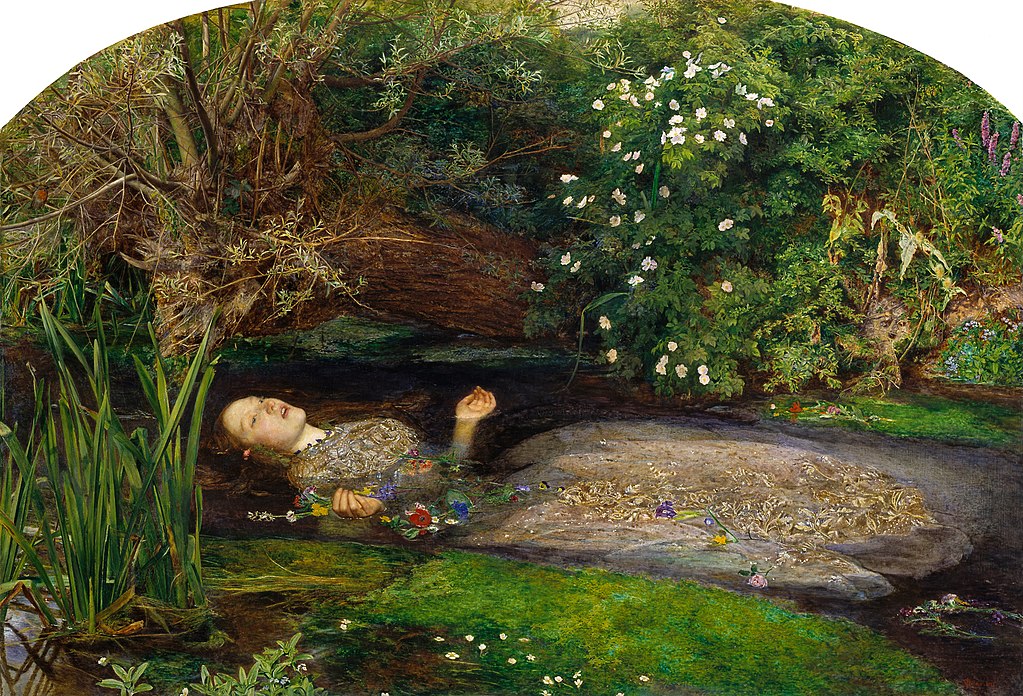
Oh, dear. It looks like you've got a tragic heroine on your hands. Well, there's only one thing to do with her: get her to the nearest body of water and dump her in.
 |
| Ophelia, John Everett Millais |
It's really astounding how many tragic heroines die by water. You'd think there was a handbook or something. Elaine, Ophelia, Hero, Helle - their deaths are all intimately associated with water. Helle's is particularly egregious, as the only purpose she serves in her entire story is to fall off the Ram with the Golden Fleece while he's flying over an ocean. Her brother, also riding the Ram, survives to found a royal line, but his sister just drops into the sea like someone cued her. She
exists to drown. I smell a thematic necessity.
 |
| The Lady of Shalott, John William Waterhouse |
It's fairly obvious at first glance why water, of all four traditional elements, is so closely identified with women. Shakespeare spells it out when Laertes mourns his sister. "Too much of water hast thou, poor Ophelia," he chokes out upon hearing of her death, "and therefore I forbid my tears." Women cry; tears are water; water is a woman's element. That makes it especially appropriate for heroines foiled in love, like Ophelia and Elaine; death by water is as good as a signed confession of love. "I drowned in the tears I shed for my lover." The Lady of Shalott dispenses even with Elaine's farewell letter; she only needs to drift down to Camelot on the river for everyone to understand that she has died for love. The symbolism of a woman in water is universal.
 |
| Hero, William Henry Rinehart |
And then there's the nature of these women's characters. Water-deaths are generally performed by women who lack control of their lives. Ophelia is hounded from pillar to post by father, brother, lover and king, until her suicide becomes her only act of agency in the entire play. Hero is first aggressively wooed by Leander, then sits in her tower and lights a lamp and waits for him to swim to shore. The several Elaines in Arthurian legend make it murky which, precisely, is the one who dies for love of Lancelot, but in some versions she's not even the spunky rapist who gives birth to Galahad; in these, she tends his wound, gets summarily rejected, pines for him, and expires right after demurely stage-managing her own death to give it the proper emotional punch. And the Lady of Shalott (who I differentiate from all the zillion Elaines because, after all, Tennyson never names her, and "Shalott" is not "Astolat") is the saddest of them all, locked in her tower by the whispered threat of a curse, and doomed to death in the very moment she truly experiences life. These are women more acted upon than acting, for whom the cool calm of a watery death seems fitting.
 |
| The Death of Dido, Peter Paul Rubens |
Compare them to, say, Dido, another suicide for love. But she dies by fire, and therein lies all the difference. Dido
is fire; she's passionate, headstrong, determined, and impulsive. She's not the kind of woman who could float from Carthage to Rome with a passive-aggressive scroll of farewell in her languid dead hands. There is nothing passive about her. When she goes out, she makes damn sure that everyone in the vicinity knows about it. She even goes the extra mile and stabs herself on her own funeral pyre, proving her courage and her recklessness - and starting the bitter feud of Rome and Carthage at the same time. All that makes her far more intimidating than an Elaine or an Ophelia. Dido, the suicide by fire, is a dangerous femme fatale. In comparison, the other tragic heroines are far easier to swallow. They don't wreak havoc; they don't die in a grand operatic manner; they have the decency to shuffle off quietly and modestly, without causing too much fuss and drama for their menfolk. Water is acceptable; fire is, well, fire. And sensible women, even tragic heroines, don't play with fire.
 |
| Ophelia, Fernando Vazquez |
But, as always, there's more to the story. Water isn't just smooth and serene. Its depths are invisible and ominous; the calm surface covers the roiling underneath. In the same way that fire provides a key to Dido's character, water tells us everything we need to know about what's really going on in the heads of the drowned heroines. These aren't emo girls who feel the need to proclaim their heartbreak at the top of their lungs. They keep everything inside, undercover, out of sight - but it doesn't mean it's not there. Sometimes it breaks free, as in Ophelia's madness; sometimes it provides a poignant emphasis to the heroine's tragic fate, like the Lady of Shalott "singing in her song" as she dies. And sometimes it drives a quiet, secretive girl like Hero to the drastic act of flinging herself out of her tower.
The water suicides make it too easy for us to take them, as we take their element, at surface value. Drama queens like Dido get all the attention, while the Ophelias and Elaines sit quietly by, holding their emotions in. But those emotions are still there. They ruffle the surface. And they offer some answers to the mysteries of these heroines.