Showing posts with label Zeus. Show all posts

Tuesday, July 10, 2012

A Woman's Other Weapon

Jupiter and Io, Antonio da Correggio
The sexploits of most gods are quite literally legendary. Sometimes a god is remarkable for being the only one in a pantheon to get much action; sometimes you just can't join the club until you drop your pants and chase every nymph in sight. What doesn't get talked about nearly as much, if at all, are the comparative lusts of goddesses.

(Yes, I just saw Magic Mike, and my mind's on double standards. Can you tell?)

Take the Greek gods. Hera's seduction of Zeus in the Iliad is possibly the only time in the entire mythos when we see its central couple engaging in mutually consensual sex, and this is well after she's given birth to at least two kids. (She's also the mother of the goddesses of youth, childbirth and discord; analyze that, Dr. Freud!) Aphrodite has a very famous roving eye, and what does it get her? Trussed up in a net by her husband, as well as being bad-mouthed forever as the biggest slut in a pantheon of sex maniacs. Echo's shy advances to Narcissus are brutally rebuffed; Eos claims a man and has to watch him wither into a grasshopper, while her sister can only sleep with her beloved while he is actually asleep. And it's never made universally clear whether Persephone was a product of rape or not.

Isis and Osiris, Susan Seddon Boulet
Things don't get much better elsewhere. The contemporary Norse turned a relatively blind eye to Freya's gadding about, but nearly everyone since has passed judgment on her actions, either by censoring, over-excusing, or simply writing her sex drive out of the story. Isis, who as a mother goddess derives an enormous amount of her power from her sexuality, gets mostly a throwaway mention about how she resurrected Osiris and slept with him to get pregnant and can we move on now please? Inanna's undeniable and insatiable passion gets her typecast as a terrifying hellion to fear and avoid, and her very real power is, if not shunned, then not actively courted. And the Virgin Mary's power is right there in her name: to be important, she has to lack desire.

So what are we talking about here? Is female sexuality too much to handle, even in primal tales of basic urges, even in pantheons with characters like Zeus and Odin and Jacob? Did the mostly-male mythologists shy away from really discussing women and sex out of blind fear? If myths ignore or censor women harnessing their sexuality free of judgment, isn't that really just an age-old manifestation of the madonna-whore complex?

Well, maybe not.

Female sexuality is an astoundingly powerful force, in myth and in reality. Women hold the power to create life as a direct result of their sexuality. You get early matriarchal society because early humans recognized and acknowledged that power. And you get creation myths like the Greek one, where Gaia trains her children to destroy her selfish and unsatisfactory consort, harnessing the product of her sexuality to annihilate Uranus once he's given her the missing ingredient to make life. And she turns that same power on Cronus when he too displeases her. It is no accident that Cronus' final defeat is Zeus castrating him; by going against the will of the female - that is, the one in charge - Cronus brings on himself his unmanning, by all the classic Greek rules of hubris.

Jupiter and Juno, Annibale Caracci
And even in the less satisfactory myths, you can see the threads of that power. Hera distracts Zeus from the most epic war of all time just by flashing a bit of cleavage. Inanna may be frightening, but as Gilgamesh aptly points out, she is not someone to mess with; tapping into her primal power allows her to control men's lives. Freya snatches up the best warriors for her own hall before even Odin gets his pick, and no one dares to question her. Isis and Mary turn the alarming threat of female sexuality into salvation by giving birth to their respective messiahs.

The Awakening of Adonis, John William Waterhouse
Yes, openly sexual women are scary things to the makers of myths. But it's not plain old misogyny. It's born of a healthy respect for the change a woman can make in the world, just by embracing her sexuality. And while stainless Vestal Virgins might get a story or two - Artemis, anyone? - it's the women grounded in their instinctive power who keep coming back to shake things up, even when the men around them get scared and try to push them away.

Saturday, April 28, 2012

Problematic Myths and the People Who Love Them

I grew up on d'Aulaire's Greek myths. My father brought it back from the library one day when I was about five or six, and my initial attempts to sound out the phenomenally impossible word "Aphrodite" sent my mom into well-muffled hysterics. (The best I could do, before she took mercy on me and corrected me, was "uh-PRO-fa-deet." And now you know.) The pictures were gorgeous, the stories were entrancing, and I wanted to be Artemis or Atalanta when I grew up. More recently, my boyfriend introduced me to the d'Aulaire book of Norse myths, which is just as awesome and explained a lot of things that confused me about the Norse gods. Safe to say, I'm a fan.

But reading those myths when I was seven, and again when I was seventeen, were two very different things. The d'Aulaires took great pains to avoid the word "mistress," even and especially when it was applicable. Zeus had a ridiculous number of "wives." Odin's seduction of Gunnlod, the mother of his son Bragi, god of bards, is hinted at but
Odin and Gunnlod, Ingri and Edgar d'Aulaire
never outright stated. (The story itself, in which Odin drinks up all three of her kettles of precious mead, then leaves her to weep beside her lost treasure, is suggestive enough.) The d'Aulaires told you that Aphrodite was in love with Ares, but I never learned the tale of Hephaestus catching them in flagrante - in a net, for maximum humor - until I was a teenager. Thor is outraged at the cutting of his wife Sif's hair not because she has awesome hair, but because a woman with shorn hair is branded a whore. It took a long time for me to realize that Daphne and Syrinx flee from Apollo and Pan because they're threatened with rape, rather than an awkward proposal of marriage.

Loki, Ingri and Edgar d'Aulaire
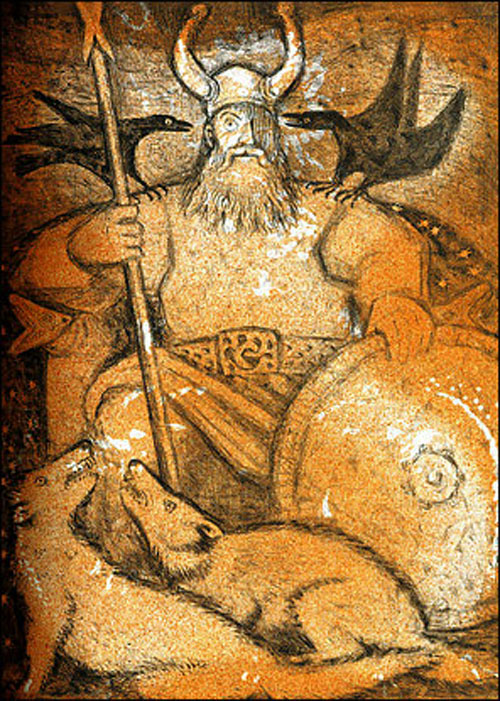
Odin, Ingri and Edgar d'Aulaire
And not even the d'Aulaires could
whitewash out the incredible sexual tension between Odin and Loki. They're attracted to each other at first sight. They mingle their blood. They swear fidelity. Odin even offers Loki a lovely, patient goddess as his beard. (Poor Sigunn also winds up as the beard for Loki's other marriage to the ogress Angerboda, mother of Hel, Fenris, and the Midgard Serpent. My guess is, safe and loving didn't do much for Loki's libido.)

I was shocked when I first read a kids' version of Edith Hamilton and asked my parents what "out of wedlock" meant. "But I thought Zeus was married to all his wives," I said. My long-suffering mother gently made clear that this was a polite fiction. And one of the great building blocks of my imaginative life began to shift. Zeus was no longer a responsible if reckless husband. He was a cad, a seducer, a thoughtless pig who cared more about the kids he sired than the women who bore them, and about his own fun most of all. The king of the gods, came the awful thought, was a jerk. And in that case, why was he the king? Why should I root for such a careless user?

The Abduction of Persephone,
Ingri and Edgar d'Aulaire
The floodgates had been opened, and the rush of criticism was impossible to stop. Hera gained a lot more of my sympathy. I stopped trying to excuse Aphrodite on account of her beauty. Hades and Persephone became one of my favorite couples for the simple reason that he was faithful to her. Suddenly the gods had faults, huge gaping faults of personality and behavior. Their humanity - the squabbles, the contests, the grousing - had been charming before. Now it became deeply problematic. The gods were worse than most people I knew. They acted with impunity, taking whatever they wanted and only offering an explanation if they felt like it. (Often those explanations were woefully inadequate. I've never been able to get behind the transformation of Niobe into a stone, just to shut up her crying. Especially since the stone itself keeps crying.)

Freya, Ingri and Edgar d'Aulaire
Other mythologies were equally subject to the criticism of my now-jaded expectations. So what if Freya's married? Her husband's missing, she's the goddess of love, and she has a hall full of strapping warriors. What do you think she's going to do with them? I revisited the tale of Sir Gawain and Lady Ragnell, understanding finally why he couldn't choose whether to have her beautiful by day or by night. I was dismally unsurprised to learn that Osiris, Isis, Set, and Nephthys were all siblings. I'd hoped for better from the Egyptians than from the Greeks, but it was par for the course; gods liked incest. Myths became more important to me for the stories than for the codes of conduct they supported, or even for the reverence of the supernatural that they'd previously made me feel. Why should I revere Zeus the rake, or Loki the asshole, or Osiris the idiot? They didn't practice what they preached; they gleefully ignored their own rules. I enjoyed the stories; it didn't mean I had to like the characters as people.

The Wooing of Gerd, Ingri and Edgar d'Aulaire
Which, I suspect, is exactly why the d'Aulaires did what they did. It's impossible to like or respect some of the choices that the gods make. Hera dooms Semele to a horrific death for sheer spite. Set takes vengeance to an appallingly vindictive level. The wooing of Gerd is an uncomfortable story of dubious consent, with a fertility moral that transforms rape into love. You could list every altruistic act of Loki's on one hand and still have fingers left over. These are awful people: morally corrupt, shamelessly self-serving, and whiny when someone else's underhanded gambit beats theirs. But they are also the core of the world's great stories, most of which wouldn't have happened without the appalling deeds committed by the gods.

So in telling those stories, you have to bowdlerize. You have to leave out the worst of the gods in order to communicate the real wonder and excitement of their stories. Especially when writing for kids, who may be encountering them for the first time, the magic should come first. There's plenty of time later for kids to learn the shades of gray. If you're going to entrance them with the glory of myth, you'd better make it as entrancing as it can be.

The Olympians, Ingri and Edgar d'Aulaire
Because it does lose something. I used to fling myself headlong into those stories, trusting in the awe-inspiring power and beauty of invincible immortals to do the right thing and save the world. I still love those stories, and I've forgiven the gods for not being as perfect as I wanted them to be. But I read them with my tongue in my cheek now. I ask questions; I groan at bad decisions; I mock the gods. I'm not sorry that I learned to think and doubt, but sometimes I miss the way it used to be. And I'm hugely grateful to the d'Aulaires for making me fall so hard for those stories that I can still love them even after I learned the truth.

Thursday, March 8, 2012

Give a Girl a Break

The Peacock Complaining to Juno, Gustave Moreau
As every Greek myth will tell you ad nauseam, Zeus's wife Hera is one jealous meanie. She's territorial to the point of obsession, with a nasty vengeful streak and a vivid imagination. The queen of the gods is, to put it bluntly, a cow.

All of which is true. As gods go, she's one of the worst to cross. (Only Artemis really equals her in terms of vicious retribution. The men, in contrast to either woman, are sissies who can't deal out pain.) But the classic portrait of her is rather one-sided. She deserves far more of a break than she gets.

Why, you ask? Well, let's start off with some early childhood trauma. The girl was swallowed whole and alive by her father at the moment of her birth. And stayed alive, in his stomach, until her littlest brother was ballsy enough to fight back. That right there should win our sympathy.

Oh, and that littlest brother? With a woman already on his arm (Metis, mother of Athena and all-around badass herself), Zeus decided to sleep with his older sisters. Demeter said yes, which is how we get Persephone; Hestia just snorted and went back to her fire; Hera flat-out
Hera and Zeus, Jun-Pierre Shiozawa
refused him. Zeus, selfish even then, would not let this stand. His solution? He made a thunderstorm, turned himself into a bird, and flew to Hera for shelter. Moved by pity, she cuddled the bird close, when all of a sudden - whoops! It's Zeus, and it looks like he just moved you both into Rapetown-on-Incest.

Who else thinks that the subsequent wedding of Zeus and Hera must have been the most awkward event ever?

Right now, we've got a plucky young goddess who survived life inside Dad's belly, only to be claimed as spoils by her liberator. At this point, Hera does one of two things. Either she decides that she might as well make good on what she's got, or she decides to spend her whole life avenging herself on the bastard brother who dealt her this crappy hand. It depends on your interpretation, really, but it's understandable either way. She can be admirable for doing her best, or she can be tragic in the same way as Macbeth. Whichever you prefer, it makes her a far more interesting character than a cardboard villainess.

Hera Imprisons Io, Ingri and Edgar d'Aulaire
I can never make up my mind about her choice there. When you consider the outright torture she perpetrates on Zeus's other conquests - keeping Io a cow, inciting Semele to arrange her own death, screwing up Heracles's entire life with vindictive abandon - it's easy to think that this is a woman consumed by vengeance, with no pity or sympathy left in her. But then you run into her relationship with her son Hephaestus, who backed her in a fight with Zeus at incredible bodily cost to himself. And her patronage of Jason is downright tender during the quest for the Golden Fleece, and lasts all the way until he throws Medea over. (And come on, Jason - did you really think Hera, of all goddesses, would support a cheater?)

And then there's the hilarious, but also touching, scene in the Iliad where Hera seduces Zeus to distract him from the fighting so Poseidon can help the Greeks. His opening gambit is to recite a list of women he's slept with, something usually guaranteed to send Hera into a rage. But
Jupiter and Juno on Mount Ida,
James Barry
then he tells her that of all of those women, none of them - not even Hera herself, way back when he pulled the wet-bird trick - was as beautiful and enticing as she is now. And then he makes a move that even I get a little swoony over: he takes her to Mount Ida and wraps them both in a golden cloud through which no one can see their lovemaking. Granted, Hera's motivated here by resentment at Zeus for not allowing the gods to interfere with Troy; granted, Zeus does not start out as the smoothest of operators. But it's bizarrely sweet, after all these tales where you assume it's a hellish marriage of a philanderer and a shrew, to see that Zeus at least has strong feelings for his wife, and that she is well aware of them. Later, when Zeus wakes up and sees Poseidon running rampant, he blames Hera; she swears her innocence by their marriage bed, a vow she says she would never make falsely. Despite their horrible beginning, there's something there that's important to them both.

Juno Ludovisi, artist unknown
And if Hera does care for Zeus, in spite of it all, it explains why she pursues his mistresses with such rabid hatred. She might not like the fact that she cares about her lousy husband, which means she might find it difficult to admit to his face. For a woman whose adult life was inexorably shaped by trauma, the kind of abuse Hera inflicts on her "rivals" might be the psychologically safest way for her to express love.

It doesn't make it right, and I still feel awful for poor innocents like Semele. But it does make more of Hera than she usually gets. And she gets so little that there's got to be some parts of the story missing.