Showing posts with label Norse. Show all posts

Tuesday, July 10, 2012

A Woman's Other Weapon

Jupiter and Io, Antonio da Correggio
The sexploits of most gods are quite literally legendary. Sometimes a god is remarkable for being the only one in a pantheon to get much action; sometimes you just can't join the club until you drop your pants and chase every nymph in sight. What doesn't get talked about nearly as much, if at all, are the comparative lusts of goddesses.

(Yes, I just saw Magic Mike, and my mind's on double standards. Can you tell?)

Take the Greek gods. Hera's seduction of Zeus in the Iliad is possibly the only time in the entire mythos when we see its central couple engaging in mutually consensual sex, and this is well after she's given birth to at least two kids. (She's also the mother of the goddesses of youth, childbirth and discord; analyze that, Dr. Freud!) Aphrodite has a very famous roving eye, and what does it get her? Trussed up in a net by her husband, as well as being bad-mouthed forever as the biggest slut in a pantheon of sex maniacs. Echo's shy advances to Narcissus are brutally rebuffed; Eos claims a man and has to watch him wither into a grasshopper, while her sister can only sleep with her beloved while he is actually asleep. And it's never made universally clear whether Persephone was a product of rape or not.

Isis and Osiris, Susan Seddon Boulet
Things don't get much better elsewhere. The contemporary Norse turned a relatively blind eye to Freya's gadding about, but nearly everyone since has passed judgment on her actions, either by censoring, over-excusing, or simply writing her sex drive out of the story. Isis, who as a mother goddess derives an enormous amount of her power from her sexuality, gets mostly a throwaway mention about how she resurrected Osiris and slept with him to get pregnant and can we move on now please? Inanna's undeniable and insatiable passion gets her typecast as a terrifying hellion to fear and avoid, and her very real power is, if not shunned, then not actively courted. And the Virgin Mary's power is right there in her name: to be important, she has to lack desire.

So what are we talking about here? Is female sexuality too much to handle, even in primal tales of basic urges, even in pantheons with characters like Zeus and Odin and Jacob? Did the mostly-male mythologists shy away from really discussing women and sex out of blind fear? If myths ignore or censor women harnessing their sexuality free of judgment, isn't that really just an age-old manifestation of the madonna-whore complex?

Well, maybe not.

Female sexuality is an astoundingly powerful force, in myth and in reality. Women hold the power to create life as a direct result of their sexuality. You get early matriarchal society because early humans recognized and acknowledged that power. And you get creation myths like the Greek one, where Gaia trains her children to destroy her selfish and unsatisfactory consort, harnessing the product of her sexuality to annihilate Uranus once he's given her the missing ingredient to make life. And she turns that same power on Cronus when he too displeases her. It is no accident that Cronus' final defeat is Zeus castrating him; by going against the will of the female - that is, the one in charge - Cronus brings on himself his unmanning, by all the classic Greek rules of hubris.

Jupiter and Juno, Annibale Caracci
And even in the less satisfactory myths, you can see the threads of that power. Hera distracts Zeus from the most epic war of all time just by flashing a bit of cleavage. Inanna may be frightening, but as Gilgamesh aptly points out, she is not someone to mess with; tapping into her primal power allows her to control men's lives. Freya snatches up the best warriors for her own hall before even Odin gets his pick, and no one dares to question her. Isis and Mary turn the alarming threat of female sexuality into salvation by giving birth to their respective messiahs.

The Awakening of Adonis, John William Waterhouse
Yes, openly sexual women are scary things to the makers of myths. But it's not plain old misogyny. It's born of a healthy respect for the change a woman can make in the world, just by embracing her sexuality. And while stainless Vestal Virgins might get a story or two - Artemis, anyone? - it's the women grounded in their instinctive power who keep coming back to shake things up, even when the men around them get scared and try to push them away.

Saturday, April 28, 2012

Problematic Myths and the People Who Love Them

I grew up on d'Aulaire's Greek myths. My father brought it back from the library one day when I was about five or six, and my initial attempts to sound out the phenomenally impossible word "Aphrodite" sent my mom into well-muffled hysterics. (The best I could do, before she took mercy on me and corrected me, was "uh-PRO-fa-deet." And now you know.) The pictures were gorgeous, the stories were entrancing, and I wanted to be Artemis or Atalanta when I grew up. More recently, my boyfriend introduced me to the d'Aulaire book of Norse myths, which is just as awesome and explained a lot of things that confused me about the Norse gods. Safe to say, I'm a fan.

But reading those myths when I was seven, and again when I was seventeen, were two very different things. The d'Aulaires took great pains to avoid the word "mistress," even and especially when it was applicable. Zeus had a ridiculous number of "wives." Odin's seduction of Gunnlod, the mother of his son Bragi, god of bards, is hinted at but
Odin and Gunnlod, Ingri and Edgar d'Aulaire
never outright stated. (The story itself, in which Odin drinks up all three of her kettles of precious mead, then leaves her to weep beside her lost treasure, is suggestive enough.) The d'Aulaires told you that Aphrodite was in love with Ares, but I never learned the tale of Hephaestus catching them in flagrante - in a net, for maximum humor - until I was a teenager. Thor is outraged at the cutting of his wife Sif's hair not because she has awesome hair, but because a woman with shorn hair is branded a whore. It took a long time for me to realize that Daphne and Syrinx flee from Apollo and Pan because they're threatened with rape, rather than an awkward proposal of marriage.

Loki, Ingri and Edgar d'Aulaire
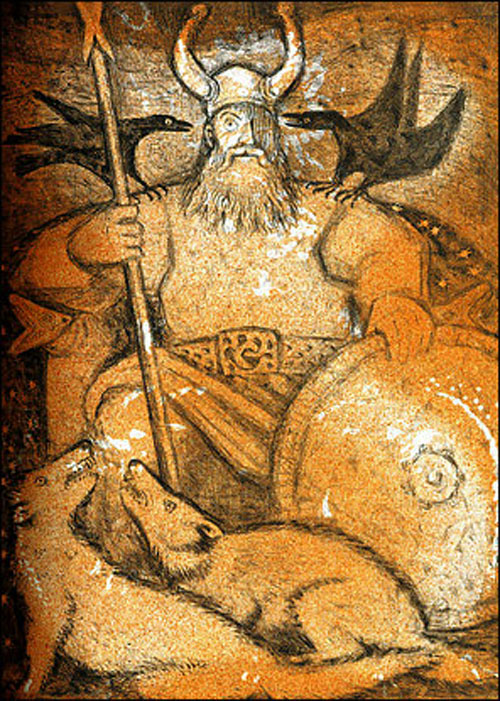
Odin, Ingri and Edgar d'Aulaire
And not even the d'Aulaires could
whitewash out the incredible sexual tension between Odin and Loki. They're attracted to each other at first sight. They mingle their blood. They swear fidelity. Odin even offers Loki a lovely, patient goddess as his beard. (Poor Sigunn also winds up as the beard for Loki's other marriage to the ogress Angerboda, mother of Hel, Fenris, and the Midgard Serpent. My guess is, safe and loving didn't do much for Loki's libido.)

I was shocked when I first read a kids' version of Edith Hamilton and asked my parents what "out of wedlock" meant. "But I thought Zeus was married to all his wives," I said. My long-suffering mother gently made clear that this was a polite fiction. And one of the great building blocks of my imaginative life began to shift. Zeus was no longer a responsible if reckless husband. He was a cad, a seducer, a thoughtless pig who cared more about the kids he sired than the women who bore them, and about his own fun most of all. The king of the gods, came the awful thought, was a jerk. And in that case, why was he the king? Why should I root for such a careless user?

The Abduction of Persephone,
Ingri and Edgar d'Aulaire
The floodgates had been opened, and the rush of criticism was impossible to stop. Hera gained a lot more of my sympathy. I stopped trying to excuse Aphrodite on account of her beauty. Hades and Persephone became one of my favorite couples for the simple reason that he was faithful to her. Suddenly the gods had faults, huge gaping faults of personality and behavior. Their humanity - the squabbles, the contests, the grousing - had been charming before. Now it became deeply problematic. The gods were worse than most people I knew. They acted with impunity, taking whatever they wanted and only offering an explanation if they felt like it. (Often those explanations were woefully inadequate. I've never been able to get behind the transformation of Niobe into a stone, just to shut up her crying. Especially since the stone itself keeps crying.)

Freya, Ingri and Edgar d'Aulaire
Other mythologies were equally subject to the criticism of my now-jaded expectations. So what if Freya's married? Her husband's missing, she's the goddess of love, and she has a hall full of strapping warriors. What do you think she's going to do with them? I revisited the tale of Sir Gawain and Lady Ragnell, understanding finally why he couldn't choose whether to have her beautiful by day or by night. I was dismally unsurprised to learn that Osiris, Isis, Set, and Nephthys were all siblings. I'd hoped for better from the Egyptians than from the Greeks, but it was par for the course; gods liked incest. Myths became more important to me for the stories than for the codes of conduct they supported, or even for the reverence of the supernatural that they'd previously made me feel. Why should I revere Zeus the rake, or Loki the asshole, or Osiris the idiot? They didn't practice what they preached; they gleefully ignored their own rules. I enjoyed the stories; it didn't mean I had to like the characters as people.

The Wooing of Gerd, Ingri and Edgar d'Aulaire
Which, I suspect, is exactly why the d'Aulaires did what they did. It's impossible to like or respect some of the choices that the gods make. Hera dooms Semele to a horrific death for sheer spite. Set takes vengeance to an appallingly vindictive level. The wooing of Gerd is an uncomfortable story of dubious consent, with a fertility moral that transforms rape into love. You could list every altruistic act of Loki's on one hand and still have fingers left over. These are awful people: morally corrupt, shamelessly self-serving, and whiny when someone else's underhanded gambit beats theirs. But they are also the core of the world's great stories, most of which wouldn't have happened without the appalling deeds committed by the gods.

So in telling those stories, you have to bowdlerize. You have to leave out the worst of the gods in order to communicate the real wonder and excitement of their stories. Especially when writing for kids, who may be encountering them for the first time, the magic should come first. There's plenty of time later for kids to learn the shades of gray. If you're going to entrance them with the glory of myth, you'd better make it as entrancing as it can be.

The Olympians, Ingri and Edgar d'Aulaire
Because it does lose something. I used to fling myself headlong into those stories, trusting in the awe-inspiring power and beauty of invincible immortals to do the right thing and save the world. I still love those stories, and I've forgiven the gods for not being as perfect as I wanted them to be. But I read them with my tongue in my cheek now. I ask questions; I groan at bad decisions; I mock the gods. I'm not sorry that I learned to think and doubt, but sometimes I miss the way it used to be. And I'm hugely grateful to the d'Aulaires for making me fall so hard for those stories that I can still love them even after I learned the truth.

Tuesday, March 27, 2012

Deadlier Than the Male

Last week I touched very briefly on war goddesses in the general context of "humans feel weird about war." But they're rather fascinating in their own right. For instance: what makes a culture like, say, ancient Greece produce a total badass like Athena, who's smart, gorgeous, and aggressive all in one? Or Freya, creation of the wargoing Norse, who could be Athena's twin (now with 78% more marital issues)? What's the story behind Hathor's alarming transformation into Sekhmet? Can anyone really ever explain Inanna?

Well, probably not. But I'll do my best.

Creation of the Witchblade, Stjepan Sejic
There's one thing a lot of them have in common. It's very glaring, and very weird. War goddesses are intimately entwined with violence and sex, in about equal measure. Gilgamesh's rejection of Inanna consists of him reciting to her a list of the ex-lovers she screwed over on a whim. Sekhmet, mad with bloodlust, is the dark side of beautiful, sensual Hathor. Durga and Kali, the best-known Indian warrior goddesses, are both manifestations of Parvati, the beloved wife of Shiva most closely identified with fertility and motherhood. Freya, goddess of beauty and fertility, had a temper that could shake the halls of the Aesir and got prime pick of the fallen dead, before even Odin. And Athena, let's not forget, never took vows of chastity like Artemis, and was invested enough in her own beauty to claim Eris's golden apple as her own.

The disturbing and obvious conclusion is that a sexually voracious female is dangerous. She's dangerous beyond the warning inherent in a goddess like Aphrodite, who's aggressive but kind of dumb. Subtext won't do for someone like this; it's got to be blatant text. You've got to dress her up in armor and give her a sword or a spear to make sure everyone gets the point. Danger! Danger! This incredibly hot woman is going to destroy you!

The Washer at the Ford, lindowyn-stock
It gets weirder. It's not just sexual aggression in a woman that gets portrayed as dangerous. It's femininity, period. The three aspects of the Morrigan - Macha, Badb, and Nemain - have little if anything to do with sex appeal. Yet they're still goddesses of war, individually and together. Their primary domain is the fear and frenzy of battle. The symbol of the Morrigan is still the crow, the eater of carrion. One of the ways in which Badb foreshadows death in battle is by washing the doomed soldier's clothes - a very feminine act of caretaking, become suddenly ominous in context. Macha, whose husband made her race horses while pregnant, went into labor after her win and cursed the male spectators to feel the pangs of childbirth at the most inconvenient time possible. This forced femaleness incapacitated all the men of Ulster except for Cuchulain in battle. No wonder Macha was worshiped - no one wanted to become like a woman again.

Is it safe to say that powerful women scared the men of ancient times? Sure. Is that the only reason for these origin stories? Absolutely not. If they were so scary, why are there so many of them? Why are they available to pray to as protectors and guardians? The very power that freaked people out seems to have been a fact of life. One highly feminized war goddess would be an anomaly. So many of them present an organized front of acknowledged power that any sane person, male or female, would want on their side. So maybe Athena gets vain from time to time. It doesn't mean you want her fighting against you. It doesn't matter whether Inanna ruins her lovers' lives; she's an unstoppable force that you might as well court.

Having a war goddess like you is certainly better than the alternative. Remember, these women don't just get angry when they're slighted. They know the ins and outs of bloody vengeance. If you don't want to go into labor in the middle of a duel to the death, you had better respect the hell out of them.

And maybe, the next time your wife or your mother or your sister took your clothes to the river to wash them, you'd remember the war goddesses and respect your own women, too. It couldn't have hurt.

Tuesday, March 20, 2012

Fighting With Gods

Thor vs. the Fire Trolls, Howard David Johnson
War. What is it good for?

Well, it produces some rather entertaining gods. Ares very kindly volunteered to be the butt monkey for the entire Greek pantheon. Thor's tempers are quite literally the stuff of legend. Durga, created to defend the world from a rampaging demon, trounces Mahishasura in what had to be the best show ever seen on the face of the earth. Nothing draws the eye quite like a war god out to make a point.

The really militant cultures understandably put the most thought into their war gods. Ares might get trapped in a jug and run screaming from the plain of Troy, but he does also have Terror and Fear pulling his chariot. And his affair with Aphrodite points up the seductive appeal of war in a culture based on fighting. Eighteen-armed Durga also represents the force of compassion; joined with fierce fighting energy, her very existence makes a fascinating argument for humanity in warfare. The Mithras cult, a favorite of Roman soldiers, provided a forum for sworn brotherhood; the god's very name might come from the Sanskrit word mitra, meaning friendship. Hachiman isn't just an ancient Japanese war god, he's the patron and teacher of warriors, as well as the particular god of an entire clan. These aren't just creatures of bloodlust - they're complicated deities with lots of responsibilities, both in their stories and symbolically.

Inanna, Luis Royo
And that's not even getting into the war goddesses. The Mesopotamians, one of the most bloodthirsty ancient cultures out there, had Inanna, goddess of sex and war. (She saw no reason not to mix the two; mythical humans rejected her as a lover at risk of their lives.) Freya has been bastardized down to the goddess of beauty, but in her day she got first pick of the battlefield dead, to take to her own halls. Athena combines wisdom and warfare, much like Durga; Bastet's most familiar manifestation, as a cat, means that she's also one of the patron goddesses of the pharaohs. Even Aphrodite enters the fray when she's needed, and is quite capable of rescuing a son here and there.

In short, we're ambivalent about war. Even in cultures that glorify strife and battle, war gods come with a mitigating circumstance built into their worship. You can pray to Thor as a thunder god, not just as a death-dealer, and if it's glory you're after, you might be better off talking to Tyr or Odin anyway. Nobody is quite easy with letting a god represent only the savagery of the field.

Ares, j-art
And that savagery is there in spades. Ares never goes anywhere without the goddess of discord; all three aspects of the Morrigan are intimately identified with death and killing; Hathor, who represents beauty and music, gets so angry at one point that she turns into Sekhmet, the lion-headed war goddess, and goes so out of control that Ra has to trick her into thinking beer is blood. Thor, the main Norse war god, is not in charge of honor or victory, only of the act of war itself.

So what creates this very real concern with war? We're not afraid of glorifying it; if we were, we wouldn't be the kind of life form that creates war gods. It could just be a storyteller's reluctance to let a perfectly good god be one-use-only. It's easy to make the leap from thunder god to war god, from sexually voracious to aggressively combative. If Inanna stories are popular, why not expand her mythos?

It could also be the up-close nature of these cultures' relation to war.

The Battle on the Ice, Boris Olshansky
If we're still talking about an ancient culture, you can bet anything they had lots of personal encounters with war. (Their enemies - the ones we've forgotten about - might not have had so many war gods.) A Norse berserker, coming off the high of a battle frenzy while surrounded by corpses, might well draw a distinct line between war and honor. The path from doer to teacher is a perfectly logical one; since Hachiman started out as the patron of fishermen, it's not hard to see how he might have become a patient instructor rather than a battlefield threat. Wisdom and compassion are very desirable things to have tempering bloodlust, especially for people who saw little of either. (Let's not forget the Iliad's massive death lists, or the straight-up anti-war sentiments of Lysistrata and The Trojan Women.) And while you'd definitely want your war gods aggressive, you'd probably prefer that the protector of your king be rational Bastet, consort of levelheaded Anubis, rather than kill-crazy Sekhmet.

Humans know it's easy to lose control when emotions are running high. But we want our gods to be better than us. We want there to be a reason to need their help. It makes sense, for whatever reason, that we'd create war gods with other things on their minds. If they can maintain control, maybe they can show us how. If they could devote themselves to other aspects of life, maybe ancient worshippers who didn't like the people that they became in war could hold out hope that there was still a better side to themselves. Either way, it shows us that even in highly war-based cultures, people still wanted their gods to have something to fight for.

Thursday, March 15, 2012

How the Trickster Won His Spurs

Pretty much everyone agrees that honor and glory are nice things. We like them. We like people who have them. We especially like ourselves when we have them. Most of legend's "good guys" are honorable men. But sooner or later, every culture gets fed up with unblemished golden boys. There comes a time when we all just want to hear about someone who can think.

Ladies and gentlemen, I give you... the trickster!

The Theft of Apollo's Cattle, Elizabeth Phillips
We've all got one. Talk about a universal character. He fits into any story; he can get away with anything; he's the life of the party, the funniest guy around. There are tons of tricksters, from Anansi to Raven to Loki, and the second they appear onstage they steal everyone else's thunder. Nobody cares that Apollo just lost all his best cows; all we care about is how Hermes will get out of this one.

So yes, you've got to have a trickster. But that doesn't mean that everyone has to like him.

The trickster may be the most morally complicated character in any pantheon. He's the undeniable audience favorite, but he also screws everyone else over like it's going out of style. Poor stupid Tiger trusts Anansi once and gets his balls stolen forever. Puss in Boots gleefully murders a passing ogre to secure a comfortable life for himself and his master. When the Norse gods call on Loki to fix a crappy situation, it's even money that Loki himself created it. Just try telling these guys that crime doesn't pay. They'll laugh in your face, ruin your life, and saunter on back to their paradises.

Brer Rabbit and the Briar Patch, Disney
And then you start asking questions about the tricksters' companions. How can they be so blind? If Odin knows everything, why doesn't he cop to Loki's double-dealing? If Raven comes to court your daughter, why don't you just shut the door and hide the valuables? No matter what Brer Rabbit tells you, why would anyone with sense ever believe him? Honor, glory, and even plain old goodness undergo a very disconcerting alchemy in the presence of a trickster; they blend together into one single, unappealing, trait: stupidity.

Loki's Punishment, Tudor Humphries
Which may be why some cultures go out of their way to tell stories in which the trickster is humbled. When Raven, who wants lots of delicious dead eyeballs to eat, forbids humans from having more than one life, his furious subjects kill his son and daughter to make him understand their pain. Coyote once courts a beautiful girl who tries to commit suicide when their liaison becomes public knowledge; he finds her in the nick of time, but the two of them are turned into ducks and can never return to her people. Loki reaps the worst punishment: when his mischief turns to malice in the killing of Balder, he's bound in a cave with a serpent dripping venom on his face until Ragnarok, when he dies in battle against the Aesir. Mess with the higher powers one too many times, and they'll have something to say about it. No one likes being made to look a fool.

Coyote Went up the River, Frederick N. Wilson
But plenty of cultures let the trickster get away scot-free. The one time Hermes gets caught (and taken to court) by Hera, he pleads his own case so eloquently and hilariously that everyone votes not to punish him. Robin Goodfellow wreaks endless household havoc and never gets called to account; instead, he gets a whole ballad in which he boasts of his exploits. Seasoned tricksters even have get-out-of-jail-free cards. All it takes to resurrect Coyote is for his friend Fox (another notable trickster) to walk over his bones.

Audience sympathy is a powerful thing. When your creator can't bear even to punish you, let alone kill you off, it's a good sign that you're here to stay.

It makes the trickster the oldest outsider in the book. He exists to upset the status quo. Having him around makes life dangerous and unpredictable; it's no wonder that he has to con his way into good fortune, since most of his fellows avoid him and the chaos he brings. It's hard to say whether he's outcast because of his tricks, or whether his tricks created a scenario in which he had to be cast out.

And it's that trait, more than any other, that makes him the popular character audiences identify with. Of all the characters in any given pantheon, fixed and steadfast in what they represent, the trickster is the only one who can change.

No wonder we like him so much. We see most of ourselves in him. He's the one who not only adapts to a new world, but shapes that world to his liking. Who wants to be a boring paragon when you could be a dynamic change-maker? Who wants to sit still when you could have fun?

Thursday, February 23, 2012

Part of Your World: Limited Engagement Only

Adrift at Sea, Nilah Magruder
So much fuss gets made over the little mermaid who failed to nab a prince that we tend to forget the scores of supernatural women who succeeded. Human men, it seems, are a hot commodity on mythical women's mash notes. And with the exception of Andersen's strangely blind prince, they tend to be rather eager for a supernatural wife. Which is no surprise - these are, after all, magical women whose goodwill can ensure success and wealth.

Some men actively set out to catch an otherworldly wife. There are endless tales of men who steal a mermaid's red cap or a selkie's sealskin to trap her on land. Others go about their wooing more delicately, like the Shepherd of Myddfai offering his chosen mermaid a bite of bread to entice her to a life on shore. Still others are forcefully wooed. The Fairy Queen is notorious for abducting handsome men with nice voices, regardless of their opinions. But the benefits of having a supernatural lover are immense. Without exception, the women's influence - from magical blessings to excellent housekeeping - win the men comfort and renown for their good luck.

So everyone's happy, right?

Not so fast. This is the fairy world. There's always a catch.

Loss, Cheryl Kirk Noll
Supernatural brides hold to the letter of their bargains. Make one wrong move (three at most), and they pop out of your life as suddenly as they entered it, taking all their magical support with them. The classic setup goes thusly: upon engagement, the bride names a single condition with which the groom must comply. Melusine forbids her husband to look at her while she bathes; the mermaid of Myddfai (in a nice move for women's rights) vows to leave her husband if he strikes her three times; the Crane Wife won't let her husband watch her weave the cloth that brings them wealth. Sounds easy, up until curiosity kills the cat and the husbands have to look, or lose their temper, or forget to lock up the sealskin. There's no fooling a supernatural bride, either. They know when the deal is broken. (Melusine's husband tries to lie to her, which only makes him look worse.)

What's more, when they go, they never come back. Volund's marriage to Hervor the Valkyrie, a perfectly happy one, ends for good when she decides she misses her old life. The husbands of local selkies get no warning when their wives discover their sealskins and return to the sea; some stories have the bereft husband walking the shore for the rest of his life, searching for his lost bride. Melusine's husband has an extra worry: in addition to the loss of his wife, he frets that she's cursed him and his lands in vengeance.

Wayland, Max Koch
Once the contract is broken, supernatural brides aren't known for their generosity. Mermaids tend to abandon their families before their children are grown and able to take over their mother's duties. The Crane Wife leaves her husband's only source of income unfinished. Volund gets bit worst: as soon as Hervor's gone, the local king orders Volund hamstrung and trapped on an island so no one else can have access to his superior smithing skills. (To be fair, Volund bites back, making the king some drinking goblets out of the skulls of the king's sons, and also raping and impregnating his only daughter, before escaping on wings he'd made in secret. All par for the course in a Norse legend.) The mermaid of Myddfai is extraordinarily generous in that, while she takes back her dowry of cattle, she also blesses her descendants with phenomenal healing powers and watches over the town. No other supernatural bride ever looks back.

Mephistophilis Appears to Doctor Faustus
The trappings of these stories are eerily similar to the tales of men who sell their souls to the devil. In exchange for instant benefits, the man makes a letter-of-the-law deal with a creature not of this world, which will hit hard when the contract inevitably runs out. True, a mermaid bride isn't quite on the same level as Mephistophilis, but the women of Melusine's line were rumored to be witches up through the Wars of the Roses. The supernatural creature retains all rights; only the human stands to lose. In some cases, the bride manipulates the terms of the contract. The mermaid of Myddfai counts an impatient "hurry up" tap on the shoulder as one of the three blows that will entitle her to return to the lake; the Fairy Queen sends True Thomas back to our world when she gets bored of him, neglecting to tell him that seven years have passed while he partied for a night in Fairyland. This is straight-up Doctor Faustus material: the seduction of a human by mystical forces that disguise the truth without ever outright lying.

Mermaid, Laurent Miny
Granted, the brides don't intend anything as sinister as dragging their husbands into Hell. But the one-sided arrangements, and the clear evidence that the power rests with the females, indicate a serious reversal of the normal run of things. It's uncomfortably easy to make the jump of reasoning that a powerful woman is on par with the devil, or at the very least in possession of abilities that are too dangerous for humans to be around for long. The Melusine story in particular throws gas on the fire: between the snake-woman and the monstrous children she bears, her identification with the devil couldn't be clearer.

So maybe there's a reason we forget those stories. They overturn the status quo. They remind us that there are forces we don't and will never understand. Like their heroines, they seduce with the promise of happiness and dash our hopes without warning. They're not comfortable bedtime stories; they're tales of man against nature, often without a clear villain or victor. Stories like that don't make for sweet dreams.