Showing posts with label gods. Show all posts

Tuesday, August 14, 2012

Troy and Other Ten-Year Problems

There's a conundrum I've been puzzling over for, ironically, ten years. I have never been able to figure it out. And it's a little embarrassing, as a fan of mythology, not to have a good reason for it. But nevertheless, it stands.

You know those two epic poems that provide some of the most basic foundations for Western society? The Iliad and the Odyssey? Well, I've read them both. I like them both a lot. I especially like Odysseus, the quintessential lovable trickster. He and Nestor provide the most reliable voices of reason in the Iliad, which makes it great fun to watch him really act out in the Odyssey. I don't really like any of the Iliad's characters as much as I like - no, let's do this right, love - Odysseus.

But despite the fact that many of its main characters are morally deplorable creatures who whine, mope, and pet their own egos, and despite the fact that the Odyssey is a far more thoughtful and touching character study... I like the Iliad better.

Let's be clear. My favorite character in the Iliad alternates between Hector, Diomedes, and Aeneas, depending on the mood I'm in that hour. Menelaus doesn't get enough screen time, Agamemnon's obnoxious, Helen's underused, Zeus is a bitch, and do not get me started on Achilles. I cannot with the glorification of a whiny self-absorbed mama's boy. I just cannot. And the characters I do like? Well, Hector is Hector, i.e. Living Awesome, but sometimes the sheer wow factor gets overwhelming. (Is there anything wrong with him? Anything at all?) Aeneas, to my surprise, turned out to be a very active participant in the war; before I read the Iliad, I thought of him as the sequel guy, and I enjoyed seeing him kick ass before Dido and Virgil got hold of him. And Diomedes... okay, he has basically one chapter, but in that chapter he makes Achilles look like a wuss, gives Aphrodite the bladed bitch-slap we all wanted her to get, and sends the freaking god of war crying home to Dad, in what is arguably the funniest scene in literary antiquity. Including everything in Lysistrata. If you can only have one chapter in which to shine, this is the one to have.

There's really no comparison with Odysseus. He's charismatic, brilliant, fast-thinking, and good at what he does. (Which is everything.) He knows exactly what he's worth, but unlike Achilles or Paris or any of the other entitled "heroes" of the Iliad, he doesn't sit around waiting for the world to give it to him. He goes after it, and if he fails the first time, he comes back with a better plan.

Calypso Takes Pity on Odysseus,
Henry Justice Ford
And oh yeah - he fails sometimes. Big time. He is the only man on his flagship (at least; he took eleven others to Troy) to make it back to Ithaca; that's one lousy rate of retention. He dozes off among his suspicious men, leaving Aeolus' bag of winds carelessly unguarded. Worst of all, he basically gives his address and phone number to an enraged and blinded Cyclops whose father rules the sea, right before he starts off on a long sea voyage. But he pays the price for those failures. He loses the men whose safety is in his keeping; he spends ten years trying to get home; he nearly dies about a million times. And he learns. By the time he gets back home, he's able (with some help from Athena) to diffuse a civil war in the making. He has the best character arc of anyone in Greek mythology.

But I confess it: when I read the Odyssey, I was bored.

Telemachus Arming, Luigi Bienaime
Maybe it's because Odysseus' adventures have crossed so deeply into popular culture that I already knew the whole story. The suspense of his escape from Polyphemus, the seductive threat of Circe, the innocent relief of Nausicaa and the Phoenician episode, all lost their full impact because I already knew how it ended. "Okay, Odysseus, you stabbed the Cyclops in his one eye. Good for you. Can you tell me something new, please?" (Full credit, by the way, to the d'Aulaires, who valiantly refrained from spoiling the Odyssey. That being said, I would have LOVED to read a d'Aulaire version.) What did make an impression on me were the Telemachus side plot and the reunion of Odysseus and Penelope. Telemachus surprised me just as Aeneas did; I kind of knew he was there somewhere, but I hadn't expected him to be
Odysseus and Penelope, John Flaxman

energetic and enterprising and very much a worthy son to Odysseus. And even though I knew the plot summary of that reunion, I was utterly unprepared for the exquisite language it's written in, and the aching sweep of love and shock and joy that carries it forward. When I read the Odyssey, I read Penelope's speech to Odysseus aloud. I can't help it. There are sentences that exist to be spoken. I had thought of that scene as the standard capper to the hero's journey; I had never envisioned it as the emotional climax of lovers estranged for twenty years. That scene broke me in all the wonderful ways literature is supposed to break you.

But no one spoiled the Iliad for me. I mean, I knew Hector died, but I didn't know Diomedes was a badass, or that there was so much divine machination, or that Helen gave Paris a verbal emasculation that rivals Lady Macbeth. No one told me about the agony of the fight over Patroclus' body. I was unprepared for the scene where Priam begs Achilles for his son's corpse. And most of all, I was stunned to find that the war epic to end all war epics is actually anti-war.

Achilles Triumphant, Howard David Johnson
Really, who does that? Who paints a masterpiece of how art sucks, or compiles a complete and working investment portfolio illuminating all the flaws of Wall Street? The guts and the vision to decry war while writing the war story astounded me. People who dismiss the death lists and the catalogue of ships completely miss the point. For chapter after chapter, the Iliad sets you up with all the glorious claptrap, applying epithets to the war leaders, giving us gorgeous details like the red bows of the Ithacan fleet, the pathetic offering of three ships from Nireus the pretty boy, and Ajax of Salamis' seven-layer shield covered with bronze.

Hector Brought Back to Troy, artist unknown
And then they die. Then they all pour onto the beach and start fighting, and we see all the men who die in their last moments. "The end of death covered over his eyes and nostrils." "The spear-point went right through [his helmet] and smashed the bone, and all his brains were spattered inside, and the man brought down in his fury." "He shrieked as the life breathed from him, and fell screaming in the dust, and his spirit flitted away." These are visceral, claustrophobic moments, rendered with sympathy for the dying and an implicit condemnation of the reason they died. It happens over and over. The Iliad is relentless. It will trick you into thinking you're reading something golden and glorious, and then it'll throw a chapter of death lists in your face and dare you to believe, after all that, that war is a good thing.

I had no idea. And I could not put the thing down.

Ulysses and the Sirens, Roman mosaic, 3rd century CE
The Odyssey, in comparison, is structurally far simpler: it's a quest, told with unusual timing but still straightforward. Odysseus starts at Point A, zigzags through a maze of adventures, and ends up at Point B. The Iliad starts exactly where it ends: two great nations, both with admirable and appalling people, destroying each other. There's no journey, no revelation, no catharsis. Achilles manages to find his humanity in the end, but that's a hollow victory, because we all know he too is soon to die; his emotional progress matters not a jot. Come the next day, these flawed and brave and blind people we've come to know so well are going to go back to that beach and keep killing each other. The Odyssey is the emotional arc of three complicated characters, disguised as a simple story; the Iliad is a message disguised as a series of episodes.

The Procession of the Trojan Horse in Troy, Domenico Tiepolo
And I have no reason for why I like one better than the other. The secrets that both were hiding blew me away. They're both seminal pieces of Western culture; I wouldn't want to live in a world without them. But the one that moves me most is the story of despair at human nature, not the uplifting and adventurous yarn. Odysseus is the best of all traveling companions, but he's only one man. The Iliad tells me hard truths about human nature, using beautiful language to create horrific images. And in that very act, it affirms the good as well as the bad in humanity: no matter how low we sink, there will always be voices like Homer's, to tell us with such blunt grace what we're doing wrong.

Saturday, August 4, 2012

Holy Insecurity, Batman!

You'd think being a god is one of the sweetest jobs out there. Incredible power, tons of perks, the ability to shape the future... a person could feel good about themselves if they were a god, right?

Wrong. Gods are some of the most insecure beings ever created. From Greece to Alaska to Egypt, gods across pantheons just can't stop showing off the extent of their power and control over every other living thing. It's as if, divine and omnipotent as they are, they still have something to prove, either to themselves or to us. I would make a "compensating for something" joke, but I'd probably get turned into rock if I did. Because the one thing gods can't stand is a lowly mortal pointing out their flaws.

Take Arachne. Granted, she was a moron for willfully engaging a goddess in a contest of skill; the barometer of stupid probably shattered when she challenged Athena. But her prideful idiocy doesn't change the fact that she was also right. Athena's entry into their weaving contest is a complacent pat-on-the-back to herself and her entire extended family; Arachne had the guts to depict the gods' ignoble moments and reveal how ridiculous and petty they often are. And sometimes the narrator even admits that Arachne's work, if blasphemous, is also better than Athena's.

What does she get for shining an irreverent but honest light on the less-than-glorious lives of the gods, via a contest she technically won? Turned into a spider. Athena is so embarrassed that she throws an appalling and uncharacteristic hissy fit: she rips up Arachne's superior tapestry and erases all evidence of the crime by disposing of the accuser. Clearly the mob missed out on a fantastic hit woman. But even in high dudgeon, Athena remains sensible enough to phrase her anger in terms that no other potentially challenging mortal could mistake: this is Arachne's punishment, not for being humiliatingly right, but for her arrogance. The message is clear: do not piss off the gods. Even if you're better. Just don't do it. We don't want to know.

Sedna, Antony Galbraith
Sedna, in comparison, gets a much better deal. But her story is still very troubling in what it says about the capricious willfulness of gods. Sedna starts out as a beautiful mortal who refuses all her suitors, until a mysterious and skilled hunter comes to town. She's interested; more importantly, her father wants her off his hands. He drugs Sedna and hands her over to the hunter, who takes her back to his "home" - an enormous nest on a clifftop. Surprise - your new husband is actually Raven, turned into a human because he spotted Sedna and fancied her!

Sedna, Tara Borger
In a shocking twist, this freaks Sedna out. (I have to wonder if Leda had a similar reaction when she was accosted and assaulted by a damn swan. What is it with randy gods and birds?) Sedna escapes from the nest, which in turn offends her putative husband's pride and dignity. Determined not to let his new bride escape - whether he's more concerned about having his disguise revealed, or losing face by losing Sedna, is rarely clear - Raven whips up a storm to drown the girl he went to such lengths to obtain. In hopes of making amends, Sedna's father kayaks over to rescue her, but only until his own life is threatened. When the storm nearly flips his boat over, Sedna's father pitches her straight into the god-sent waves, sacrificing his daughter again for his own sake. And when the poor girl, probably now thoroughly pissed at men in general, clings to the side of the kayak, her paragon of a dad cuts her fingers off so she can't hold on. Luckily karma takes a hand at this point; Sedna's severed fingers become whales and seals and fish, the creatures of the as-yet-unpopulated sea, and Sedna herself becomes a sea goddess. It's a much-deserved reward for her seriously crappy run of luck.

But having been the firsthand victim of a god's fickle pride, Sedna has a hard time learning the lesson of good behavior. She throws temper tantrums when her hair gets tangled underwater, requiring tribal shamans to travel to her ocean home to comb out the knots (since they, after all, have fingers). Only when she is appeased will she release the sea creatures for humans to catch. On one hand, yes, the lack of fingers and the inability to attend to her own personal grooming would get on someone's nerves; on the other, you'd think someone so shabbily treated would know to be helpful rather than coercive. The only lesson Sedna seems to have learned about divine-human relations is the one that led Raven to kidnap her: humans exist to serve the will of gods.

And lest you think this is just a hormonal female thing, we haven't even gotten to the most appalling divine exhibition of power.

Back in the bad old days before the Ten Commandments, Yahweh was a Mesopotamian thunder god with a lot to prove. His chosen people go nomad for a couple generations, essentially run the richest country in the known world, and then promptly get enslaved when a trigger-happy Pharaoh thinks they've gone too far. When Yahweh finally wakes up to the less-than-ideal state of his worshipers - and the affront to him implied in the subjugation of his chosen ones - he seriously loses his cool. He snags a passing Moses and makes him a divine mouthpiece for Yahweh's over-the-top display of vindictive power.

Who does he unleash this power on? The Pharaoh who enslaved his people? The overseers and taskmasters who make their lives hell? The priests who deemed him so helpless?

How about everyone?

The Plagues of Egypt, John Martin
Yahweh's reputation and career are on the line. He's up against the far more experienced and entrenched might of the Egyptian pantheon. And he is not happy with being ignored. So he makes damn sure that no one will ever forget what happens when you make him angry. He systematically ravages the entire country, forcing every single Egyptian to pay literally in blood for the insult to his prowess. His opening act is to turn Egypt's only source of potable water into blood. Once dehydration sets in, Pharaoh relents and calls Moses back. "Okay, I'm sorry, you guys can go now, but for the love of Hapi, can you get me a freaking drink of water?"

The Plague of Locusts, James Tissot
To recap: Yahweh has brought a country to its knees with one stroke. The most powerful king in the world is begging with his chosen spokesman, acknowledging Yahweh's superior might. But this is not enough. Yahweh's just getting started on his revenge. Exodus explicitly states that "God hardened Pharaoh's heart," and proceeded to unleash the other nine Plagues on the population of an entire country, just to prove beyond the shadow of a doubt that he was awesome. He does it again and again, bringing Pharaoh to desperation and then refusing to let the king's own admission of Yahweh's power stand. He kills all the cattle; he withers all the crops; he plunges the entire country into permanent darkness. And ultimately, as his master stroke, Yahweh slaughters the firstborn of every single Egyptian family. When this is depicted, the dead firstborn are nearly always children. Innocents. Noncombatants. Some of whom had probably never met an Israelite in the whole of their short life.

Death of the Pharaoh's Firstborn Son, Lawrence Alma-Tadema
They die to prove a point. They die to show that Yahweh is not a god to ignore. They die because of a god's authority crisis. They are collateral damage in a war of divine attrition, because a couple of powerful humans wondered what would happen if they poked a sleeping dragon.

Gods are not nice people. Gods are primordial creatures, wearing a sheen of civilization over the basest impulses known to man. They exist to be worshiped. And if you forget, they will be more than happy to remind you - brutally, savagely, in a triumph of self-conscious insecurity - what happens when you don't give them their due.

Tuesday, July 3, 2012

The Lone Artist

Let's talk about Hephaestus.

Hephaestus, Scott Eaton

Because honestly, who else is going to? The poor guy is the underdog to beat all underdogs, even in a mythos that includes Menelaus. He's the son of Zeus and his actual wife, so he gets no fun cavorting origin story. He's got a much hotter, flashier brother - and a gorgeous wife who flagrantly cheats on him with said brother. He's stuck in a volcano making pretty and amazing things for the ungrateful bastards he calls family, who grab what he gives them and don't even stay to say thank you. After Oedipus, he may have been dealt the worst hand in all of Greek mythology.

Mars and Venus Surprised by Vulcan,
Alexandre Charles Guillemot
It gets worse. All the memorable Hephaestus myths involve him getting humiliated in some way. How did he become lame? Well, Zeus pitched him off Olympus for siding with Hera in a marital spat. How did he score the most beautiful of all goddesses? Well, because his dad thought opposites might attract (and also figured that he owed him one after the whole laming business). How did he finally figure out that Aphrodite was two-timing him? Well, he had to catch her with Ares in a net before he could get anyone to pay attention. Even when he's a peripheral character, he's put-upon; when Achilles needs new armor in which to kill Hector, guess who has to pull an all-nighter to have it ready by morning?

You have to feel for the guy.

What makes things even sadder is that everyone on Olympus recognizes his competence.  No one dreams of going to anyone but Hephaestus for everything from jewelry repairs to new thunderbolts. Among scads of glory-hungry and talented deities, he is universally recognized as the most gifted. And no one ever asks anything more of him than what they want from him. He's the ugly friend who makes you look better by comparison.

And he does his job tragically well. Athena gets all the glory for giving handicrafts to humans, with no mention of who might have taught her. Apollo runs away with the artistic laurels, because it's not like any other god might be good at making pretty things. The guy can make a freaking volcano erupt when he works the night shift, but his own father steals the shock-and-awe points whenever he feels like pitching a hissy fit and a few thunderbolts. Hephaestus gets no credit for things that, in a more attractive god, would be cause for adoration and fangirling.

To which he says, with consummate grace: So what?

Hephaestus isn't a fame-seeker. He's not waiting with bated breath for the popular verdict on his latest creation. He knows it's good. He knows he made it. And he knows the next one will be even better. Hephaestus is an artist. He's actually a much more dedicated artist than Apollo, who spends more time skirt-chasing and scoring good PR than actually making music. Hephaestus lives in his studio. He literally breathes his creations. He is focused 24/7 on the thing he does well and that he loves to do. And most importantly, he's made it pay. All artists need patrons; what good is art if no one sees it? Hephaestus's skills earn him a dedicated clientele. Big freaking deal if they don't actually talk to him; capital-P Patrons of Art are almost always assholes in one way or another. The main thing is, they come back. They recognize the value of what he creates, and they want more. Hephaestus is living the artist's dream.

Sure, he's the solitary artist, the one who works in seclusion churning out beauties. But he's also a god. When he wants something done, he gets it done, whether it's a gorgeous new shield or an invisible wife-catching net. It's no coincidence that he traps Ares and Aphrodite in the literal coils of his own skill, which they thoughtlessly undervalued in undervaluing him. Hephaestus lives by his art. And he likes it that way.

Because if he didn't? Come on. This is a go-getter. This is a guy who knows where he's headed. If he didn't like the destination, he'd just set course for a new one. He wouldn't do it with a fuss and a fanfare, and someone would probably tease him for it. But he'd still be doing what he wanted. You just can't stop him.

Tuesday, May 8, 2012

We Are Not Amused

"All right, people. Our next lot is one Muse of fire, a bit late for Shakespeare but just in time for you lucky folks! Do I hear one thousand?

"What do you mean, what's she like? She's a Muse! Of fire! Isn't that all you need to know?"

Well, that's the thing. Muses are weird that way. They might be Greek mythology's greatest crossover success story. Countless modern artists invoke them, whether in blame or in thanks. We love the idea of patron goddesses of the arts, watching over those brave and reckless souls who dare to pursue art.

We just don't know a single thing about who the Muses actually are.


Apollo, Mnemosyne, and the Nine Muses, Anton Raphael Mengs

Sure, we know what they represent. Poetry, theater, dance, even history and astronomy. All cool, worthwhile things. But beyond each Muse's designated area of specialization, we know squat. They're the nine daughters of Zeus and Mnemosyne, they hang out with Apollo (who got around with quite a few of them), they serve on occasion as jury and record-keepers for the Olympians. Calliope has a bunch of sons. That's about it.

Okay, so maybe they're the personifications of their individual arts, not just the patron goddesses. All well and good, except even in the arts that have definable personalities, they come off as extremely one-note and confusing. Is Thalia, Muse of comedy, an absurd gigglefest? Does Clio get frustrated with Terpsichore dancing away while she's trying to give a lecture on history? How does personifying epic poetry get Calliope all that action? Shouldn't that logically be the domain of Erato, Muse of love poetry? If a solution raises more questions than it answers, it's probably not the right solution.

Hesiod and the Muse, Gustave Moreau
There's another problem with the Muses and their lack of personality, related directly to the artists who call on them for help. Those artists consider the Muses their personal property. "Sing, Muse, of the rage of Achilles." "My muse isn't cooperating." "I'm blocked; I can't get to my muse." Shakespeare in Love uses the introduction of its title character to let him discourse on his need to "find" his muse. Did you check under the bed yet, Will?

From benevolent patrons who can withhold their needed assistance, the Muses become things that are owned. Part of it comes from the close identification of art with artist: it's "your" artwork, after all, and it's easy to see where the muse that inspired it could become "your" muse. But it's easy to do precisely because the Muses lack personality. Can you imagine anyone owning Zeus, or Poseidon, or Aphrodite? Artemis turns a guy into a deer and has him slaughtered by his own hounds for nothing more than the implication that he might want to possess her. The Muses don't even put up a fight. Instead they take on the personality of the artist who claims them.

The Nine Muses, wegs
There are no Muse-centric stories. In the stories where they feature, it's always as side characters, and always in a group. They judge the music contest between Apollo and Marsyas (three guesses as to who wins); they gather Orpheus' strewn limbs; they get super-vindictive when a prize idiot named Thamyris tries to do a rerun of the Apollo-Marsyas contest, except with himself as Marsyas and the Muses as Apollo. When he fails to outsing them, they blind him and strip him of his skill with the lyre. But here's the kicker: yes, it's excessive punishment, but it's completely par for the course among the Greek gods. It only strikes us as over-the-top because the Muses, unlike the Olympians, have no personality to justify their harshness. Apollo, let's not forget, flayed Marsyas and made a drum out of his skin. The Muses were merciful in comparison. So we still don't know anything about them as characters.

It may well have something to do with the fact that the "traditional" nine Muses took a while to show up. For quite some time there were only three - Melete, Aoide, and Mneme (kind of like the equally character-less Three Graces, who receive Aphrodite on Cyprus and do basically zip for the rest of the mythology). It's tricky to make up lasting stories when no one can even agree on the number and names of your prospective characters. But even after the Romans cemented their names, number and specialties, no one had any Muse stories to tell. They stayed as they always had: benevolent but shadowy figures, popping in and out of the narrative.

The Muses, Ingri and Edgar d'Aulaire
It's a tricky business, looking for inspiration to an unknown quantity. You never know what she'll bring you, if she brings you anything at all. Artistic narcissism raises the uncomfortable question: is your muse actually you, an idealized you who only has good ideas? And why ask for help from someone randomly designated by some clown in a toga?

The Muses, Ingri and Edgar d'Aulaire
If the Muses have personality, it comes from the artists who supplicate them, who see in them the personification of inspiration, that rush of excitement and energy in which nothing bad can be created. But they're not individuals. In a pantheon full of living, breathing characters, the Muses are as three-dimensional as a line. And it's very weird to have nonentities presiding over humanity's greatest form of individual expression.

Saturday, April 28, 2012

Problematic Myths and the People Who Love Them

I grew up on d'Aulaire's Greek myths. My father brought it back from the library one day when I was about five or six, and my initial attempts to sound out the phenomenally impossible word "Aphrodite" sent my mom into well-muffled hysterics. (The best I could do, before she took mercy on me and corrected me, was "uh-PRO-fa-deet." And now you know.) The pictures were gorgeous, the stories were entrancing, and I wanted to be Artemis or Atalanta when I grew up. More recently, my boyfriend introduced me to the d'Aulaire book of Norse myths, which is just as awesome and explained a lot of things that confused me about the Norse gods. Safe to say, I'm a fan.

But reading those myths when I was seven, and again when I was seventeen, were two very different things. The d'Aulaires took great pains to avoid the word "mistress," even and especially when it was applicable. Zeus had a ridiculous number of "wives." Odin's seduction of Gunnlod, the mother of his son Bragi, god of bards, is hinted at but
Odin and Gunnlod, Ingri and Edgar d'Aulaire
never outright stated. (The story itself, in which Odin drinks up all three of her kettles of precious mead, then leaves her to weep beside her lost treasure, is suggestive enough.) The d'Aulaires told you that Aphrodite was in love with Ares, but I never learned the tale of Hephaestus catching them in flagrante - in a net, for maximum humor - until I was a teenager. Thor is outraged at the cutting of his wife Sif's hair not because she has awesome hair, but because a woman with shorn hair is branded a whore. It took a long time for me to realize that Daphne and Syrinx flee from Apollo and Pan because they're threatened with rape, rather than an awkward proposal of marriage.

Loki, Ingri and Edgar d'Aulaire
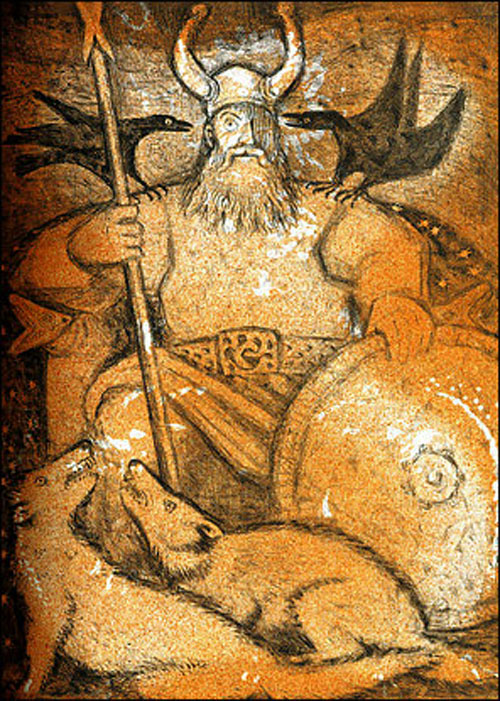
Odin, Ingri and Edgar d'Aulaire
And not even the d'Aulaires could
whitewash out the incredible sexual tension between Odin and Loki. They're attracted to each other at first sight. They mingle their blood. They swear fidelity. Odin even offers Loki a lovely, patient goddess as his beard. (Poor Sigunn also winds up as the beard for Loki's other marriage to the ogress Angerboda, mother of Hel, Fenris, and the Midgard Serpent. My guess is, safe and loving didn't do much for Loki's libido.)

I was shocked when I first read a kids' version of Edith Hamilton and asked my parents what "out of wedlock" meant. "But I thought Zeus was married to all his wives," I said. My long-suffering mother gently made clear that this was a polite fiction. And one of the great building blocks of my imaginative life began to shift. Zeus was no longer a responsible if reckless husband. He was a cad, a seducer, a thoughtless pig who cared more about the kids he sired than the women who bore them, and about his own fun most of all. The king of the gods, came the awful thought, was a jerk. And in that case, why was he the king? Why should I root for such a careless user?

The Abduction of Persephone,
Ingri and Edgar d'Aulaire
The floodgates had been opened, and the rush of criticism was impossible to stop. Hera gained a lot more of my sympathy. I stopped trying to excuse Aphrodite on account of her beauty. Hades and Persephone became one of my favorite couples for the simple reason that he was faithful to her. Suddenly the gods had faults, huge gaping faults of personality and behavior. Their humanity - the squabbles, the contests, the grousing - had been charming before. Now it became deeply problematic. The gods were worse than most people I knew. They acted with impunity, taking whatever they wanted and only offering an explanation if they felt like it. (Often those explanations were woefully inadequate. I've never been able to get behind the transformation of Niobe into a stone, just to shut up her crying. Especially since the stone itself keeps crying.)

Freya, Ingri and Edgar d'Aulaire
Other mythologies were equally subject to the criticism of my now-jaded expectations. So what if Freya's married? Her husband's missing, she's the goddess of love, and she has a hall full of strapping warriors. What do you think she's going to do with them? I revisited the tale of Sir Gawain and Lady Ragnell, understanding finally why he couldn't choose whether to have her beautiful by day or by night. I was dismally unsurprised to learn that Osiris, Isis, Set, and Nephthys were all siblings. I'd hoped for better from the Egyptians than from the Greeks, but it was par for the course; gods liked incest. Myths became more important to me for the stories than for the codes of conduct they supported, or even for the reverence of the supernatural that they'd previously made me feel. Why should I revere Zeus the rake, or Loki the asshole, or Osiris the idiot? They didn't practice what they preached; they gleefully ignored their own rules. I enjoyed the stories; it didn't mean I had to like the characters as people.

The Wooing of Gerd, Ingri and Edgar d'Aulaire
Which, I suspect, is exactly why the d'Aulaires did what they did. It's impossible to like or respect some of the choices that the gods make. Hera dooms Semele to a horrific death for sheer spite. Set takes vengeance to an appallingly vindictive level. The wooing of Gerd is an uncomfortable story of dubious consent, with a fertility moral that transforms rape into love. You could list every altruistic act of Loki's on one hand and still have fingers left over. These are awful people: morally corrupt, shamelessly self-serving, and whiny when someone else's underhanded gambit beats theirs. But they are also the core of the world's great stories, most of which wouldn't have happened without the appalling deeds committed by the gods.

So in telling those stories, you have to bowdlerize. You have to leave out the worst of the gods in order to communicate the real wonder and excitement of their stories. Especially when writing for kids, who may be encountering them for the first time, the magic should come first. There's plenty of time later for kids to learn the shades of gray. If you're going to entrance them with the glory of myth, you'd better make it as entrancing as it can be.

The Olympians, Ingri and Edgar d'Aulaire
Because it does lose something. I used to fling myself headlong into those stories, trusting in the awe-inspiring power and beauty of invincible immortals to do the right thing and save the world. I still love those stories, and I've forgiven the gods for not being as perfect as I wanted them to be. But I read them with my tongue in my cheek now. I ask questions; I groan at bad decisions; I mock the gods. I'm not sorry that I learned to think and doubt, but sometimes I miss the way it used to be. And I'm hugely grateful to the d'Aulaires for making me fall so hard for those stories that I can still love them even after I learned the truth.