Showing posts with label gender issues. Show all posts

Tuesday, July 10, 2012

A Woman's Other Weapon

Jupiter and Io, Antonio da Correggio
The sexploits of most gods are quite literally legendary. Sometimes a god is remarkable for being the only one in a pantheon to get much action; sometimes you just can't join the club until you drop your pants and chase every nymph in sight. What doesn't get talked about nearly as much, if at all, are the comparative lusts of goddesses.

(Yes, I just saw Magic Mike, and my mind's on double standards. Can you tell?)

Take the Greek gods. Hera's seduction of Zeus in the Iliad is possibly the only time in the entire mythos when we see its central couple engaging in mutually consensual sex, and this is well after she's given birth to at least two kids. (She's also the mother of the goddesses of youth, childbirth and discord; analyze that, Dr. Freud!) Aphrodite has a very famous roving eye, and what does it get her? Trussed up in a net by her husband, as well as being bad-mouthed forever as the biggest slut in a pantheon of sex maniacs. Echo's shy advances to Narcissus are brutally rebuffed; Eos claims a man and has to watch him wither into a grasshopper, while her sister can only sleep with her beloved while he is actually asleep. And it's never made universally clear whether Persephone was a product of rape or not.

Isis and Osiris, Susan Seddon Boulet
Things don't get much better elsewhere. The contemporary Norse turned a relatively blind eye to Freya's gadding about, but nearly everyone since has passed judgment on her actions, either by censoring, over-excusing, or simply writing her sex drive out of the story. Isis, who as a mother goddess derives an enormous amount of her power from her sexuality, gets mostly a throwaway mention about how she resurrected Osiris and slept with him to get pregnant and can we move on now please? Inanna's undeniable and insatiable passion gets her typecast as a terrifying hellion to fear and avoid, and her very real power is, if not shunned, then not actively courted. And the Virgin Mary's power is right there in her name: to be important, she has to lack desire.

So what are we talking about here? Is female sexuality too much to handle, even in primal tales of basic urges, even in pantheons with characters like Zeus and Odin and Jacob? Did the mostly-male mythologists shy away from really discussing women and sex out of blind fear? If myths ignore or censor women harnessing their sexuality free of judgment, isn't that really just an age-old manifestation of the madonna-whore complex?

Well, maybe not.

Female sexuality is an astoundingly powerful force, in myth and in reality. Women hold the power to create life as a direct result of their sexuality. You get early matriarchal society because early humans recognized and acknowledged that power. And you get creation myths like the Greek one, where Gaia trains her children to destroy her selfish and unsatisfactory consort, harnessing the product of her sexuality to annihilate Uranus once he's given her the missing ingredient to make life. And she turns that same power on Cronus when he too displeases her. It is no accident that Cronus' final defeat is Zeus castrating him; by going against the will of the female - that is, the one in charge - Cronus brings on himself his unmanning, by all the classic Greek rules of hubris.

Jupiter and Juno, Annibale Caracci
And even in the less satisfactory myths, you can see the threads of that power. Hera distracts Zeus from the most epic war of all time just by flashing a bit of cleavage. Inanna may be frightening, but as Gilgamesh aptly points out, she is not someone to mess with; tapping into her primal power allows her to control men's lives. Freya snatches up the best warriors for her own hall before even Odin gets his pick, and no one dares to question her. Isis and Mary turn the alarming threat of female sexuality into salvation by giving birth to their respective messiahs.

The Awakening of Adonis, John William Waterhouse
Yes, openly sexual women are scary things to the makers of myths. But it's not plain old misogyny. It's born of a healthy respect for the change a woman can make in the world, just by embracing her sexuality. And while stainless Vestal Virgins might get a story or two - Artemis, anyone? - it's the women grounded in their instinctive power who keep coming back to shake things up, even when the men around them get scared and try to push them away.

Tuesday, June 26, 2012

Chivalry in Skirts

Arthurian legend has no shortage of uppity women. From Guinevere to Nimue to Morgan le Fay, the legends abound with damsels and ladies who know their own minds, set their own goals, and aren't afraid to admit their ambitions. Unfortunately, most of them get absolutely squashed. Whether by outside interference or their own backfiring machinations, scarcely a go-getting Arthurian lady gets what she came for.

So it stands to reason that when one of them does, she is vividly remembered.

Linette, the razor-tongued sister of Lady Lionors, is unique among the ladies of Arthuriana not only because she gets everything she set out to get, but because she is one of the only successful cases of character development in the legends. So many characters spring to life already equipped with their defining personality traits: Lancelot is noble and has a guilt complex, Mordred is evil and scheming, Merlin is wise, Guinevere is beautiful and capricious. We see Arthur develop in the early going from impulsive youth to mature and just king, but he's pretty much the only one.

Sir Gareth and Lady Lynette, Arthur Rackham
Besides Linette. We first meet her when she demands a champion from the king while refusing to give her name, the name of her sister (for whom she's requesting said champion), or even the common courtesy due to another person. When Gareth, incognito as a kitchen boy, calls in the favors Arthur owes him and claims her quest as his, she spits out a few choice insults and rides in high dudgeon from the court. Undaunted, Gareth catches up; equally unfazed, Linette proceeds to blister the air for days with details of his idiocy, his inadequacy, and his incapability to survive a poke, let alone a series of one-on-one combats. There is literally no reason at all to like her.

And then she gets her wake-up call. The second of four knights that Gareth trounces is a real gentleman, inviting his ex-foe and his companions to dinner. Linette does her usual awful shtick; unlike Gareth (who handles his crappy damsel with true chivalry), the defeated knight calls her on it. And suddenly Linette realizes she's been a complete hag to the one man who was willing to help her sister.

For comparison: Lancelot gets a similar wake-up call on the Grail Quest, when his sinful love for Guinevere bars him even from seeing the Grail. He gets the message loud and clear. He is the greatest earthly knight in the world; he knows just how badly he failed. And when he gets back to Camelot, he promptly forgets all about it.
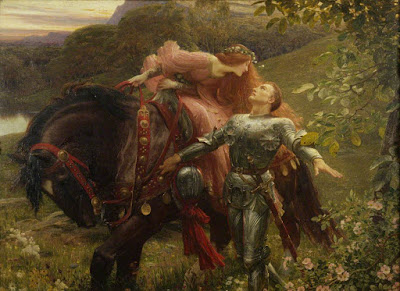
La Belle Dame Sans Merci, Frank Dicksee
Not Linette. The very next day she apologizes to Gareth. When he fights his next foe, she acts as his own personal cheerleading squad; it's her cry of support that energizes him when he was ready to give up. The most atrociously snobby character in Arthuriana becomes, in the space of a few paragraphs, one of the most endearingly human: she recognizes her fault and takes every possible step to amend it. Some versions (Tennyson's among them) even end with Gareth marrying Linette, rather than her beautiful and anonymous sister to whose rescue he rode.

So what gives? Why does Linette get off with a scolding, while other ambitious women get utterly broken? Morgan le Fay is foiled, exposed, and vilified. Guinevere is disgraced and often portrayed as a jealous shrew. The Lady of the Lake gets her head chopped off by Balin, who offers a deeply insufficient excuse: "She was a witch!" Geraint's wife Enid, as haughty and outspoken as Linette, is mocked by her neighbors, verbally abused by her husband, and threatened with rape on multiple occasions. In
The Lady Lyonors, Katharine Cameron
contrast, Linette's only real peers are Lady Ragnell, who also takes her fate into her own hands and is amply rewarded, and her own sister Lionors, who concocts a scheme to expose Gareth's identity before she'll marry him. Unlike her sister, Lionors' uppityness is very subversive; Linette wears her heart on her sleeve, while Lionors hides her quick wits behind a frigid courtly mask and bids to control her own life behind the scenes. Neither sister suffers in any material way for daring to shape their destinies.

The answer to their mysterious get-out-of-jail-free cards lies in their circumstances. The women punished for their ambition all have men to speak for them. Guinevere's duty is to be true to Arthur; Morgan is actually married, and supposed to be subordinate to her husband, when she concocts her deadliest plots against her brother; Enid's troubles stem from her flouting of her owed obedience to husband and father. Even the Lady of the Lake uses Merlin as intercessor with Arthur; her death is the end result of the one time she came on her own. Their downfalls come about because they disregard the rules of the world they live in.

Erec and Enide, Rowland Wheelwright
But the social order and the chivalric code have utterly failed all the successful uppity ladies. Linette and Lionors are trapped by a pack of rogue knights no one challenges; Ragnell's own brother has turned against her. No one speaks for them; no one is coming to their rescue. Lacking any socially-expected champion, these women have to stand up for themselves in order to survive. In extremis, it's not only okay to own your fate - it's actually celebrated.

In that sense, Linette and her fellows are actually playing the roles of knights-errant, filling in the gaps of an idealistic system put into practice by flawed human beings. They know exactly what's due to them, they know why they're not getting it, and they possess the wit and courage to get it for themselves when the system fails. They operate within that system, fixing it as best they can, and upholding the very social order they seem, at first glance, to subvert.

Someone get these girls a couple of chairs at the Round Table.

Tuesday, April 24, 2012

Too Much of Water

Oh, dear. It looks like you've got a tragic heroine on your hands. Well, there's only one thing to do with her: get her to the nearest body of water and dump her in.

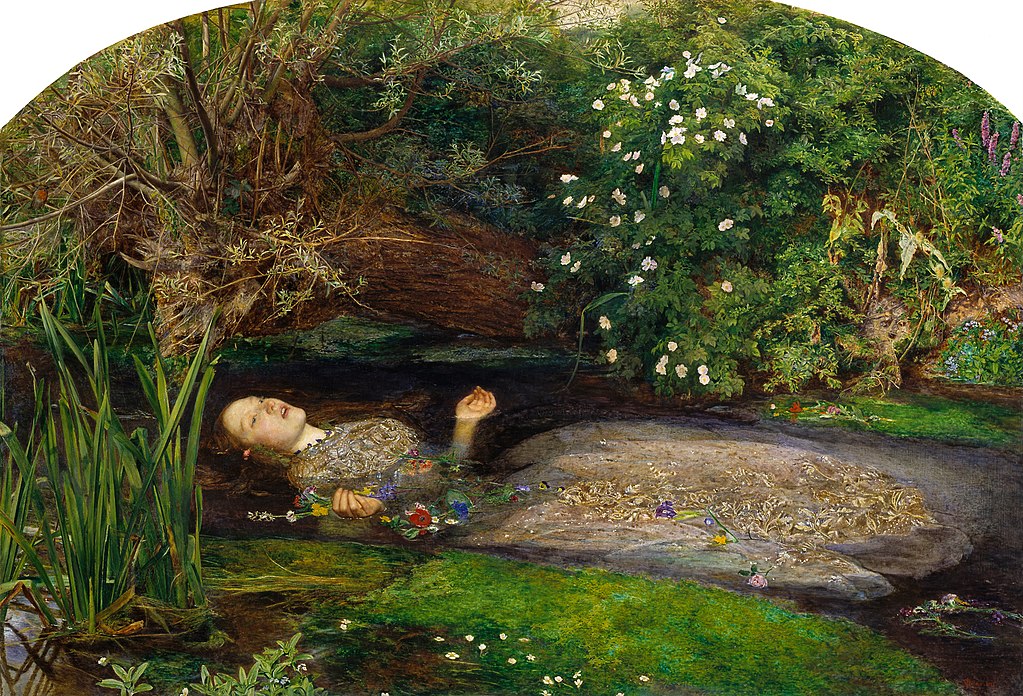
Ophelia, John Everett Millais

It's really astounding how many tragic heroines die by water. You'd think there was a handbook or something. Elaine, Ophelia, Hero, Helle - their deaths are all intimately associated with water. Helle's is particularly egregious, as the only purpose she serves in her entire story is to fall off the Ram with the Golden Fleece while he's flying over an ocean. Her brother, also riding the Ram, survives to found a royal line, but his sister just drops into the sea like someone cued her. She exists to drown. I smell a thematic necessity.

The Lady of Shalott, John William Waterhouse
It's fairly obvious at first glance why water, of all four traditional elements, is so closely identified with women. Shakespeare spells it out when Laertes mourns his sister. "Too much of water hast thou, poor Ophelia," he chokes out upon hearing of her death, "and therefore I forbid my tears." Women cry; tears are water; water is a woman's element. That makes it especially appropriate for heroines foiled in love, like Ophelia and Elaine; death by water is as good as a signed confession of love. "I drowned in the tears I shed for my lover." The Lady of Shalott dispenses even with Elaine's farewell letter; she only needs to drift down to Camelot on the river for everyone to understand that she has died for love. The symbolism of a woman in water is universal.

Hero, William Henry Rinehart
And then there's the nature of these women's characters. Water-deaths are generally performed by women who lack control of their lives. Ophelia is hounded from pillar to post by father, brother, lover and king, until her suicide becomes her only act of agency in the entire play. Hero is first aggressively wooed by Leander, then sits in her tower and lights a lamp and waits for him to swim to shore. The several Elaines in Arthurian legend make it murky which, precisely, is the one who dies for love of Lancelot, but in some versions she's not even the spunky rapist who gives birth to Galahad; in these, she tends his wound, gets summarily rejected, pines for him, and expires right after demurely stage-managing her own death to give it the proper emotional punch. And the Lady of Shalott (who I differentiate from all the zillion Elaines because, after all, Tennyson never names her, and "Shalott" is not "Astolat") is the saddest of them all, locked in her tower by the whispered threat of a curse, and doomed to death in the very moment she truly experiences life. These are women more acted upon than acting, for whom the cool calm of a watery death seems fitting.

The Death of Dido, Peter Paul Rubens
Compare them to, say, Dido, another suicide for love. But she dies by fire, and therein lies all the difference. Dido is fire; she's passionate, headstrong, determined, and impulsive. She's not the kind of woman who could float from Carthage to Rome with a passive-aggressive scroll of farewell in her languid dead hands. There is nothing passive about her. When she goes out, she makes damn sure that everyone in the vicinity knows about it. She even goes the extra mile and stabs herself on her own funeral pyre, proving her courage and her recklessness - and starting the bitter feud of Rome and Carthage at the same time. All that makes her far more intimidating than an Elaine or an Ophelia. Dido, the suicide by fire, is a dangerous femme fatale. In comparison, the other tragic heroines are far easier to swallow. They don't wreak havoc; they don't die in a grand operatic manner; they have the decency to shuffle off quietly and modestly, without causing too much fuss and drama for their menfolk. Water is acceptable; fire is, well, fire. And sensible women, even tragic heroines, don't play with fire.

Ophelia, Fernando Vazquez
But, as always, there's more to the story. Water isn't just smooth and serene. Its depths are invisible and ominous; the calm surface covers the roiling underneath. In the same way that fire provides a key to Dido's character, water tells us everything we need to know about what's really going on in the heads of the drowned heroines. These aren't emo girls who feel the need to proclaim their heartbreak at the top of their lungs. They keep everything inside, undercover, out of sight - but it doesn't mean it's not there. Sometimes it breaks free, as in Ophelia's madness; sometimes it provides a poignant emphasis to the heroine's tragic fate, like the Lady of Shalott "singing in her song" as she dies. And sometimes it drives a quiet, secretive girl like Hero to the drastic act of flinging herself out of her tower.

The water suicides make it too easy for us to take them, as we take their element, at surface value. Drama queens like Dido get all the attention, while the Ophelias and Elaines sit quietly by, holding their emotions in. But those emotions are still there. They ruffle the surface. And they offer some answers to the mysteries of these heroines.

Tuesday, March 27, 2012

Deadlier Than the Male

Last week I touched very briefly on war goddesses in the general context of "humans feel weird about war." But they're rather fascinating in their own right. For instance: what makes a culture like, say, ancient Greece produce a total badass like Athena, who's smart, gorgeous, and aggressive all in one? Or Freya, creation of the wargoing Norse, who could be Athena's twin (now with 78% more marital issues)? What's the story behind Hathor's alarming transformation into Sekhmet? Can anyone really ever explain Inanna?

Well, probably not. But I'll do my best.

Creation of the Witchblade, Stjepan Sejic
There's one thing a lot of them have in common. It's very glaring, and very weird. War goddesses are intimately entwined with violence and sex, in about equal measure. Gilgamesh's rejection of Inanna consists of him reciting to her a list of the ex-lovers she screwed over on a whim. Sekhmet, mad with bloodlust, is the dark side of beautiful, sensual Hathor. Durga and Kali, the best-known Indian warrior goddesses, are both manifestations of Parvati, the beloved wife of Shiva most closely identified with fertility and motherhood. Freya, goddess of beauty and fertility, had a temper that could shake the halls of the Aesir and got prime pick of the fallen dead, before even Odin. And Athena, let's not forget, never took vows of chastity like Artemis, and was invested enough in her own beauty to claim Eris's golden apple as her own.

The disturbing and obvious conclusion is that a sexually voracious female is dangerous. She's dangerous beyond the warning inherent in a goddess like Aphrodite, who's aggressive but kind of dumb. Subtext won't do for someone like this; it's got to be blatant text. You've got to dress her up in armor and give her a sword or a spear to make sure everyone gets the point. Danger! Danger! This incredibly hot woman is going to destroy you!

The Washer at the Ford, lindowyn-stock
It gets weirder. It's not just sexual aggression in a woman that gets portrayed as dangerous. It's femininity, period. The three aspects of the Morrigan - Macha, Badb, and Nemain - have little if anything to do with sex appeal. Yet they're still goddesses of war, individually and together. Their primary domain is the fear and frenzy of battle. The symbol of the Morrigan is still the crow, the eater of carrion. One of the ways in which Badb foreshadows death in battle is by washing the doomed soldier's clothes - a very feminine act of caretaking, become suddenly ominous in context. Macha, whose husband made her race horses while pregnant, went into labor after her win and cursed the male spectators to feel the pangs of childbirth at the most inconvenient time possible. This forced femaleness incapacitated all the men of Ulster except for Cuchulain in battle. No wonder Macha was worshiped - no one wanted to become like a woman again.

Is it safe to say that powerful women scared the men of ancient times? Sure. Is that the only reason for these origin stories? Absolutely not. If they were so scary, why are there so many of them? Why are they available to pray to as protectors and guardians? The very power that freaked people out seems to have been a fact of life. One highly feminized war goddess would be an anomaly. So many of them present an organized front of acknowledged power that any sane person, male or female, would want on their side. So maybe Athena gets vain from time to time. It doesn't mean you want her fighting against you. It doesn't matter whether Inanna ruins her lovers' lives; she's an unstoppable force that you might as well court.

Having a war goddess like you is certainly better than the alternative. Remember, these women don't just get angry when they're slighted. They know the ins and outs of bloody vengeance. If you don't want to go into labor in the middle of a duel to the death, you had better respect the hell out of them.

And maybe, the next time your wife or your mother or your sister took your clothes to the river to wash them, you'd remember the war goddesses and respect your own women, too. It couldn't have hurt.

Tuesday, February 28, 2012

The Coward's Weapon

Say I handed you a weapon. It was something completely unlike anything you'd seen before: a device that could take out an attacker before he even knew you were there. It could be wielded in complete stealth, with excellent accuracy, and it wasn't expensive to make.

I am speaking, of course, of the bow.


As long as there have been bows, there have been legends associated with them. It makes perfect sense: at heart, the bow is an impossibly miraculous weapon. It puts the rich man in armor on the same playing field as the peasant with good aim and access to a yew tree. It ensures a certain amount of protection for its wielder - a good archer can get rid of a lot of foes before they get close enough to hit him back. Legends can't ignore the bow; they're full of archers, most of them crack shots. But no one can quite make up their mind about what the weapon says about the wielder.

Mostly, anyway. There is one true cowardly archer: Paris of Troy. In a culture where courage is measured by risking life and limb in a chariot melee, the pretty boy who shoots arrows from behind his city walls is never going to get much respect. When Paris and Menelaus fight their duel over Helen, it's implicit that the bow is not an allowed weapon: real men fight face-to-face, not bow-to-shield. Paris's slaying of Achilles is hideously ironic - the greatest warrior of the age, a man who physically attacked a river and won, is killed with the weapon of a coward. It's deliciously karmic that the Greeks turn Paris's own weapon against him; his killer, Philoctetes, inherited from Heracles the bow and poisoned arrows he uses to take out Paris. But that very act takes some of the sting out of the taunting of Paris as a fraidy-cat archer. He may sleep around with another man's wife while his brothers die in the dust, but his archery was something not only to be feared, but to be emulated. Even when it's the coward's weapon, a good bow is worth having on your side.

Errol Flynn as Robin Hood, Warner Bros.
Things could only get better for the bow, and did they ever. From the moment Robin Hood shot his first arrow, the bow was enshrined in legend as the weapon of the underdog. So you can't afford a sword or chain mail or a war horse? No problem! You can go them one better. For a few hours of labor, you can make yourself an armor-piercing weapon that keeps you out of reach of a sword's edge or a horse's hooves. Rebels from William Tell to Katniss Everdeen embrace the bow's practical and symbolic value. Armed with bows, the oppressed masses are no longer defenseless. Singlehandedly, an archer can start a rebellion; get a group of Merry Men together, and you've got a full-scale coup on your hands. The sheer nature of the weapon - requiring forethought and planning - also seems to influence its wielders: legendary archers tend to be far more strategically minded than swordsmen.

Eventually, nobility is allowed to use the bow. One of the engagement challenges for the hand of Princess Yasodhara requires her suitors to string and bend a massive bow. Siddhartha, the future Buddha, calmly fires off an arrow as well, when no other suitor had even managed to string the weapon. Similarly, Odysseus is the only man who can use his own personal bow; his reclamation of kingdom and queen truly begins when he completes Penelope's impossible challenge. But the nobility is still weird about archery; both instances are the only times we see either hero use a bow, and they're relegated firmly to the arena of showmanship, with no practical side in evidence. Rama is rarely depicted without a bow, but Rama is in a strange fix: undeniably royal, he's also a prince in exile. He may be the only noble to escape without censure from the practical wartime use of a bow.

Jennifer Lawrence as Katniss Everdeen, Lionsgate
Most recently, the bow has become an oddly gendered weapon. In an unfortunate modern transposition, the "cowardly" archer has become "feminine." The two best-known archers in pop culture are Katniss and Legolas. One's a girl, one's played by Orlando Bloom. Women in stories set in or influenced by the Middle Ages have a choice of two weapons: the knife, for close work when her protection has failed, or the bow, to keep her out of danger but still enable her to please a modern audience by fighting. It's the same stigma that Paris dealt with: men don't fight from a distance, ergo men don't use bows. And the complexity of Katniss, currently the most visible archer around, means that while we admire her incredible aim and accuracy, we are always horrifyingly aware of what it costs her to use her skill to kill. She's not a good-versus-evil hero, and while her weapon represents rebellion, she's not one with it in the same way that Robin Hood is.

It's a weird full-circle situation, with the bow slipping off its rebellious pedestal into, if not ill repute, certainly a loss of luster. And it's hard to predict exactly where the bow will wind up next. But it will probably always be the weapon of revolution; its equalizing nature will never change. It will circle back around to pure uncomplicated heroism, and then around again as we remember what long-range weapons do to a gallant charge of heroes. It's a complicated weapon, and it'll probably always make us a little bit nervous.

Tuesday, January 31, 2012

Shut Up, You're Only Getting Married

What is the deal with fathers in legends? Either they're criminally neglectful and allow their second wives to mistreat their daughters, or they're stiflingly protective and would rather kill a guy than let him say boo to his baby girl. It's as if the state of being the father of an attractive young woman triggers a chemical reaction that turns even the mildest of dads into psychotic serial killers.

You think I'm kidding? The father of the Twelve Dancing Princesses killed an unspecified number of princes before the soldier came along. Forgall sent Cuchulainn to fight a deadly warrior woman before he'd let him marry Emer. Ysbaddaden practically replicated the labors of Hercules to keep Culhwch from marrying Olwen (although to be fair, that was also to preserve Ysbaddaden's own life). And then there was the total nutjob who was so opposed to the idea of his daughter having a life of her own that he locked her on top of a glass mountain. They do say your kids drive you crazy, but that is just uncalled for.

Atalanta and Melanion, John Dickson Batten
And then there's Atalanta.

Full disclosure: this girl is My Girl. I wanted to be her when I grew up. I spent hours practicing my running, hoping one day to be as fast as her. She was a bow-shooting, speed-racing, take-no-prisoners badass, and I was dazzled from day one. But even I couldn't turn a blind eye to the engagement challenge that she, not her father, dreamed up. Beat her in a race or die? There's loading the dice, and then there's not even playing.

I always thought that that absurdly cruel challenge was a power play between Atalanta and her father. "You want to marry me off? Fine. But we'll do this my way, and even then you won't really be able to pretend you've got any say in my life." Dozens of poor saps, as infatuated as I was, got sent to their deaths for something that had absolutely nothing to do with them.

Atalanta's engagement challenge is doubly unique: 1) The potential bride gets input, and 2) her input creates the challenge. The other promised girls rarely get a word in edgewise about what they think of the unnumbered men who die for their sakes. Emer slips out of a marriage proposal while she's waiting for Cuchulainn, but only because Fiance Number Two decides not to be a jerk and steal Our Hero's girl. The Twelve Dancing Princesses certainly connive at their suitors' deaths, but their actions are never judged within the story, and they never comment on how they feel about dooming these men.

The Prince Enters the Briar Wood, Edward Burne-Jones
The worst-case scenario, as in so many other things, is poor Sleeping Beauty. No one ever asks her what she wants. She exists in limbo while men die in sight of her tower. None of it is her fault - unlike Atalanta, she has no say in whether or not anyone dies - but what a lot of baggage to wake up to. The knowledge that a century of death and pain went on while you slept, unaware and unable to help, must be devastating.

Culhwch at Ysbaddaden's Court, Ernest Wallcousins
And what about someone like Olwen, where the choice is between your father's life and your future? Culhwch kills Ysbaddaden at the end of the story without a second thought, neatly getting vengeance for a broken promise, fulfilling the gimmick of the plot, and securing his task-free life with his blissful bride. Except for the bit about how he just cut her father's head off. Have fun with that in marriage counseling. Would Olwen be happy with Culhwch, who after all is brave and stubborn enough to fulfill her father's insane challenges, or would she prefer to have her dad alive? Or was there someone else she'd rather have married? Or did she want to get married at all? No one ever asks.

The fulfillment of the challenge is always treated as the bride's answer: of course she'll marry the hero! He's jumped through all these hoops for her sake! It would be a total bitch move, not to mention anticlimactic, if she refused him! No one wonders what life would be like, married to a prince who happened by the castle on the right day, or to a guy who'd let her dad get flayed and beheaded, or to a girl who'd have sent you to die without regrets if you hadn't happened to toss her a few shiny apples. Sometimes the story goes out of its way to prove that there will be a happy ending: Olwen does in fact fall in love with Culhwch, Emer holds out for Cuchulainn, Atalanta and Hippomenes actually get busted by the gods for having too much sex. But what about the soldier, married to a Dancing Princess who wanted him dead? What about Sleeping Beauty and the prince from another century? What about all the rescued princesses who get handed over to whatever schlub pries them free from the dragon, or the wizard, or the sacrificial knife?

Brides are mute. No one's interested in what they have to say, unless they're a wild card like Atalanta, and the most even she can do is amend the engagement challenge rather than dispense with it completely. When brides try to have a say in their future, it's disregarded. The most Olwen can do to help Culhwch is to get him an audience with Ysbaddaden, at which the men do all the talking despite Olwen's presence; after that, she has to sit around and wait for outside factors to decide her fate. Sleeping Beauty's castle throws a wedding party about ten seconds after waking up. Spell or no spell, that is no way to treat a disoriented teenager in the grip of someone else's will (in this case, the goddamn fairy who was supposed to fix her life). We know it'll work out; we flipped to the end and saw "Happily Ever After." But the implications of the silencing of the women at the moment of crucial choice are terrifying. A fairytale bride's entire culture conspires jointly to shut her up at the very moment when her voice should be heard. And this is the happy ending.

For extra weirdness, often the stated reason for an engagement challenge is to ensure that the prospective bride's husband is "worthy of her." If you care so much about your daughter's welfare and happiness, wouldn't it make more sense to ask her what she thinks?