Showing posts with label marriage. Show all posts

Saturday, December 22, 2012

A Love Letter to Bigamists

Right off the bat, you need to know that the Snow White story has never done much for me. This may have something to do with being traumatized before age 6 by the re-release of the Disney version (the transformation scene, oh my god), but it's also deeply rooted in my disdain for heroines who don't do anything, and distrust of stories that hold them up as role models. By now you should know that I'll take Kate Crackernuts over the fairest of them all any day of the week.

Which makes it odd that a Snow White variant is among my favorite fairy tales of all time.

Silver-tree, John Batten
"Gold-tree and Silver-tree" is different from the classic version, though, in all the ways that matter. The Scots felt no need to whitewash the mother's murderous designs on her biological daughter; Silver-tree, the evil queen, even couches her single successful plot in a false solicitude for Gold-tree's well-being. Gold-tree has a modicum of sense; when she sees Silver-tree's ship coming for her, she knows perfectly well that her mother wants to kill her, and that she needs to hide. But the biggest difference, and the reason why I love this version, lies in the actions of the prince.

In the Grimms' Snow White, the prince is at best a moron and at worst a necrophiliac. Either way, he is primarily a plot device. And in "Gold-tree and Silver-tree," that's exactly how he starts out. Right after Silver-tree finds out that Gold-tree is more beautiful than she is, up rides the prince, seeking Gold-tree's hand in marriage. Problem solved: Gold-tree marries the prince, her father slips Silver-tree a goat's heart, and for bonus points, Gold-tree and the prince actually fall in love. Everything's perfect until Silver-tree realizes that Gold-tree's alive, sticks a poisoned dart in her finger, and sails back home, presumably cackling all the way.

Death of Gold-tree, Michelle Hunt
Point one in the prince's favor: He doesn't try to kiss, sleep with, or otherwise perform acts of dubious consensuality on the seemingly-dead body of his wife. (He does keep her unblemished corpse in a locked room, but he can't really be blamed for that, since it's plot-relevant and he's grieving for his lost love. At least, I cut him some slack on that. And I bet poor Talia would, too.)

And then things get really interesting. The prince remarries.

So. It's a fairy tale. We already know that Gold-tree's not really dead. But no one in the story does. This may be the one and only time where I'm glad to see characters not operating in full awareness of fairy tale logic. I'll pull out my hair and scream at clueless third brothers and innocent girls victimized by their stepsisters, wondering why the hell they don't wise up. But here, I'm completely on board, because what's happening is that real-life logic is superseding fairy tale logic. Of course the prince would remarry. He's a prince, and he didn't have any kids with Gold-tree. It's his job, regardless of the fact that he still mourns the woman he loved.

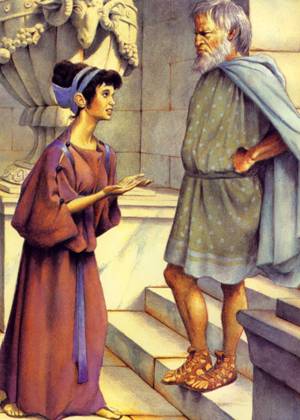
Gold-tree, Morris Meredith Williams
And then, he wins my undying love, because his second wife is a complete and total badass. When he forgets to take the key to Gold-tree's locked room, she Bluebeards in there and finds the body of her predecessor. Does she go all "other woman" on poor defenseless Gold-tree? Does she cook her in a stew? Does she confront her husband about the near-literal skeleton in his closet?

Nope. She just takes out the poisoned dart. And when the prince gets home, she tells him right away, "Hey, I woke up your first wife, and you obviously still love her, so I'll just peace out and let you two lovebirds get back together." Is there anyone else in fairy tales who freely walks away from a love conflict with sincere goodwill? Is there anyone in the real world who can do that? The second wife basically thumbs her nose at fairy tale convention, while at the same time making us desperate to keep her around. I love her for it.

Two Princesses, One Prince, V-Eclipse
Point two in the prince's favor: He made a very intelligent second marriage.

Point three in the prince's favor: As soon as the second wife offers to step out, he refuses to let her. She says she'll go away. His exact words in reply? "Oh! indeed you shall not go away, but I shall have both of you."

This guy is so cool. Maybe not smart enough to just take the dart out of his first wife's finger, but totally smart enough to marry a woman with brains, to value her for her intelligence, and to let his first and second loves know that he cherishes them both equally.

It's hardly conventional, either in fairy tales or in the world we live in. But I have to think that this is one awesome three-way marriage. No one is superior: Gold-tree owes her life to the second wife, who owes her continued place to the prince, who owes his happiness to both of them. It's impossible to feel like anyone's an interloper here, because they all play integral parts in the relationship. Plus we get to keep the smart girl on the heroes' team. This is a total win for everyone involved.

The clincher of it all, vindicating the prince's unconventional decision, is that the second wife is solely responsible for the death of Silver-tree (remember her?). Once again, Silver-tree hears that Gold-tree's alive and comes back for more murder. Gold-tree's initial instinct - to flee, again - is firmly countermanded by the second wife, who gets them both down on the beach to say hello. Silver-tree offers Gold-tree a cup laced with poison, pulling the caring-mother card yet again in front of witnesses. Cool as a cucumber, the second wife retorts that she doesn't know where you come from, honey, but in this country the person offering a drink takes a sip first, I mean really, where are your manners. And when Silver-tree pretends to drink, the second wife just smacks the bottom of the cup so that the poison goes straight into the would-be murderess's mouth. Call me crazy, but I think that's even more karmic than Snow White's stepmother dancing to death in red-hot iron shoes. It's quick, it's elegant, and it's not nearly as grotesque.

The Two Princesses of Bamarre, eala-nedea
This is a fairy tale where real-world rules also apply. Sure, there's a talking trout and some confusion over the actual fact of death. There's also unvarnished mother-daughter darkness, the irreplaceable value of second love, and perhaps the most unconventional marriage fairy tales have to offer, portrayed in unambiguously glowing terms. I've never read a fairy tale quite like this one. With the exception of the Beauty and the Beast variants, I've never seen more interesting romantic dynamics. It's a lot more complicated and compelling than "someday my prince will come."

And it's subversive as hell. It pokes fun at the passive heroine. It giggles at the genre's conventions. A secondary character steals center stage halfway through, and the reader never looks back. It never punishes its heroes for their atypical choices, and in fact rewards the unexpected over the standard. Fairy tales exist to reinforce the status quo. But by the end of this one, you're cheering for the triumph of true love expressed through bigamy. That is gutsy like nobody's business. And more than anything else, I love this story for that very fact: that it stakes out its territory, takes a stand, and refuses to back down.

If only we could get Snow White to read it...

Thursday, June 21, 2012

You're Grounded, Young Lady

Unsurprisingly for a man who wrote one of his two surviving daughters out of his will, Shakespeare's plays are full of girls with daddy issues. Hermia, Ophelia, Kate, Hero, Miranda, Cordelia and the terrible twosome, and that's without opening a book. Regardless of whether they're shrews or angels, every heroine whose father appears onstage gets put through the wringer, often in ways deliberately designed to test her relationship with her father. And sometimes it's hard to say who suffers more, the daughter or her father.

King Lear and His Three Daughters, William Hilton
Take the obvious example, King Lear. The body count in this play would be ridiculous if it wasn't so devastating. Lear, trying vainly to hold onto the trappings of power (both political and fatherly) without actually doing his job, endures more excruciating onstage agony than any other Shakespearean character. Goneril and Regan delight in backstabbing their trusting father, only to fight to the death over a man even worse than they are. Cordelia gets punished and exiled for being honest, loses a battle even with right on her side, and is strangled in prison a few hours after being reunited with her sadder-but-wiser father. The play might as well be called Ye Olde Daddy Issues. It's really, really hard to say who gets the rawest deal.

King Lear is perhaps the best illustration of Shakespeare's view of the father/daughter relationship at its worst. From Lear to Polonius to Baptista Minola, Shakespearean fathers have an incredibly hard time letting their daughters grow up. And when, inevitably, they do, both father and daughter suffer from the father's deliberate refusal to give his daughter agency in her own life. You can play it for comedy: Baptista really wishes Kate would just get married and get out of his house. You can play it for tragedy: Polonius brutally squashes Ophelia's timid attempts to make her own decisions about her love life, leading directly to his murder and her insanity. And given that it's Shakespeare, you can even play it for weird dark laughs: if Hermia doesn't marry the man Egeus wants her to marry, he's perfectly happy to let her be ritually sacrificed.

In every case, the fathers know exactly what they want their daughters to grow up into. When the daughters get their own ideas about who they want to be, the fathers uniformly lose their marbles. Baptista forces Kate into marriage with a hilarious and terrifying abuser. Cymbeline banishes Imogen from England when her secret love-match with Posthumus comes to light. Lord Capulet threatens to let 13-year-old Juliet starve to death unless she marries his choice of husband. And most horrifically, Leonato wishes death on Hero to her face at the first hint that she might not be a perfect human being. (Hero, as always, gets dealt the worst hand ever: she alone didn't actually do the thing her father reviles her for.)

Prospero and Miranda, William May Egley
Mercifully, for us and possibly also for Shakespeare's daughters, it's not all bad. Among all the chaos, one father/daughter relationship stands out as sweet and touching. Prospero and Miranda's relationship is the most important one in The Tempest. It's for his daughter's sake that Prospero engineers the entire plot; he doesn't want her to grow up isolated and ignorant of her rightful heritage. Their first scene together is tender and funny by turns, and Prospero uses the most loving language of any Shakespearean father for a daughter. Miranda, for her part, is still very young, running to her father to fix all the wrongs in her world - but she also teases him for his long-winded story, and even in her instant attraction to Ferdinand is hesitant to cross Prospero's will.

Ferdinand and Miranda, Paul Falconer Poole
But even Prospero finds it hard to let go. He makes very clear - to the audience, if not to Miranda - that he has planned her meeting with Ferdinand specifically to restore her to power and luxury. He exults to himself and to Ariel about the success of this scheme. And he throws as many roadblocks as possible in the way of his daughter's burgeoning love, and the womanhood that comes with it. His excuse is that Ferdinand may not cherish Miranda as he should if he wins her too easily. But it's hard not to see in him the master manipulator's petty glee as he turns the man who would take away his daughter into his own personal slave. (Not to mention that his pro-chastity speech would terrify any prospective son-in-law.) At the beginning of the play, Prospero is not above casually putting Miranda into a magical sleep to get her out of the way. His struggle to rise above himself and renounce his eerie powers is also a struggle to let his daughter live her own life.

Claudio, Deceived by Don John, Accuses Hero, Marcus Stone
Luckily for Prospero, Miranda's about as perfect as you can get. She jumps enthusiastically at his plan for her, which helps to ease the uncomfortable feeling that she's still doing just what he wants; it also happens to be what she wants. Other daughters, even seemingly perfect ones, don't cooperate. Sweet Bianca is revealed to be as willful and more manipulative than her sister Kate. Juliet's defiance of her father comes as a true shock to parents accustomed to dictating orders. Lear gets bit twice: first Cordelia refuses to play his game, then Goneril and Regan change the rules without informing him. And even cooperation isn't a sure bet; Ophelia winds up an insane suicide for her trouble.

The only ones who manage to survive the gauntlet with their relationship even a little intact are the fathers and daughters who let each other go. Prospero and Miranda will probably always adore each other; long-suffering Hero forgives her alarming father and her appalling fiance; Cymbeline, faced with Imogen's sheer guts, has the grace to realize that he can't put her back in a box she's already broken out of. The fathers who cling to their own visions for their daughters' future actually destroy it. And the harder they hold on, the harder the girls fight to be free, and everyone gets hurt much, much worse.

Tuesday, April 3, 2012

Dancing with the Stars

I talk about the Twelve Dancing Princesses quite a bit on this blog. What I haven't yet confessed is that I have a real soft spot for the story, quite beyond the wish-fulfillment fantasy of being a princess who gets to wear spiffy new shoes and dance with a prince every night.

The Soldier, Clive Hicks Jenkins
The unnamed soldier who drives the story is my favorite fairy tale hero. Only the Beast rivals him in my affections. Prince Charming and all his ilk can scram. Give me a tricksy thinker any day of the week.

Why the soldier? Why a nameless late-arrival in a lesser-known fairy tale? Why a guy Disney hasn't supplied with a swoony animated face? Partly for the same reason that Beauty and the Beast is my favorite fairy tale: the complexity of his character, hinted at subtly but in every version I've ever heard. And partly because he's just awesome.

The fairy tale canon is stuffed to overflowing with heroes who are heroic because it's what they're supposed to do. Why does Cinderella's prince scour the kingdom for the girl with the tiny feet? Why does Sleeping Beauty's prince brave a gruesome death to save a girl he's never even seen? Why does Aladdin do anything? Because they're heroes. They know what's expected of them just like we do. They read their script, and they're going to perform the hell out of it, and no one needs to ask any questions.

The soldier is different. He's got motivation. He's a commoner who sees a chance to rise in the world - a near-impossible thing, given his position in a society hierarchical enough for the Princesses' father to permit only princes to investigate his daughters. Sometimes I've seen him played or written as wounded, which means his only form of income is gone. In the more draconian versions, where failed candidates get executed, the soldier is literally on his last chance. Solving the Princesses' mystery is the only path to survival open to him.

The Twelve Dancing Princesses, Anne Anderson
Be honest: in his situation, you'd allow yourself some time to panic, hyperventilate, engage in self-doubt, etc., yes? (I would, too. It's okay.) But this is where the soldier earns his stripes as a hero. He doesn't do any of that. He gets to the palace, persuades the king to let him have a go, and becomes goal-oriented like you wouldn't believe. He's three steps ahead of everyone, including the clever Eldest Princess who's been running circles around the rest of the palace chumps. After successfully tracking the Princesses on the very first night, instead of spilling the beans in a fit of glee, he has the sense to take all his allotted time to gather a whole mess of irrefutable proof. And during the day, he deploys his champion poker face to keep the Princesses from being suspicious, while probably courting them into the bargain (now that he knows he's going to win).

I don't care what you say. He is the textbook definition of cool.

Granted, if all we ever saw him do was track a bunch of girls through the woods at night, I'd be more concerned. But the very first time we meet him, we receive ample proof of his awesomeness. Remember, he's extremely down on his luck. No profession, no money, no prospect of long life and happiness. And yet he shares his lunch with a poor woman who has even less than he does. Was anyone surprised when she turned out to be one of those good witches who crisscrosses Fairy Tale Land rewarding good guys? Those characters exist for people like the soldier: unassuming decent people who just need one push in the right direction to turn their lives around.

Plus, there's that hilarious ending to one of the variants where, given his choice of bride among the Princesses, the soldier picks the Eldest Princess because neither of them are spring chickens and will suit each other best. Clever, pragmatic, and snarky? Sign me up! (Confession: I always think he marries the Eldest Princess anyway, regardless of their ages. The Youngest Princess - who, let's face it, is the only other real option - does nothing but squeal when he steps on her dress. The Eldest Princess is almost as smart and cunning as the soldier himself. They would suit each other best.)

There's just no one quite like him. For wit, quick thinking, sense, and goodness, no hero rivals the soldier. He's a self-made man in a universe that thrives on the status quo. He relies on his own talents and ambition - and of course, the charm that makes people like me fall head over heels for him. He is the complete package, and part of the fun of reading his story is learning just how much he deserves the good fortune that he earns.

Thursday, March 8, 2012

Give a Girl a Break

The Peacock Complaining to Juno, Gustave Moreau
As every Greek myth will tell you ad nauseam, Zeus's wife Hera is one jealous meanie. She's territorial to the point of obsession, with a nasty vengeful streak and a vivid imagination. The queen of the gods is, to put it bluntly, a cow.

All of which is true. As gods go, she's one of the worst to cross. (Only Artemis really equals her in terms of vicious retribution. The men, in contrast to either woman, are sissies who can't deal out pain.) But the classic portrait of her is rather one-sided. She deserves far more of a break than she gets.

Why, you ask? Well, let's start off with some early childhood trauma. The girl was swallowed whole and alive by her father at the moment of her birth. And stayed alive, in his stomach, until her littlest brother was ballsy enough to fight back. That right there should win our sympathy.

Oh, and that littlest brother? With a woman already on his arm (Metis, mother of Athena and all-around badass herself), Zeus decided to sleep with his older sisters. Demeter said yes, which is how we get Persephone; Hestia just snorted and went back to her fire; Hera flat-out
Hera and Zeus, Jun-Pierre Shiozawa
refused him. Zeus, selfish even then, would not let this stand. His solution? He made a thunderstorm, turned himself into a bird, and flew to Hera for shelter. Moved by pity, she cuddled the bird close, when all of a sudden - whoops! It's Zeus, and it looks like he just moved you both into Rapetown-on-Incest.

Who else thinks that the subsequent wedding of Zeus and Hera must have been the most awkward event ever?

Right now, we've got a plucky young goddess who survived life inside Dad's belly, only to be claimed as spoils by her liberator. At this point, Hera does one of two things. Either she decides that she might as well make good on what she's got, or she decides to spend her whole life avenging herself on the bastard brother who dealt her this crappy hand. It depends on your interpretation, really, but it's understandable either way. She can be admirable for doing her best, or she can be tragic in the same way as Macbeth. Whichever you prefer, it makes her a far more interesting character than a cardboard villainess.

Hera Imprisons Io, Ingri and Edgar d'Aulaire
I can never make up my mind about her choice there. When you consider the outright torture she perpetrates on Zeus's other conquests - keeping Io a cow, inciting Semele to arrange her own death, screwing up Heracles's entire life with vindictive abandon - it's easy to think that this is a woman consumed by vengeance, with no pity or sympathy left in her. But then you run into her relationship with her son Hephaestus, who backed her in a fight with Zeus at incredible bodily cost to himself. And her patronage of Jason is downright tender during the quest for the Golden Fleece, and lasts all the way until he throws Medea over. (And come on, Jason - did you really think Hera, of all goddesses, would support a cheater?)

And then there's the hilarious, but also touching, scene in the Iliad where Hera seduces Zeus to distract him from the fighting so Poseidon can help the Greeks. His opening gambit is to recite a list of women he's slept with, something usually guaranteed to send Hera into a rage. But
Jupiter and Juno on Mount Ida,
James Barry
then he tells her that of all of those women, none of them - not even Hera herself, way back when he pulled the wet-bird trick - was as beautiful and enticing as she is now. And then he makes a move that even I get a little swoony over: he takes her to Mount Ida and wraps them both in a golden cloud through which no one can see their lovemaking. Granted, Hera's motivated here by resentment at Zeus for not allowing the gods to interfere with Troy; granted, Zeus does not start out as the smoothest of operators. But it's bizarrely sweet, after all these tales where you assume it's a hellish marriage of a philanderer and a shrew, to see that Zeus at least has strong feelings for his wife, and that she is well aware of them. Later, when Zeus wakes up and sees Poseidon running rampant, he blames Hera; she swears her innocence by their marriage bed, a vow she says she would never make falsely. Despite their horrible beginning, there's something there that's important to them both.

Juno Ludovisi, artist unknown
And if Hera does care for Zeus, in spite of it all, it explains why she pursues his mistresses with such rabid hatred. She might not like the fact that she cares about her lousy husband, which means she might find it difficult to admit to his face. For a woman whose adult life was inexorably shaped by trauma, the kind of abuse Hera inflicts on her "rivals" might be the psychologically safest way for her to express love.

It doesn't make it right, and I still feel awful for poor innocents like Semele. But it does make more of Hera than she usually gets. And she gets so little that there's got to be some parts of the story missing.

Tuesday, January 31, 2012

Shut Up, You're Only Getting Married

What is the deal with fathers in legends? Either they're criminally neglectful and allow their second wives to mistreat their daughters, or they're stiflingly protective and would rather kill a guy than let him say boo to his baby girl. It's as if the state of being the father of an attractive young woman triggers a chemical reaction that turns even the mildest of dads into psychotic serial killers.

You think I'm kidding? The father of the Twelve Dancing Princesses killed an unspecified number of princes before the soldier came along. Forgall sent Cuchulainn to fight a deadly warrior woman before he'd let him marry Emer. Ysbaddaden practically replicated the labors of Hercules to keep Culhwch from marrying Olwen (although to be fair, that was also to preserve Ysbaddaden's own life). And then there was the total nutjob who was so opposed to the idea of his daughter having a life of her own that he locked her on top of a glass mountain. They do say your kids drive you crazy, but that is just uncalled for.

Atalanta and Melanion, John Dickson Batten
And then there's Atalanta.

Full disclosure: this girl is My Girl. I wanted to be her when I grew up. I spent hours practicing my running, hoping one day to be as fast as her. She was a bow-shooting, speed-racing, take-no-prisoners badass, and I was dazzled from day one. But even I couldn't turn a blind eye to the engagement challenge that she, not her father, dreamed up. Beat her in a race or die? There's loading the dice, and then there's not even playing.

I always thought that that absurdly cruel challenge was a power play between Atalanta and her father. "You want to marry me off? Fine. But we'll do this my way, and even then you won't really be able to pretend you've got any say in my life." Dozens of poor saps, as infatuated as I was, got sent to their deaths for something that had absolutely nothing to do with them.

Atalanta's engagement challenge is doubly unique: 1) The potential bride gets input, and 2) her input creates the challenge. The other promised girls rarely get a word in edgewise about what they think of the unnumbered men who die for their sakes. Emer slips out of a marriage proposal while she's waiting for Cuchulainn, but only because Fiance Number Two decides not to be a jerk and steal Our Hero's girl. The Twelve Dancing Princesses certainly connive at their suitors' deaths, but their actions are never judged within the story, and they never comment on how they feel about dooming these men.

The Prince Enters the Briar Wood, Edward Burne-Jones
The worst-case scenario, as in so many other things, is poor Sleeping Beauty. No one ever asks her what she wants. She exists in limbo while men die in sight of her tower. None of it is her fault - unlike Atalanta, she has no say in whether or not anyone dies - but what a lot of baggage to wake up to. The knowledge that a century of death and pain went on while you slept, unaware and unable to help, must be devastating.

Culhwch at Ysbaddaden's Court, Ernest Wallcousins
And what about someone like Olwen, where the choice is between your father's life and your future? Culhwch kills Ysbaddaden at the end of the story without a second thought, neatly getting vengeance for a broken promise, fulfilling the gimmick of the plot, and securing his task-free life with his blissful bride. Except for the bit about how he just cut her father's head off. Have fun with that in marriage counseling. Would Olwen be happy with Culhwch, who after all is brave and stubborn enough to fulfill her father's insane challenges, or would she prefer to have her dad alive? Or was there someone else she'd rather have married? Or did she want to get married at all? No one ever asks.

The fulfillment of the challenge is always treated as the bride's answer: of course she'll marry the hero! He's jumped through all these hoops for her sake! It would be a total bitch move, not to mention anticlimactic, if she refused him! No one wonders what life would be like, married to a prince who happened by the castle on the right day, or to a guy who'd let her dad get flayed and beheaded, or to a girl who'd have sent you to die without regrets if you hadn't happened to toss her a few shiny apples. Sometimes the story goes out of its way to prove that there will be a happy ending: Olwen does in fact fall in love with Culhwch, Emer holds out for Cuchulainn, Atalanta and Hippomenes actually get busted by the gods for having too much sex. But what about the soldier, married to a Dancing Princess who wanted him dead? What about Sleeping Beauty and the prince from another century? What about all the rescued princesses who get handed over to whatever schlub pries them free from the dragon, or the wizard, or the sacrificial knife?

Brides are mute. No one's interested in what they have to say, unless they're a wild card like Atalanta, and the most even she can do is amend the engagement challenge rather than dispense with it completely. When brides try to have a say in their future, it's disregarded. The most Olwen can do to help Culhwch is to get him an audience with Ysbaddaden, at which the men do all the talking despite Olwen's presence; after that, she has to sit around and wait for outside factors to decide her fate. Sleeping Beauty's castle throws a wedding party about ten seconds after waking up. Spell or no spell, that is no way to treat a disoriented teenager in the grip of someone else's will (in this case, the goddamn fairy who was supposed to fix her life). We know it'll work out; we flipped to the end and saw "Happily Ever After." But the implications of the silencing of the women at the moment of crucial choice are terrifying. A fairytale bride's entire culture conspires jointly to shut her up at the very moment when her voice should be heard. And this is the happy ending.

For extra weirdness, often the stated reason for an engagement challenge is to ensure that the prospective bride's husband is "worthy of her." If you care so much about your daughter's welfare and happiness, wouldn't it make more sense to ask her what she thinks?