Showing posts with label knights. Show all posts

Thursday, October 4, 2012

Revisiting Lancelot

Sir Lancelot, Melissa A. Benson
Is it just me, or is Lancelot kind of boring?

Because really, you can only hear "best knight in the world" so many times before you get sick of both the phrase and the person it describes. From his intro to his elegantly repenting death, Lancelot is so perfect it's disgusting. He usurps the stories the second he appears; his arrival at Camelot signals the transition from "exploits of Arthur the warrior king" to "loosely connected vignettes mostly centering on this new French guy." There's no enemy who can face him, and no woman who can avoid falling head over heels the second she sees his exquisite yet manly face. He does exactly one thing wrong in his entire life, and even that had a certain inevitability to it: of course the world's most beautiful woman is going to fall for the best knight.

It's even written into the legends that Lancelot nauseates his fellow knights, who understandably don't get the joke the seventeenth time Monsieur Perfect knocks them out of their saddles. (While in disguise. And then rides away like tournaments are beneath him, when he obviously cares enough to joust in them.) Let's not forget how easy it was for Mordred to gather a band of disaffected knights to surprise him in Guinevere's chamber. Dude did not have a huge fan club.

So here's the thing. If we accept that it's very easy to get bored with Lancelot, the question that never gets asked is: why?

Sort of redundant, yes? Didn't I just answer it?

The Sword of Lancelot, Howard David Johnson
Well, yes and no. Take a step back from the stories. Look at them as plot alone. Lancelot is incredible. Remember what I said a few paragraphs above about how no enemy can face him? No enemy can face him. He goes up against knights who make careers of killing for fun, and he routinely destroys them. He does unspeakable things to ideas like "hopeless situation" and "no way out." When the woman he loves is in danger, he morphs into this amazing cross between James Bond and Superman, traveling incognito, busting up everything but his beloved during the rescue, and fighting the abductor with one hand tied behind his back because honor demands it. And he still splits this guy's head open. There is a reason this man is described as the best knight in the world. And it is because he is the best knight in the world.

One could argue that if it weren't for everyone else's insistence on his perfection, Lancelot would be seen not as irreparably fallen and kind of bland, but as the badass to end all badasses. I'd bet on him versus anyone. Batman? Please. Darth Vader? Don't make me laugh. Lancelot could take out Jaws if he wanted to. Without even using a boat.

Gawain and the Green Knight, David Hitchcock
Look at Gawain, another badass from the same cycle, and another owner of the "best in show" title (before Lancelot came along, that is). No sissy perfection for Gawain. He runs headlong into danger, carried away by his impulses, and he too wins more than should be humanly possible. But he (and his authors) aren't nearly as obsessed with his perfection as Lancelot. Sure, "Sir Gawain and the Green Knight" takes valuable time out of the quest shenanigans to explain why his pentangle shield is the most sacred thing ever, but it's really just ironic foreshadowing of Gawain's ultimate failure. He carries the perfect shield, but the knight it guards is only human.

Sound familiar? Perfect knight, fatal weakness, inevitable fall... It's the same story as Lancelot's ill-fated romance with Guinevere. On the outside, he is all that a knight should be; inside, he knows himself to be unworthy.

The difference between them, though, is that Gawain moves on. Humiliated and angry with himself, he tells all of Camelot about his disgrace. But Arthur, demonstrating exactly why he's awesome, gently reminds Gawain of his many accomplishments over the course of the quest, not least of which is the fact that the Green Knight honored him enough to leave him alive. Arthur takes it a step further by declaring that Gawain's green garter, until now a badge of shame, will be regarded by all as a symbol of Gawain's honor and courage in revealing his own weakness.

For obvious reasons, Lancelot cannot do the same. But that's a cop-out, because of course Arthur isn't stupid and already knows about Guinevere. Gawain's declaration allows him to get his failure off his chest, and in fact helps him reclaim the honor he thought he had lost; Lancelot's unwillingness to jeopardize that very same appearance of honor dooms him to cling to his sin. With no expiation, it festers, becoming the central facet of his character, while Gawain is able to grow beyond his misdeed.

So in addition to being the biggest badass at the Round Table, Lancelot's also got the most emotional turmoil of anyone (except maybe Arthur). Constantly aware of the hypocrisy on which his life is built, hating himself but loving Guinevere more, he has the most fascinating inner life of all the knights. He is a man desperate for perfection who can't help clinging to his one flaw. And he knows it the whole time. He is never allowed a moment to forget the contradiction of himself. He wrestles with it every single day, and always comes back with the same answer: he is not strong enough to reject what is at once the best and worst thing in his life.

He's not just a badass. He's a relatable badass.
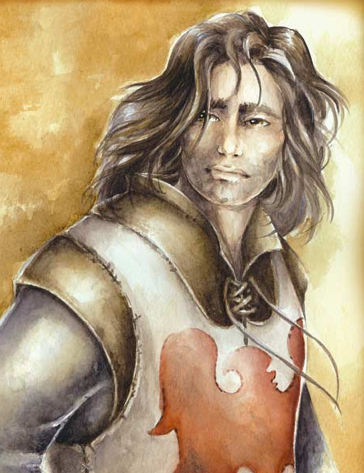
Lancelot of the Lake, Delphine Gache
Everyone knows about the struggle to succeed; everyone understands the unexpected roadblocks that get in the way; everyone knows how bitter failure tastes. Lancelot's story is the story of every time we couldn't make something better. He is universal and human like no other character in the entire cycle.

I think it's time we reclaimed Lancelot. It's not going to be easy; his character forms around the very thing that holds him back. But we can definitely start celebrating his feats of arms as the ridiculously awesome career that they are. We can see the good as well as the sinful in his love for Guinevere; it's hard to do justice to the man when we keep dismissing and belittling the passion for which he sacrificed his soul. And instead of complaining about how boring he is, we - and I include myself here - can instead start asking why, for hundreds and hundreds of years, we've kept coming back to his story and finding things in it that touch our hearts.

Tuesday, June 26, 2012

Chivalry in Skirts

Arthurian legend has no shortage of uppity women. From Guinevere to Nimue to Morgan le Fay, the legends abound with damsels and ladies who know their own minds, set their own goals, and aren't afraid to admit their ambitions. Unfortunately, most of them get absolutely squashed. Whether by outside interference or their own backfiring machinations, scarcely a go-getting Arthurian lady gets what she came for.

So it stands to reason that when one of them does, she is vividly remembered.

Linette, the razor-tongued sister of Lady Lionors, is unique among the ladies of Arthuriana not only because she gets everything she set out to get, but because she is one of the only successful cases of character development in the legends. So many characters spring to life already equipped with their defining personality traits: Lancelot is noble and has a guilt complex, Mordred is evil and scheming, Merlin is wise, Guinevere is beautiful and capricious. We see Arthur develop in the early going from impulsive youth to mature and just king, but he's pretty much the only one.

Sir Gareth and Lady Lynette, Arthur Rackham
Besides Linette. We first meet her when she demands a champion from the king while refusing to give her name, the name of her sister (for whom she's requesting said champion), or even the common courtesy due to another person. When Gareth, incognito as a kitchen boy, calls in the favors Arthur owes him and claims her quest as his, she spits out a few choice insults and rides in high dudgeon from the court. Undaunted, Gareth catches up; equally unfazed, Linette proceeds to blister the air for days with details of his idiocy, his inadequacy, and his incapability to survive a poke, let alone a series of one-on-one combats. There is literally no reason at all to like her.

And then she gets her wake-up call. The second of four knights that Gareth trounces is a real gentleman, inviting his ex-foe and his companions to dinner. Linette does her usual awful shtick; unlike Gareth (who handles his crappy damsel with true chivalry), the defeated knight calls her on it. And suddenly Linette realizes she's been a complete hag to the one man who was willing to help her sister.

For comparison: Lancelot gets a similar wake-up call on the Grail Quest, when his sinful love for Guinevere bars him even from seeing the Grail. He gets the message loud and clear. He is the greatest earthly knight in the world; he knows just how badly he failed. And when he gets back to Camelot, he promptly forgets all about it.

La Belle Dame Sans Merci, Frank Dicksee
Not Linette. The very next day she apologizes to Gareth. When he fights his next foe, she acts as his own personal cheerleading squad; it's her cry of support that energizes him when he was ready to give up. The most atrociously snobby character in Arthuriana becomes, in the space of a few paragraphs, one of the most endearingly human: she recognizes her fault and takes every possible step to amend it. Some versions (Tennyson's among them) even end with Gareth marrying Linette, rather than her beautiful and anonymous sister to whose rescue he rode.

So what gives? Why does Linette get off with a scolding, while other ambitious women get utterly broken? Morgan le Fay is foiled, exposed, and vilified. Guinevere is disgraced and often portrayed as a jealous shrew. The Lady of the Lake gets her head chopped off by Balin, who offers a deeply insufficient excuse: "She was a witch!" Geraint's wife Enid, as haughty and outspoken as Linette, is mocked by her neighbors, verbally abused by her husband, and threatened with rape on multiple occasions. In
The Lady Lyonors, Katharine Cameron
contrast, Linette's only real peers are Lady Ragnell, who also takes her fate into her own hands and is amply rewarded, and her own sister Lionors, who concocts a scheme to expose Gareth's identity before she'll marry him. Unlike her sister, Lionors' uppityness is very subversive; Linette wears her heart on her sleeve, while Lionors hides her quick wits behind a frigid courtly mask and bids to control her own life behind the scenes. Neither sister suffers in any material way for daring to shape their destinies.

The answer to their mysterious get-out-of-jail-free cards lies in their circumstances. The women punished for their ambition all have men to speak for them. Guinevere's duty is to be true to Arthur; Morgan is actually married, and supposed to be subordinate to her husband, when she concocts her deadliest plots against her brother; Enid's troubles stem from her flouting of her owed obedience to husband and father. Even the Lady of the Lake uses Merlin as intercessor with Arthur; her death is the end result of the one time she came on her own. Their downfalls come about because they disregard the rules of the world they live in.

Erec and Enide, Rowland Wheelwright
But the social order and the chivalric code have utterly failed all the successful uppity ladies. Linette and Lionors are trapped by a pack of rogue knights no one challenges; Ragnell's own brother has turned against her. No one speaks for them; no one is coming to their rescue. Lacking any socially-expected champion, these women have to stand up for themselves in order to survive. In extremis, it's not only okay to own your fate - it's actually celebrated.

In that sense, Linette and her fellows are actually playing the roles of knights-errant, filling in the gaps of an idealistic system put into practice by flawed human beings. They know exactly what's due to them, they know why they're not getting it, and they possess the wit and courage to get it for themselves when the system fails. They operate within that system, fixing it as best they can, and upholding the very social order they seem, at first glance, to subvert.

Someone get these girls a couple of chairs at the Round Table.

Thursday, April 19, 2012

The Problem With Gawain

I have a problem. It's very serious. Ladies and gentlemen, I confess to you all that I am a Gawainaholic.

You wouldn't think it would really be a problem. Gawain's one of the shining stars of Camelot. He has more adventures than anyone but Lancelot, and his pedigree is better than that French interloper's, anyway. His marriage to Lady Ragnell is one of the great love stories of the whole cycle, and unlike most of the others it even has a happy ending. He's there at the beginning, and he lasts almost until the bitter end.

Sir Gawaine Finds the Beautiful Lady, Howard Pyle
But while those are among the many reasons why I love Gawain, there are also the inevitable issues of character continuity in a story cycle tweaked over centuries with no initial canon. The interpretation of my favorite knight's character runs the gamut from dreamy ideal knight to dimwitted oaf to bloody avenger. It's very hard to reconcile the bold idealist of "Sir Gawain and the Green Knight" with the end of Malory, when Gawain pursues vengeance against Lancelot even when it costs his life and the security of Arthur's rule. Even allowing for the inevitable jading of a youth as he matures, that is a huge change in personality from the kid who's heartbroken when he fails to do the right thing. Later variations of the Loathly Lady story even impose a random separation between Gawain and Ragnell, where she leaves him after a certain number of years because she "must." (There is no truly official Arthurian canon - even Malory wrote long after the legends had mutated beyond any original form - so I ignore this nonsense utterly. In my Arthuriana, Gawain and Ragnell live happily ever after forever.)

It's pretty easy to see where this change happens. The instant Lancelot comes on the scene, everyone else gets massively downgraded. It makes sense, of course; the greatest knight in the world is going to trounce everyone else in everything, be it chivalry, honor, or feats of arms. He's the greatest for a reason. But Gawain takes the brunt of that hit. He doesn't just lose prestige at court, he loses character depth. The day before Lancelot arrived, he was upstanding, honorable, valiant, and badass. By the next morning, he becomes crass, boastful, and kind of an idiot.

Hey, French troubadours! I'll still like your character even if he's not the only nice guy in the bunch. I PROMISE, OKAY?

Orkney Princes, LilyBotanica
It's also no coincidence that in his later, less glorious years, Gawain is deeply identified with the rest of his siblings, the bold and problematic Orkney princes. The children of the traitorous Morgause and Lot turn out very flawed (with the exception of Gareth, who of course is Lancelot's best friend and of course gets accidentally killed, which provides the reason for Gawain's loss of reason at the end of his life). Agravain is generally seen as all bad, mainly because he hangs out with Mordred, who's also in a way part of the Orkney brood. Gareth is a sweetheart, Gawain often a blustering bruiser, Gaheris a nonentity who can go either way. But despite their many good points (not least of which is their loyalty to Arthur), the Orkney princes are instrumental in the downfall of Camelot. Gaheris (or on occasion Agravain) ropes his brothers into a blood feud with their mother's lover, which results in the death of Lamorak and the exiling of a few of the Orkney princes. Gareth's death at rage-blinded Lancelot's hands shatters what goodwill is
The Joust, Mariusz Kozik
left, driving Gawain to an obsessive quest for revenge that pits Arthur against Lancelot, sends Guinevere to a nunnery, and leaves Britain undefended when Mordred makes his move. You'd think we'd have heard something about Gawain's intensely close relationships with his brothers before - you know, a touching farewell when he heads off to face the Green Knight, or a bawdy commiseration as he prepares to marry hideous Lady Ragnell - but no. Gawain is a lone wolf when heroic. And all his less-than-heroic deeds tie directly back to the demands of his family when they do decide to pop up.

The Green Knight, Julek Heller
I blame a lot of Gawain's character deterioration on the troubadours who wanted to puff up Lancelot. With the exception of the doomed love for his queen, Lancelot just acquired wholesale most of Gawain's heroic traits: the solitude on a quest for honor, the widely acknowledged superiority of strength and will, even the reputation for heedless acts of courage. But that's not fair to Lancelot, who's very much a character in his own right.

It's much more interesting to look at Gawain as the embodiment of Camelot, in microcosm. At first, young and on his own, he achieves incredible glory through his own bravery and resolve. He basks in the glow of his accomplishments without resting on his laurels, building a reputation for honor as his fame spreads. And it's through the direct intervention of familial ties, that the seeds are sown for his downfall.

I don't know about you guys, but that sounds a lot like Arthur, and the course of Camelot itself, to me.

Not that it's intentional. I don't think the storytellers shaped Gawain's tale like this on purpose. It's far more likely that they realized they'd forgotten about their initial Best Knight and pulled him back in for the climax, disregarding his early characterization. But I also don't think it's an accident that Gawain is destroyed by his devotion to his family, just as Arthur (and Camelot by extension) is destroyed by his son's betrayal. At its core, the Death of Arthur is a dysfunctional family drama played out on a world stage. As Arthur's nephew, Gawain is implicated in that drama and doomed by it.

It all comes down to family. The youthful idealism of the beginning is broken by the betrayal of kin at the end. It holds true for every member of Arthur's family. But Gawain, who has a place with the heroes as well as with the villains, is the only one whose life mirrors the trajectory of Arthur's kingdom.

Thursday, April 5, 2012

The King's Evolution

What happened to King Arthur? One minute he's a young warrior king who can pull swords out of rocks and anvils, the next he's stuck shuffling papers in some keep while his wife dallies with his best friend. That is one serious midlife crisis.

And it happens very abruptly, too. The first quarter, at least, of any Arthurian cycle revolves around the once and future king himself: his conception, his fostering, his coming-of-age via sword trick, his defeat of the rival kings, his marriage to Guinevere, and his creation of the Round Table knights.

The Sword in the Stone, Rodney Matthews

Then all of a sudden it's about the knights, each one getting a day in the limelight. Gawain, Percival, Balin and Balan, Kay, Gareth, and of course Lancelot, each with his own quests, successes and failures, which they dutifully report on back at Camelot. Where Arthur's
King Arthur, Winchester
Round Table
sitting, presiding over feasts and refusing to eat until he sees marvels and all that jazz. Kind of a comedown for a vigorous young king whose early career puts everyone else's to shame.

There's a lot going on in the transition from fighter to lawgiver, from active participant to benevolent presence in the wings. The first factor in play was probably the difficulty legends have with making a legislator a warrior. The archetypal "wise leader" is rarely found making corpses on a battlefield. We remember Hammurabi as the first lawgiver in history, conveniently ignoring the fact that he was a Mesopotamian emperor, which by definition means he kicked ass like nobody's business. Nestor, spouting smart advice Agamemnon rarely heeds, is old and ill suited to hack up Trojans. Ptah, the Egyptian god of creation, also presides over handicrafts, products of peaceful times; Maat, who represents balance and justice, is a woman. Nobody wants their legal system in the hands of a berserker. So for Arthur to take the place he himself has prepared - that of lawgiver to the masses, bringer of peace to a troubled land - he has to become inactive. He can't represent good government while also taking the lead in all quests that come to Camelot. And once it becomes clear that Guinevere will never give him a son, it's all the more important that the king protect his life and not go gallivanting after every Questing Beast and white hart that turns up.

The White Hart, Arthur Rackham
There's also the nature of the mythos itself. Arthurian legend as we know it is a hodgepodge of individual stories collected under one great umbrella. That umbrella is Arthur and his law-forged peace, which wasn't even in some of the stories in their original forms. Latecomers to the mythos - Merlin, Lancelot, Galahad, Tristan and Isolde - are the active and heroic centers of their own stories. There's simply no way to inject Arthur into a tragic tale of star-crossed lovers, especially given its similarity to his own marriage, except to say, "Well, it was happening in Arthur's reign." Merlin's exploits become a prequel and a foreshadowing of Arthur's greater glory; Lancelot can fight for the honor of Queen Guinevere as easily as for any other woman. But their stories are their own. Arthur's peace can bring them all together and give us a tapestry of courtly life, possible only in peace. Without Arthur, they'd be disconnected and blurring together; but his inclusion, although important for the unification of the mythos, is in name only.

And then there's the whole question of courtly love. Let's face it: the husband never comes off well in those stories. It's actually a miracle that Arthur survives his bout with courtly love with an even greater reputation as a friend, lover and king. It would be so easy to turn him into a
Lancelot Brings Guenevere to Arthur, Henry Justice Ford
Mark of Cornwall, obsessed with proving his wife's guilt and stabbing his friend in the back. Instead, facing a scenario tailor-made to break a great man, Arthur proves his greatness of spirit by acknowledging Lancelot and Guinevere's pain at their betrayal of him. He may be the only cuckold in legend with depth. But he's never going to be the hero of this story. That part is always going to go to Lancelot, to the flashy young wooer in love with a woman above his station. The whole notion of courtly love was invented so that character could seem heroic rather than lecherous. Lancelot is a creation of courtly love; the structure of the story requires that he be the hero. It's a testament to the appeal of Arthur as benevolent ruler that the worst he suffers is passivity, rather than character assassination.

So in terms of the mythos' requirements, Arthur has to be deactivated. You could argue that his
time with Merlin is his apprenticeship in learning how to rule from a throne rather than a battlefield, and that Merlin only leaves when Arthur finally learns. But that doesn't mean we have to forget that teenage Arthur led an army against several northern kings and defeated them all to prove his right to the throne, or that his earliest appearances in Welsh legend are all as a great war-leader, or that in the twilight of his reign he still personally led troops to Brittany.

The Two Crowns, Frank Dicksee
We tend to simplify Arthur. He makes it easy for us; he takes so easily to the mantle of lawgiver that we give him no other plaudits. But he's a much more complicated figure than that. He's a gifted warrior who deliberately retreats from the field of glory to concentrate on day-to-day administration. He's a devoted husband and friend who sacrifices his peace of mind to protect the hearts and consciences of the people he loves. He steps back to give other people time to shine, becoming forgotten even in his own story cycle until the end. He's a leader, in every sense of the word. And he shouldn't be put in a neat little box. He's too interesting for that.

Thursday, January 19, 2012

The Best Knight in the World

Hi, Round Table. Nice to see you here.

King Arthur and the Knights of the Round Table, Michel Gantelet
Just the sight of it makes me happy. The equality of it all! The enlightenment! The awareness that being the best is less important than doing your best... except actually, not at all.

Despite the ideals of the Round Table, the legends forget about all that in short order. The King Arthur stories are crammed with applicants for the job of Best Knight Ever. Either Camelot was full of inferiority complexes, or the Round Table wasn't doing its job of promoting equality.

We begin with our starter kit, the knights who rallied behind Arthur back when he was a teenage sprog with a talent for freeing stuck swords. (Spoiler alert: none of these guys are The Best Knight in the World.) This quarrelsome lot provides the need for a Round Table in the first place; they won't shut up until assured that they're all equal to each other. The question of who's best is finally moot when Guinevere brings the Table with her dowry.

Sir Gawain and the Green Knight, John Howe
Along comes Gawain. Young, brave, impulsive, and nephew to the king. Maybe not so much stronger than more experienced knights, but was anyone else volunteering to get his head cut off by the Green Knight, or to marry the queen of ugly so he could save his king's life? Didn't think so. When Gawain comes back from the Green Chapel, pretty much everyone agrees that he deserves an extra portion of respect and honor.

So... he's the best, right?

Hold your horses, ladies and gentlemen and especially ladies.

Sir Lancelot, Melissa A. Benson
Lancelot wants a word. Lancelot is
easily the strongest of the
bunch. He could unhorse every knight at court twice and still have time for breakfast. He comes prepackaged with his own hype - a king's son, raised by the Lady of the Lake, his coming foretold by Merlin - and unlike many a Next Big Thing, lives up to and beyond it. He's a strong, sensitive stud who's so famous that he has to ride incognito in tournaments so he won't win by default.

So... he's the best, right?

Yeah, right. The name Guinevere mean anything to you?

The Temptation of Sir Percival,
Arthur Hacker
Besides, eventually Percival shows up, full of youthful naivete (also known as purity) and more good intentions than even he knows what to do with. Percival's a magnet for quests that only The Best Knight Ever can achieve, and mostly he achieves them. He never falls prey to sinful love, remaining either virginal or true to his first love for his whole life. Not to mention that in early versions of the Grail Quest, Percival is the knight who accomplishes it.

So... he's the best, right?

Sir Galahad, George Frederic Watts
And then there's Galahad. The only impure thing ever to happen to Galahad was the whole "conceived out of wedlock" business. There's a reason that his name is synonymous with "perfect knight." He surpasses his father's strength, young as he is. Few knights on the Grail Quest didn't need their butts saved by Galahad's intervention. The Siege Perilous was created for him alone. He gets a reprise of Arthur's sword-in-the-stone miracle within minutes of his arrival at Camelot. And he achieves the Grail, while even Percival has to sit on his slightly less pure hands and watch.

So... he's the best, right?

Oh, who even knows anymore? It seems like every time a new knight pops up on the scene, he's hailed as Today's Best Knight. Tristan gets this treatment once he tears himself away from Isolde and comes to Camelot. Bors gets it out of nowhere when Malory has to explain why a knight we've barely met is worthy to see the Grail. Gareth gets it briefly, after defeating four knights and Linette's taunting. And King Arthur gets the reverse version, with his personal reputation as a fighter taking distant second place to his law-giving fame.

Jousting Knights, c. 1445
It's a strange conundrum that a company famous for their equality should be so hung up on superiority. Because they are. They ooh and aah over each New Best Knight. Galahad only has to sit down for Bors to turn into Mr. Ollivander and declare that they all expect great things from him. Anyone who manages to unhorse one of the Big Four practically has a party thrown in their honor.

Could it be that the knights are just glad to see a dominating presence proved human? Sure. Obviously those guys are part of the legend; Mordred wouldn't have had supporters without them. And maybe that's the point. Even at the height of its glory, Camelot is only human. The knights want one person to be better than another. No one wants to say that Kay is as good as Lancelot. What they want to say is that they're better than Kay. Or Lionel, or Bedivere, or whoever they want to surpass. On one hand, it's proactive goal-setting; on the other hand, it turns one of the greatest ideals of the story into a vessel for lip service. And given that Camelot falls through human failing, I like the idea that that failing was there all along.