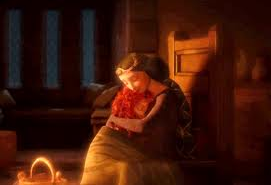
It's impossible to read fairy tales without realizing one very glaring absence in the lives of nearly every hero or heroine. They have no mothers. They have stepmothers out the wazoo, perfectly ready to throw their innocent stepchildren under the closest available bus, but no mothers. They have fathers, who are either malicious favorite-players or ineffectual weaklings bullied by their second wives. But no mothers. Fairytale Land should put out an APB for all its missing moms.
 |
| The Death of Rachel, Giambettino Cignaroli |
The lack of maternal influence has painfully obvious results. Scads of motherless heroines fall effortlessly into the clutches of their evil stepmothers. And that's not even the worst of it. Take the story of Joseph and his brothers. Granted, those kids had four mothers to share around, but the death of the beloved Rachel leaves a huge hole in the structure of Jacob's family. Zilpah and Bilhah are never allowed much say in the raising of their sons, and Leah is either incapable of or uninterested in keeping twelve rowdy boys in line. In effect, if not in fact, Jacob's sons are motherless. They live in a world of ruthless male competition. And Jacob himself, as consolation for the loss of his love, makes no bones about the fact that Rachel's son Joseph is his favorite. With no mother to teach morality and a father who's hardly modeling good behavior, it's no wonder that resentment and hatred fester among the brothers, leading ultimately to the other eleven selling Joseph into slavery to get rid of their rival. It's difficult to say what would have happened with Rachel as an active presence in their lives, but it's pretty clear that Jacob wouldn't have favored Joseph so flagrantly if he hadn't been mourning the boy's mother.
 |
| Snow White illustration, Franz Juttner |
The plot thickens when you go back to the Grimm stories and realize that those clever German boys weren't just cataloging folktales. They were deliberately shaping the moral compasses of the next generation. Mothers,
real mothers, could never be allowed to do the horrific things to their children that they do in those well-loved stories: poison them with apples, abandon them in the woods, etc. It was much easier to kill the mothers before they had a chance to become evil. That way, the stories preserved a saintly image of a mother who often dies in giving her child life, side by side with the villainous hag who usurps her place. Better to put the kids at risk from a world without a mother than to admit that mothers are, in fact, capable of the same horrors as other human beings.
 |
| Kate Crackernuts, Trina Schart Hyman |
But that line of thinking leaves us singularly ill-equipped to handle, say, the heroine's mother in
Kate Crackernuts. Bold, quick-thinking princess Kate is clearly the story's protagonist, but her half-sister Anne is the beauty of the family. Kate's mother (who is Anne's stepmother) resents her biological daughter being overshadowed, so
out of love for Kate, she magics a sheep's head onto Anne's shoulders. What on earth should our reaction be? Should we be glad that at least one fairytale mother cares about her daughter's future? Should we be outraged that the queen could do such a thing to her trusting stepdaughter? Should we renounce the queen's actions utterly (as Kate herself does), or should we allow that her motive was love and concern? After all, the queen's just doing exactly what fairytale convention demands of her: being cruel and manipulative toward her stepdaughter. It's her bad luck that her story involves one of the few sets of siblings who actually like each other, creating an instant gray area where the evil stepmother's biological child is our hero.
So, having no mother is bad. Having a vindictive mother is bad. Having a caring mother is bad. Is there
any kind of good mother who's not also dead?
 |
| Demeter and Persephone, Ingri and Edgar d'Aulaire |
Well, there's always Demeter.
Right from the start, she's got the loving and nurturing aspect of motherhood covered; she's goddess of the harvest, so we already know she'll take awesome care of her daughter. And going by the brief glimpse we get of young carefree Persephone before Hades abducts her, it seems fair to say that Demeter knocked it out of the park. Once Persephone goes missing, Demeter essentially shuts down the earth, holding life itself hostage until her daughter is returned. Her determined crusade to find Persephone is the sole reason Zeus gets off his arse and sends Hermes to bring Persephone back. And even though Hades tricks Persephone into spending three months of the year with him, the remaining nine are divinely judged to be the purview of the mother-daughter team of spring and harvest, which creates lovely weather and plentiful harvests and ensures that even the mortals want Persephone to stay with her mom.
 |
| Isis & Horus, Judith Page |
And look over there! It's Isis, who brought her dead husband back to life just so she could get pregnant. She spends decades incognito, using her powerful magic to protect Horus from his murderous uncle who's got teams canvassing Egypt looking for him. When Set gets past her vigilance and nearly kills Horus via scorpions, Isis calls in favors from the gods in order to save her son. She devotes every waking minute to teaching Horus exactly how to survive the inevitable battle with Set. Unlike with Demeter and Persephone, we get to see Isis's efforts fulfilled: Horus trounces Set (albeit with
some interesting methods), avenges his father, and becomes king of Egypt (and ultimately a god). Well done, Isis.
And now the Virgin Mary is knocking at the door. Gotta count her,
too. Betrothed-but-not-married knocked-up-by-God virgin mom sounds like
the premise of a VH1 show. But Mary makes it work. She convinces a very skeptical Joseph that she didn't actually cheat on him (at least not by choice - we can talk
 |
| Madonna and Child, Il Sassoferrato |
about God's consent issues later), goes with him to Bethlehem ready to drop at any second, gives birth alone in a freaking stable, and maintains a strong and loving relationship with her son for his entire life, which sadly ends before hers. Statistically, she should have been screwed. Every card was stacked against her. But out of the jaws of defeat, Mary snatches an enormous parental victory. Very few women can successfully raise a Savior.
So yes, there are positive models of motherhood who play active and crucial roles in their children's stories. But there's a catch. They're all goddesses. (You can quibble about Mary's divine status, but she ascends to Heaven at the moment of her death, and has more icons and fan-worship than any sanctified Christian who's not Jesus. The woman's a goddess.) Fairytale mothers are mortals with only mortal strength. Is it fair to ask human mothers to live up to the astonishing lengths that goddesses go to in protecting and raising their children?
 |
| Brave, Disney/Pixar |
It might actually be fine. Because what the ranks of good living mothers sorely need to oppose the army of evil mothers is
power. The evil mother's menace comes from the fact that she has all the power and her child-victim has none. To declare her disgust for her mother's methods, Kate Crackernuts has to go into self-imposed exile. Even the sainted dead moms have power; Cinderella's dresses her up for the ball, assisting her in her only avenue of escape from her powerful stepmother's dominance. So the good mothers
need the power that goddesses of life and love can provide: the strength to endure, the courage to nurture, the will to make things better. The goddess-mothers aren't providing an unreachable ideal. They exist to brace up mortal mothers, to show them what qualities will serve them best, and to remind them that - divine or not - every good mother has what it takes.