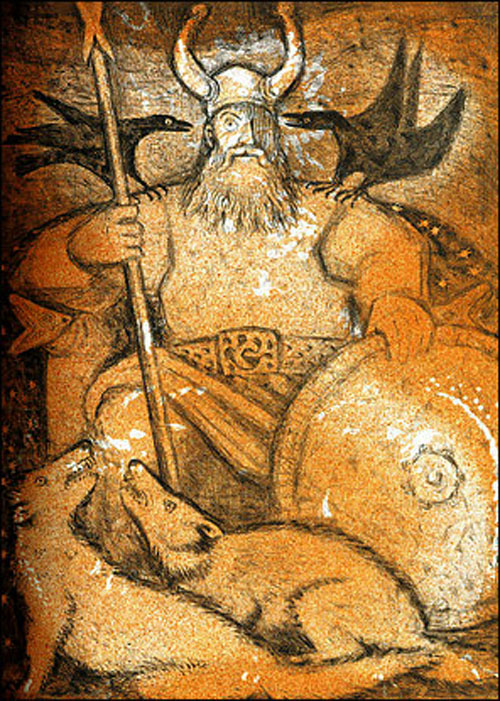
I grew up on d'Aulaire's Greek myths. My father brought it back from the library one day when I was about five or six, and my initial attempts to sound out the phenomenally impossible word "Aphrodite" sent my mom into well-muffled hysterics. (The best I could do, before she took mercy on me and corrected me, was "uh-PRO-fa-deet." And now you know.) The pictures were gorgeous, the stories were entrancing, and I wanted to be Artemis or Atalanta when I grew up. More recently, my boyfriend introduced me to the d'Aulaire book of Norse myths, which is just as awesome and explained a lot of things that confused me about the Norse gods. Safe to say, I'm a fan.

But reading those myths when I was seven, and again when I was
seventeen, were two very different things. The d'Aulaires took great
pains to avoid the word "mistress," even and especially when it was
applicable. Zeus had a ridiculous number of "wives." Odin's seduction of
Gunnlod, the mother of his son Bragi, god of bards, is hinted at but
 |
| Odin and Gunnlod, Ingri and Edgar d'Aulaire |
never outright stated. (The story itself, in which Odin drinks up all three of her kettles of precious mead, then leaves her to weep beside her lost treasure, is suggestive enough.) The d'Aulaires told you that Aphrodite was in love with Ares, but I never learned the tale of Hephaestus catching them in flagrante - in a net, for maximum humor - until I was a teenager. Thor is outraged at the cutting of his wife Sif's hair not because she has awesome hair, but because a woman with shorn hair is branded a whore. It took a long time for me to realize that Daphne and Syrinx flee from Apollo and Pan because they're threatened with rape, rather than an awkward proposal of marriage.
 |
| Loki, Ingri and Edgar d'Aulaire |
 |
| Odin, Ingri and Edgar d'Aulaire |
And not even the d'Aulaires could
whitewash out the incredible sexual tension between Odin and Loki. They're attracted to each other at first sight. They mingle their blood. They swear fidelity. Odin even offers Loki a lovely, patient goddess as his beard. (Poor Sigunn also winds up as the beard for Loki's other marriage to the ogress Angerboda, mother of Hel, Fenris, and the Midgard Serpent. My guess is, safe and loving didn't do much for Loki's libido.)
I was shocked when I first read a kids' version of Edith Hamilton and asked my parents what "out of wedlock" meant. "But I thought Zeus was married to all his wives," I said. My long-suffering mother gently made clear that this was a polite fiction. And one of the great building blocks of my imaginative life began to shift. Zeus was no longer a responsible if reckless husband. He was a cad, a seducer, a thoughtless pig who cared more about the kids he sired than the women who bore them, and about his own fun most of all. The king of the gods, came the awful thought, was a jerk. And in that case, why was he the king? Why should I root for such a careless user?
 |
The Abduction of Persephone,
Ingri and Edgar d'Aulaire |
The floodgates had been opened, and the rush of criticism was impossible to stop. Hera gained a lot more of my sympathy. I stopped trying to excuse Aphrodite on account of her beauty. Hades and Persephone became one of my favorite couples for the simple reason that he was faithful to her. Suddenly the gods had faults, huge gaping faults of personality and behavior. Their humanity - the squabbles, the contests, the grousing - had been charming before. Now it became deeply problematic. The gods were worse than most people I knew. They acted with impunity, taking whatever they wanted and only offering an explanation if they felt like it. (Often those explanations were woefully inadequate. I've never been able to get behind the transformation of Niobe into a stone, just to shut up her crying. Especially since
the stone itself keeps crying.)
 |
| Freya, Ingri and Edgar d'Aulaire |
Other mythologies were equally subject to the criticism of my now-jaded expectations. So what if Freya's married? Her husband's missing, she's the goddess of love, and she has a hall full of strapping warriors. What do you
think she's going to do with them? I revisited the tale of Sir Gawain and Lady Ragnell, understanding finally why he couldn't choose whether to have her beautiful by day or by night. I was dismally unsurprised to learn that Osiris, Isis, Set, and Nephthys were all siblings. I'd hoped for better from the Egyptians than from the Greeks, but it was par for the course; gods liked incest. Myths became more important to me for the stories than for the codes of conduct they supported, or even for the reverence of the supernatural that they'd previously made me feel. Why should I revere Zeus the rake, or Loki the asshole, or Osiris the idiot? They didn't practice what they preached; they gleefully ignored their own rules. I enjoyed the stories; it didn't mean I had to like the characters as people.
 |
| The Wooing of Gerd, Ingri and Edgar d'Aulaire |
Which, I suspect, is exactly why the d'Aulaires did what they did. It's impossible to like or respect some of the choices that the gods make. Hera dooms Semele to a horrific death for sheer spite. Set takes vengeance to an appallingly vindictive level. The wooing of Gerd is an uncomfortable story of dubious consent, with a fertility moral that transforms rape into love. You could list every altruistic act of Loki's on one hand and still have fingers left over. These are awful people: morally corrupt, shamelessly self-serving, and whiny when someone else's underhanded gambit beats theirs. But they are also the core of the world's great stories, most of which wouldn't have happened without the appalling deeds committed by the gods.
So in telling those stories, you have to bowdlerize. You have to leave out the worst of the gods in order to communicate the real wonder and excitement of their stories. Especially when writing for kids, who may be encountering them for the first time, the magic should come first. There's plenty of time later for kids to learn the shades of gray. If you're going to entrance them with the glory of myth, you'd better make it as entrancing as it can be.
 |
| The Olympians, Ingri and Edgar d'Aulaire |
Because it does lose something. I used to fling myself headlong into those stories, trusting in the awe-inspiring power and beauty of invincible immortals to do the right thing and save the world. I still love those stories, and I've forgiven the gods for not being as perfect as I wanted them to be. But I read them with my tongue in my cheek now. I ask questions; I groan at bad decisions; I mock the gods. I'm not sorry that I learned to think and doubt, but sometimes I miss the way it used to be. And I'm hugely grateful to the d'Aulaires for making me fall so hard for those stories that I can still love them even after I learned the truth.


 But reading those myths when I was seven, and again when I was
seventeen, were two very different things. The d'Aulaires took great
pains to avoid the word "mistress," even and especially when it was
applicable. Zeus had a ridiculous number of "wives." Odin's seduction of
Gunnlod, the mother of his son Bragi, god of bards, is hinted at but